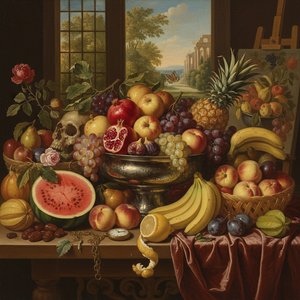
1927. Oil. Kitakyushu Municipal Museum of Art.

§ 1Dati del catalogo


§ 2Astratto
Descrizione del reperto
A vibrant still life of nature's bounty featuring colorful fruits and flowers by Japanese modernist pioneer Narashige Koide, offering a timeless glimpse into 1927 avant-garde beauty for your collection.
 Espandi i dettagli
Biografia dell'artista
Scopri Narashige Koide (1887-1931), pioniere dell'Hanshinkan Modernism nella pittura yōga giapponese. Esplora ritratti evocativi, nudi suggestivi e il suo approccio innovativo tra tradizione Nihonga e stili occidentali.
§ 3Commento
A Symphony of Stillness: The Bounty of Narashige Koide
In the quiet corners of early 20th-century modernism, few works capture the humble elegance of daily life as poignantly as Narashige Koide’s 1927 masterpiece, Vegetables on the Table. This evocative still life serves as a profound meditation on texture, color, and the simple abundance of nature. At first glance, the viewer is greeted by a vibrant arrangement of life: the sun-kissed curves of oranges and apples, the elongated grace of bananas, and a central vase of flowers that acts as the composition's beating heart. Set against a deep, atmospheric blue background, the subjects do not merely sit upon the table; they emerge from the shadows with a sculptural presence that commands the room.
The brilliance of this piece lies in Koide’s ability to bridge the gap between the delicate sensibilities of Nihonga—the traditional Japanese style he studied in his youth—and the bold, structural experimentation of Western Yōga painting. There is a rhythmic balance at play here, where the placement of two humble bowls and a solitary cup creates a sense of domestic harmony. For the discerning collector or interior designer, this painting offers more than just visual interest; it provides a focal point of stability and warmth. The interplay between the cool, receding blue backdrop and the warm, tactile fruits creates a chromatic tension that breathes life into any sophisticated space.
Beyond its aesthetic charm, Vegetables on the Table carries a deeper symbolic weight, reflecting the era's fascination with finding beauty in the mundane. During a period of intense cultural transition in Japan, Koide utilized the still life genre to explore form and light, stripping away the unnecessary to focus on the essential. The arrangement feels both spontaneous and meticulously curated, suggesting that even in the most ordinary objects, there exists an eternal, artistic truth. Each brushstroke contributes to a sense of weight and volume, inviting the viewer to reach out and touch the velvety skin of a peach or the smooth surface of a ceramic bowl.
For those seeking to infuse their homes with a sense of historical depth and quiet luxury, a high-quality reproduction of this work offers an unparalleled opportunity. It is a piece that transcends mere decoration, acting as a window into the soul of Japanese modernism. Whether placed in a sunlit dining room to echo its themes of nourishment or in a contemporary study to provide a classical counterpoint to modern furniture, Koide’s vision remains timeless. To possess this image is to hold a fragment of 1927—a moment of stillness captured forever in a dance of color and light.
Domande e risposte
L'immagine di "Vegetables on the Table" di Narashige Koide può essere riprodotta liberamente?
Stato del copyright per "Vegetables on the Table" di Narashige Koide: l'opera è di pubblico dominio - il copyright è scaduto. Ciò determina se sia possibile effettuare liberamente riproduzioni dell'immagine.
In che modo "Vegetables on the Table" si inserisce nel percorso artistico di Narashige Koide?
"Vegetables on the Table" condivide con le altre opere di Narashige Koide lo stile Modernism e i temi ricorrenti: western painting techniques, nihonga tradition influence, japanese modernism exploration, hanshinkan modernism movement, still life composition.
Posso visualizzare "Vegetables on the Table" come una presentazione a schermo intero?
Il diaporama di "Vegetables on the Table" è disponibile nella pagina Slideshow dell'opera.


 Passa alle stampe


 Per opere d'arte o riproduzioni con un lato superiore a 105 cm (circa 41 pollici), la cornice verrà spedita in forma di kit smontato. Questo metodo garantisce una consegna sicura e previene danni durante il trasporto.