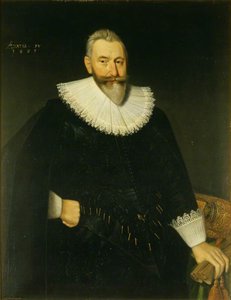
Adam de Colone: Bridging Netherlandish Tradition and Scottish Portraiture
Adam de Colone (c.1572–1651) stands as a pivotal figure in the artistic landscape of 17th-century Scotland, representing a fascinating confluence of influences—primarily rooted in the vibrant traditions of the Low Countries yet skillfully adapted to capture the spirit of his adopted homeland. While biographical details remain somewhat elusive due to gaps in historical records, recent scholarship spearheaded by the Netherlands Institute for Art History has illuminated crucial aspects of his life and career, revealing him as the brother of Susanna de Colonia—a connection that underscores a familial legacy intertwined with entrepreneurial endeavors within Antwerp’s saddle-making trade. Born into a family steeped in mercantile activity, Adam’s formative years were spent amidst the bustling commercial hub of Antwerp, where he honed his artistic skills under the tutelage of Louis Jansz Colonia, his father. This early exposure to the artistic currents circulating throughout Europe undoubtedly shaped his aesthetic sensibilities. By 1598, he formally joined the guild in Dordrecht, demonstrating a commitment to professional development and establishing himself as an active painter within the burgeoning Dutch Republic. Notably, Adam’s brother-in-law was Adrian Vanson—a celebrated court painter serving James VI of Scotland—a relationship that fostered artistic exchange and contributed to the dissemination of Netherlandish stylistic principles across the British Isles. De Colone's artistic output is characterized by a distinctive approach: he employed meticulously crafted inscriptions featuring uniquely shaped letters and numerals – a practice that continues to intrigue art historians today. These markings serve as tangible evidence of his involvement in commissions and provide valuable insights into the patronage system prevalent during his time. His early works showcased an undeniable influence from the Flemish masters, particularly Hugo van der Goes’s monumental Trinity Altarpiece, which arrived in Scotland in 1625, sparking considerable artistic debate and inspiring a new generation of Scottish painters. The altarpiece's dramatic lighting and expressive figures established a benchmark for visual storytelling that would resonate throughout the century. His career culminated in London during the reign of James I, where he secured lucrative commissions from royalty—a testament to his reputation as a skilled portraitist. Among his most enduring achievements are two full-length portraits of James VI, executed in 1623, capturing the king’s regal bearing and conveying an aura of authority. Furthermore, De Colone's prolific output extended beyond royal patronage; he documented the Scottish nobility with remarkable accuracy and sensitivity, preserving a visual record of Scotland’s cultural elite during a period of significant political upheaval. The portrait of Sir William Stewart of Grandtully (1567–1646), completed in 1613, exemplifies his masterful technique—a testament to his ability to convey psychological depth alongside formal elegance. Adam de Colone's legacy extends beyond individual portraits; he fostered a creative lineage through his son Isaac Colonia (1611–1663) and grandson Adam Colonia (1634–1685), ensuring that the traditions of Netherlandish painting continued to flourish in Scotland for decades after his death. His contribution to Scottish art history is undeniable, marking him as a crucial link between European artistic innovation and the evolving visual culture of Scotland during its golden age.Domande e risposte
Dove posso vedere tutte le opere di Adam De Colone?
Tutte le opere di Adam De Colone presenti su questo sito web sono consultabili nella pagina Tutte le opere dell'artista.
Dove posso vedere il profilo cromatico delle opere di Adam De Colone?
L'uso del colore di Adam De Colone nelle opere presenti su questo sito web può essere approfondito consultando la pagina Profilo Cromatico dell'Artista dell'artista.
Posso esplorare le opere di Adam De Colone in base allo spettro dei colori?
La pagina Indice dei colori di Adam De Colone organizza le opere dell'artista in base al colore.