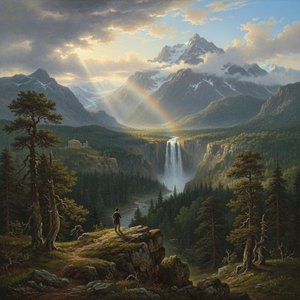
The Luminous Legacy of Anne Allanson
Anne Allanson, born in 1934, remains a profound voice in the realm of landscape painting, offering a vision that bridges the delicate sensibilities of Impressionism with the rugged, untamed spirit of the Australian wilderness. Her journey as an artist is one of deep observation and a steadfast commitment to representational beauty. While many of her contemporaries sought refuge in the fractured geometries of abstraction or the raw energy of abstract expressionism, Allanson turned her gaze toward the enduring rhythms of nature. Her work serves as a poetic dialogue between light and land, capturing not just the physical topography of the Western Australian landscape, but the very atmosphere that breathes life into it.
The foundation of Allanson’s artistic language was laid in Perth, where her early fascination with the natural world began to coalesce into a formal discipline. Through her studies at the Curtin University School of Art Design and Multimedia, she mastered the nuanced complexities of both watercolor and oil painting. This technical rigor allowed her to translate the dramatic vistas of the Darling Range onto canvas with remarkable precision. Her formative years were spent immersed in the textures of granite outcrops and the swaying silhouettes of eucalyptus groves, landscapes that would eventually become the emotional and thematic cornerstone of her entire oeuvre.
A Mastery of Light and Impressionistic Spirit
To understand the soul of Allanson’s work, one must look to the masters of the Impressionist movement. She was deeply moved by the legacies of Claude Monet, Alfred Sisley, and Pierre-Auguste Renoir—artists who understood that a landscape is never static, but rather a fleeting arrangement of light, shadow, and color. Allanson adopted their pursuit of the sensory moment, prioritizing the way sunlight dances across a surface over mere photographic documentation. Her technique was a sophisticated dance of layering thin washes of color to build up rich tonal gradations, creating a sense of luminosity that seems to radiate from within the canvas itself.
This devotion to light allowed her to render the Darling Range with an unparalleled sensitivity. In her paintings, the interplay of shadow and sun is not merely a visual effect but a way to convey emotional resonance. One can almost feel the warmth of the Australian sun or the cool dampness of a morning mist through her delicate brushstrokes and harmonious color palettes. Her ability to capture the essence of the Australian wilderness—the ruggedness of the earth paired with the ethereal quality of the atmosphere—distinguishes her as a painter of profound depth.
Artistic Evolution and Enduring Significance
Throughout her career, Allanson’s work has been characterized by a remarkable consistency of vision and an unwavering dedication to her subject matter. Her paintings, such as the evocative Covertrack series and Rocks and Sea, demonstrate a lifelong preoccupation with the textures of the natural world. Whether she was exploring the intricate details of a single grove or the sweeping expanse of a coastal vista, her focus remained on the spiritual connection between the observer and the environment. Her art invites the viewer into a state of quiet contemplation, fostering a deep appreciation for the subtle beauties that often go unnoticed in the rush of modern life.
The historical significance of Anne Allanson lies in her role as a guardian of representational landscape painting. In an era of rapid stylistic shifts, she remained a steadfast practitioner of light and form, ensuring that the classical traditions of Impressionism found a vibrant new expression within the unique context of the Australian landscape. Her legacy is one of beauty, resilience, and a profound respect for the natural world, leaving behind a body of work that continues to illuminate the enduring magic of the earth.
Domande e risposte
A quali movimenti appartiene l'opera di Anne Allanson?
I movimenti di Anne Allanson sono consultabili nella pagina Tutti i movimenti, che raggruppa le opere per movimento.
Quante opere di Anne Allanson sono disponibili nel catalogo?
Puoi sfogliare 6 opere d'arte opere di Anne Allanson nella pagina Tutte le opere.
Dove posso vedere tutte le opere di Anne Allanson?
Tutte le opere di Anne Allanson presenti su questo sito web sono consultabili nella pagina Tutte le opere dell'artista.