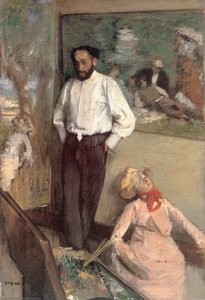
A Life Immersed in Movement: The World of Edgar Degas
Hilaire-Germain Edgar De Gas was born July 19, 1834, Paris, France—died September 27, 1917, Paris (aged 83), and is considered one of the most complex and innovative figures of his generation. He was the eldest son of Célestine Musson De Gas, a Creole from New Orleans, and he reinforced his formal academic art training by copying Old Master paintings both in Italy, where he spent three years (1856–1859), and at the Louvre. Degas early on developed a rigorous drawing style and a respect for line that he would maintain throughout his career. His first independent works were portraits and history paintings but in the early 1860s he began to paint scenes from modern life. He started with the world of horse racing and by the end of the decade, he was already experimenting with new techniques and exploring unconventional compositions—a departure from the traditional academic art favored by many of his contemporaries.Beyond Impressionism: A Unique Artistic Vision
While contemporaries like Monet chased the fleeting effects of light outdoors, Degas largely worked within the confines of his studio, meticulously constructing scenes from observation and memory. His subject matter was decidedly modern—a departure from the historical or mythological themes favored by many academic painters. He found inspiration in the everyday lives of Parisians: laundresses, cabaret singers, milliners, and, most famously, dancers. It is this fascination with ballet that defines much of his oeuvre. Degas didn’t simply paint beautiful ballerinas; he captured the grueling reality of their profession—the endless rehearsals, the physical strain, the fleeting moments of grace amidst a world of hard work. His compositions are often unconventional, cropping figures in unexpected ways and utilizing asymmetrical arrangements that create a sense of dynamism and immediacy. He was a master of capturing movement, not through blurred lines or hazy effects, but through precise observation and careful rendering of form. Dancer, A Group of Dancers, and Women Combing Their Hair are prime examples of this dedication to portraying the human figure in motion and revealing the complexities of modern life.Influences and Artistic Development
Degas’s artistic journey was shaped by a diverse range of influences. His early training emphasized classical principles, particularly the work of Jean-Auguste-Dominique Ingres, whose emphasis on draftsmanship and precise form left a lasting impression. However, Degas also admired the Realists, such as Gustave Courbet, who challenged academic conventions and championed the depiction of contemporary life. A pivotal moment in his development came through his association with Camille Pissarro, a leading Impressionist who introduced him to other artists and encouraged him to experiment with new techniques. He was captivated by Japanese prints—Ukiyo-e—which influenced his use of asymmetrical compositions, flattened perspectives, and bold patterns. He also embraced photography, recognizing its potential as a tool for studying movement and capturing fleeting moments in time. This willingness to incorporate diverse influences into his work is what sets Degas apart and contributes to the unique character of his art.Major Achievements & Legacy
Degas’s prolific output spanned painting, sculpture, printmaking, and drawing—demonstrating an unparalleled mastery across multiple mediums. He achieved renown for his portraits of prominent figures—including artists, writers, and intellectuals—capturing their psychological depth with remarkable sensitivity. His ballet paintings revolutionized the genre, portraying dancers not as idealized beauties but as human beings grappling with physical exertion and emotional vulnerability. Furthermore, Degas’s exploration of horse racing and jockeying offered a fresh perspective on sport and social life. He was recognized as one of the most influential artists of his time, shaping the trajectory of modern art and inspiring generations of subsequent painters. His legacy continues to resonate today, celebrated for its innovation, honesty, and profound understanding of human experience. Museums worldwide—including the Musée d'Orsay and the Musée de l’Orangerie in Paris—house significant collections of his paintings, pastels, sculptures, and prints, ensuring that his artistic vision will endure for centuries to come.Domande e risposte
Posso sfogliare le opere di Hilaire-Germain-Edgar Degas in base all'umore?
La Spazi d'atmosfera di Hilaire-Germain-Edgar Degas raccoglie le opere dell'artista suddivise per umore.
Dove posso vedere il profilo cromatico delle opere di Hilaire-Germain-Edgar Degas?
Il Profilo Cromatico dell'Artista di Hilaire-Germain-Edgar Degas è una pagina che presenta il profilo cromatico dell'intera produzione dell'artista.
In quale città e in quale paese è nato/a Hilaire-Germain-Edgar Degas?
Hilaire-Germain-Edgar Degas è nato a Parigi, in Francia.