The Architect of the Iron Age
George Stephenson (1781–1848) stands as a monumental figure in the annals of British history, undeniably recognized as the ‘father of railways.’ However, his legacy extends far beyond the transformative impact he had on transportation; it subtly yet powerfully influenced artistic movements and sensibilities of the Victorian era. This influence wasn’t born from brushstrokes or pigment palettes but rather from the profound societal shifts instigated by his groundbreaking innovations—shifts that reverberated throughout British culture, including its visual arts. Born in Wylam, Northumberland, Stephenson's formative years were characterized by an exceptional aptitude for mechanics. From a young age, he demonstrated a fascination with machines and instruments, fueling a lifelong pursuit of understanding how things worked. This inquisitive spirit would prove instrumental in his future endeavors as an engineer.
His journey from a humble background to the pinnacle of industrial achievement is a narrative of pure, unadulterated grit. Without formal education, Stephenson taught himself the fundamentals of reading, writing, and arithmetic, driven by a thirst for knowledge that mirrored the steam engines he would later perfect. His early career in the coal mines of the North East provided the raw, gritty crucible necessary to forge his genius. It was here, amidst the soot and iron of the Industrial Revolution, that he began to envision a world connected by steel. His decision to adopt the ‘Stephenson gauge’—a standardized railway track width—established a benchmark that continues to define global rail infrastructure today. This standardization was not merely a technical feat; it was an act of unification, physically and conceptually knitting together a fragmented landscape.
The Steam Engine as a Cultural Catalyst
As the iron rails began to pierce through the pastoral landscapes of Britain, they brought with them a new aesthetic reality. The sheer scale of railway construction demanded new materials and methods—iron, coal, and steam—which fundamentally altered the visual vocabulary of the era. While painters like John Constable captured the vanishing tranquility of the English countryside, the encroaching presence of Stephenson’s locomotives introduced a sense of dynamic motion and industrial power. This tension between the traditional and the modern became a central theme in Victorian art. The arrival of the railway was not just a logistical triumph; it was a sensory revolution that changed how light, shadow, and distance were perceived by the human eye.
The expansion of the rail network also facilitated a new era of artistic mobility. Artists could now travel more easily to remote landscapes, bringing the rugged beauty of the North and the dramatic vistas of the coast into the urban galleries of London. This connectivity allowed for a broader dissemination of styles and ideas, contributing to the vibrant, often contradictory, energy of the Victorian period. Even as the Arts and Crafts movement emerged as a poignant reaction against the perceived dehumanizing effects of industrialization—led by figures such as William Morris—it was reacting to the very world that Stephenson had helped build. The movement's reverence for handcrafted beauty and organic forms served as a profound counterpoint to the precision and mass production epitomized by the railway age.
A Legacy Forged in Iron and Vision
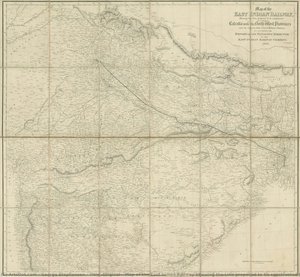
The achievements of George Stephenson are etched into the very geography of the modern world. His work on the Stockton and Darlington Railway and the development of the legendary Locomotion No. 1 laid the groundwork for a global transportation revolution. Beyond the mechanical, his influence can be seen in the way history itself is recorded and visualized. The detailed maps and technical drawings produced during this era, such as those documenting the East Indian Railway, serve as unique windows into a time of unprecedented expansion and colonial ambition.
Ultimately, Stephenson’s significance lies in his role as a pioneer of progress. He embodied the Victorian ideal of diligent application and an unquenchable thirst for improvement. While he may not have held a paintbrush, his hand guided the movement of the very society that produced some of the most iconic works of art in history. To study Stephenson is to study the heartbeat of the Industrial Revolution—a rhythmic, powerful pulse of steam and steel that forever altered the trajectory of human civilization.