Jacobus Linthorst: A Master of Dutch Still Life
Born in Amsterdam around 1745, Jacobus Linthorst emerged as a significant figure within the vibrant world of 18th-century Dutch painting. His legacy rests primarily on his exquisite still lifes – meticulously rendered arrangements of fruit, flowers, and occasionally insects – that transcended mere decoration to become profound studies in color, texture, and light. Linthorst’s work offers a captivating glimpse into the refined tastes of the period, reflecting an appreciation for both natural beauty and the burgeoning scientific interest in botany and entomology.
Early influences shaped Linthorst's artistic trajectory. He was deeply indebted to Rachel Ruysch, the celebrated flower painter who revolutionized still life with her dramatic use of light and shadow and her commitment to anatomical accuracy. Ruysch’s influence is readily apparent in Linthorst’s compositions – his careful observation of detail, his ability to capture the fleeting beauty of decaying petals or the glistening surface of a peach, all speak to this foundational connection. Furthermore, he admired Jan van Huysum, known for his botanical illustrations and his dedication to depicting plants with scientific precision. This combined influence fostered in Linthorst a unique style: one that balanced artistic expression with a rigorous understanding of the natural world.
The Art of Arrangement
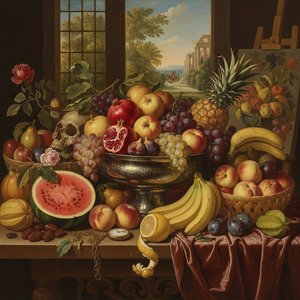
Linthorst’s paintings are not simply depictions of objects; they are carefully constructed narratives. He wasn't merely arranging fruit and flowers; he was orchestrating a visual dialogue, considering the interplay of color, form, and texture to create a harmonious whole. His compositions often feature a dramatic use of chiaroscuro – strong contrasts between light and dark – which elevates the subjects beyond the mundane, imbuing them with an almost theatrical quality. The placement of each element is deliberate, guiding the viewer’s eye through the arrangement and highlighting its inherent beauty.
A key characteristic of Linthorst's work is his remarkable attention to detail. He meticulously rendered the textures of fruit skins, the delicate veins of leaves, and the intricate patterns on insect wings. This level of realism was achieved through a combination of direct observation and careful study. He frequently worked from life, setting up elaborate still lifes in his studio and patiently observing their transformations over time. The result is an astonishingly lifelike quality that draws the viewer into the scene.
Membership and Legacy
In 1789, Linthorst joined the Amsterdam Guild of St. Luke, a prestigious organization that regulated artistic practice in the Netherlands. This membership signified his recognition as a professional artist and provided him with access to resources and opportunities within the art world. It also reflects the growing importance of artists within Dutch society during this period.
Linthorst continued to paint until his death in Amsterdam in 1815. While he didn’t achieve the same level of widespread fame as Ruysch, his work is now recognized for its technical mastery and its subtle yet profound exploration of beauty. His paintings are held in prestigious collections, including the Rijksmuseum in Amsterdam, and continue to captivate viewers with their exquisite detail and evocative atmosphere. Linthorst’s legacy lies not only in his individual achievements but also in his contribution to the development of Dutch still life painting – a genre that remains beloved for its ability to transport us to a world of delicate beauty and quiet contemplation.
Notable Works
- Stilleven met vruchten (Still Life with Fruit): A prime example of his meticulous rendering of fruit, showcasing the subtle variations in color and texture. (Rijksmuseum)
- Various floral arrangements: Linthorst’s dedication to capturing the ephemeral beauty of flowers is evident in his numerous depictions of bouquets and individual blossoms.
Further information about Jacobus Linthorst can be found on the Art UK website: https://en.wikipedia.org/wiki/Jacobus_Linthorst