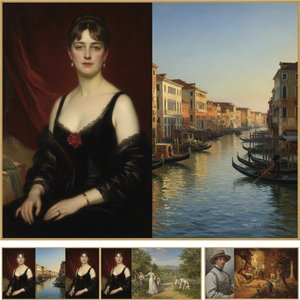
The Quiet Brilliance of John Richardson Gauld
In the annals of British art history, certain names resonate with thunderous fame, while others linger like a soft, evocative shadow. John Richardson Gauld (1885–1962) belongs to that more intimate category—a painter whose work possesses a quiet, penetrating brilliance that speaks directly to the soul. Born in the intellectually vibrant atmosphere of Edinburgh, Scotland, Gauld’s early life was steeped in the spirit of the Scottish Enlightenment. This environment, which championed scientific observation and rigorous curiosity, became the bedrock of his artistic identity. His initial training in watercolor and drawing instilled in him a meticulous devotion to detail, a trait that would later allow him to capture the most subtle nuances of light and human emotion.
As his artistry matured, Gauld found himself navigating the shifting tides of European modernism. The influence of Impressionism and Post-Impressionism—the revolutionary movements led by masters such as Monet and Cézanne—left an indelible mark on his sensibilities. From these predecessors, he inherited a profound fascination with the ephemeral nature of light and the expressive potential of color. Yet, Gauld was never a mere imitator; instead, he sought to marry the fleeting beauty of the moment with a deeper, more psychological realism. He possessed a rare ability to observe the world through a lens of scientific accuracy while simultaneously imbuing his subjects with an unmistakable sense of inner life.
A Mediterranean Transformation
The trajectory of Gauld’s life and art underwent a profound shift in 1923 when he relocated to Valletta, Malta. Drawn by the island's storied cultural heritage and its sun-drenched landscapes, Gauld found in Malta a new muse that would redefine his palette and perspective. Establishing a studio overlooking the magnificent St John’s Co-Cathedral, he immersed himself in the vibrant, rhythmic pulse of Maltese society. This move was more than a change of scenery; it was an artistic rebirth. The rugged, historic textures of Malta provided a dramatic backdrop for his evolving style, allowing him to experiment with tonal depth and a more grounded, earthy aesthetic.
His work during this period began to reflect the very essence of the Mediterranean landscape. He moved away from the lighter washes of his youth toward a more robust use of oil on canvas, employing a palette dominated by ochres, browns, and deep greys. These tones did not merely represent the earth; they lent an air of solemnity and timelessness to his compositions. Whether capturing the architectural grandeur of Valletta or the quiet dignity of its inhabitants, Gauld’s brushwork remained sensitive to the subtle shifts in atmosphere, creating works that felt both physically present and emotionally resonant.
The Mastery of the Human Spirit
While his landscapes were evocative, it was in the realm of portraiture that Gauld achieved his most enduring legacy. He became recognized as one of Malta’s foremost portrait artists, celebrated for an uncanny ability to transcend mere physical likeness. To gaze upon a Gauld portrait is to encounter the psychological depth of the sitter. He did not seek the grand, theatrical gestures common in much of the era's academic art; instead, he focused on the quiet, introspective moments that reveal true character.
His achievements can be seen in the way he navigated the complexities of human identity through several key artistic pillars:
- Psychological Depth: His portraits serve as windows into the inner workings of his subjects, capturing a sense of thought and feeling that lingers long after the viewer has turned away.
- Tonal Nuance: Through a masterful command of light and shadow, he created a sense of volume and presence, making his figures appear to breathe within the frame.
- Meticulous Realism: His dedication to accurate representation ensured that every texture—from the fabric of a garment to the weathered skin of an elder—was rendered with profound respect for reality.
Today, the significance of John Richardson Gauld lies in his role as a bridge between traditions. He carried the disciplined observation of his Scottish roots into the vibrant, light-filled world of Malta, creating a body of work that is uniquely his own. His paintings, such as The Students and The Artist's Wife, remain testament to a life dedicated to the pursuit of truth through art—a truth found not in the loud or the dramatic, but in the quiet, enduring essence of the human experience.
Q&A
キーワードごとに分類されたJohn Richardson Gauldの作品はどこでご覧いただけますか?
John Richardson Gauldのキーワード別ページでは、アーティストの作品をキーワードごとに分類してご紹介しています。
カタログ内で閲覧可能なJohn Richardson Gauldの作品数はいくつですか?
すべての作品一覧ページでは、John Richardson Gauldによる作品数 8点点のアートワークをご覧いただけます。
John Richardson Gauldの作品を主題別に探すことはできますか?
John Richardson Gauldの作品は、アーティストの主題別アトラスページから主題別に探すことができます。