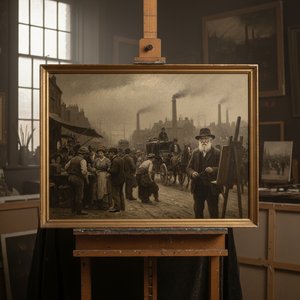
Thérèse Lessore: A Quiet Observer of Bloomsbury Beauty
Thérèse Lessore (1884 – 1945) was a British artist whose distinctive watercolor paintings and collaborative designs for Wedgwood pottery cemented her place as a significant figure in the artistic landscape of the early twentieth century. Born in Southwick, West Sussex, she inherited an artistic lineage stretching back to Jules Frédéric Lessore, her father—a French painter who had established himself in England—and his wife Ada Louise Cooper. Her family’s connections to Wedgwood and its celebrated designers further shaped her creative vision, fostering a fascination with decorative arts alongside her passion for capturing the subtleties of human experience.
Her formative years were marked by exposure to artistic excellence; she attended the Slade School of Fine Art from 1904 to 1909, where she honed her skills and earned the prestigious Melville Nettleship Prize for figure composition. This accolade was a testament to her burgeoning talent and dedication to mastering traditional techniques, acknowledging her ability to convey emotion and narrative through meticulous observation and skillful brushwork—qualities that would characterize her entire artistic career.
A Convergence of Modernist Influences
Lessore's involvement with the Camden Town Group, spearheaded by Walter Sickert, proved pivotal in shaping her aesthetic sensibilities. As the third wife of Sickert, she moved within a circle of profound creative energy. Collaborating closely with fellow artists like Vanessa Bell and Duncan Grant—members of the influential Bloomsberry Group—she embraced a looser style informed by Impressionistic principles. This association instilled in her an appreciation for understated beauty and a commitment to portraying subjects with sensitivity and nuance, prioritizing atmospheric light and color palettes that mirrored the group's exploration of psychological depth.
Her artistic development was not limited to the canvas alone. Her work for Wedgwood pottery showcased a unique ability to translate fine art sensibilities into functional, decorative objects. This multidisciplinary approach allowed her to bridge the gap between high art and the domestic sphere, much like the Bloomsbury artists who sought to integrate aesthetic beauty into everyday life.
Mastery of Light and Landscape
The breadth of Lessore’s output spanned oil, watercolor, and ceramics, each medium revealing a different facet of her artistry. Her watercolor landscapes are particularly noted for their serenity and atmospheric precision. In works such as “Greta” (1942), which depicts Bath’s Pulteney Bridge, she demonstrates a mastery of capturing the quiet, evocative moments of the English landscape. Her ability to render light through transparent layers of color allowed her to evoke a sense of nostalgia and peace.
Beyond landscapes, her subject matter often touched upon the rhythmic pulse of urban and social life. Critics of her time noted her "serene" portrayal of diverse subjects, including:
- Children playing in London parks, captured with a gentle, observational intimacy.
- Figures at the circus or theatre, where she utilized her skill in figure composition to convey movement and drama.
- Rural scenes, such as Sussex fishermen, which grounded her work in the natural textures of the British coast.
Legacy and Historical Significance
As a founder member of the London Group in 1913, Lessore stood at the forefront of a movement that sought to combine the experimental spirit of the Vorticists with the more established traditions of the Camden Town Group. Her first solo exhibition at the Eldar Gallery in 1918 was met with significant acclaim; even Walter Sickert contributed a preface to her catalogue, praising her "sense of design, her spare style, and her technical skill."
Thérèse Lessore remains a vital figure for understanding the interconnectedness of British modernism. Her life and work represent a beautiful synthesis of tradition and experimentation, where the precision of the Slade training met the fluid, emotive possibilities of the Bloomsbury aesthetic. Through her watercolors and her contributions to the decorative arts, she left behind a legacy of quiet, enduring beauty that continues to resonate with those who seek the soul within the landscape.
アーティストへのQ&A
Thérèse Lessoreの作品をカラーパレット別に閲覧することはできますか?
カラーパレットから探すページでは、Thérèse Lessoreの作品をカラーパレットごとに分類してご紹介しています。
Thérèse Lessoreの作品を色別に探すには、どこへ行けばよいですか?
Thérèse Lessoreの作品は、アーティストのカラーインデックスページにて、色別に探すことができます。
Thérèse Lessoreの作品を年代順に鑑賞できる場所はどこですか?
Thérèse Lessoreの作品は、アーティストの作品の年表ページにて、制作年代順にご覧いただけます。