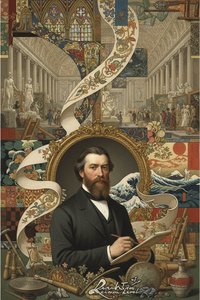
The Prague Observer
Vojtěch Bartoněk did not merely paint the Czech landscape; he documented its pulse through a shifting lens of historical weight and everyday reality. While his early training at the Academy of Fine Arts in Prague under Jan Swerts, Antonín Lhota, Maximilian Pirner, František Sequens, and František Čermák provided a rigorous technical foundation, his true development lay in his ability to pivot between scales of subject matter. He began with the heavy demands of history painting, yet he eventually found more substance in the mundane rhythms of the streets, squares, and marketplaces of Prague.
His work moved from the grand narrative to the specific, local detail. This transition is visible in his shift from large-scale historical compositions to genre scenes that captured the life of the city. He possessed a particular talent for finding importance in the common, whether it was a dairywoman or a scene at a fence. His technical skill extended beyond the canvas into architectural interventions, such as the lunettes at the Old Town Market and ceiling paintings for the Church of the Assumption in Klecany.
Technical Precision and Collaborative Reach
Bartoněk’s education was not confined to Bohemia. His time at the École des Beaux Arts in Paris introduced a level of refinement that he brought back to his restorative work and his painting. This duality—being both a creator of new images and a restorer of old ones—gave him a unique understanding of pigment, surface, and historical continuity. He was not an isolated figure; his career was marked by significant professional intersections.
His output included several notable projects and illustrations:
- A collaborative diorama with Mikoláš Aleš titled Pobití Sasíků pod Hrubou Skálou.
- Illustrations for the literary works of Božena Němcová.
- Contributions to periodicals such as Světozor and Zlatá Praha.
- The painting Recruits, which gained institutional recognition when purchased by Josef Hlávka in 1888.
A Legacy of Local Detail
To look at Bartoněk’s work is to see a specific era of Prague through a disciplined eye. He avoided the trap of purely romanticized landscapes, preferring the grit and activity of the marketplace. His paintings like Spor, Spring (At the Fence), and Bridesmaid and Grandfather demonstrate a commitment to capturing character and atmosphere without relying on hollow sentiment. He focused on the tangible: the movement of people in a square or the light hitting an architectural feature. Even his work as an illustrator required a sharp sense of composition that could translate complex narratives into single, readable images. His significance remains tied to this ability to anchor Czech identity in the observable reality of his time.
アーティストへのQ&A
カタログ内で閲覧可能なVojtěch Bartoněkの作品数はいくつですか?
全作品一覧ページでは、Vojtěch Bartoněkによる作品数 17点点のアートワークをご覧いただけます。
Vojtěch Bartoněkの作品を鑑賞できる3Dバーチャルツアーはありますか?
Vojtěch Bartoněkの作品は、アーティストの3Dギャラリーページにある3Dギャラリーでご覧いただけます。
Vojtěch Bartoněkのキャリアは、どのように時代ごとに分けられていますか?
Vojtěch Bartoněkのアーティスト・クロニクルは、スクロールに合わせて展開するタイムライン形式となっており、アーティストのキャリアを時代ごとに章立てし、その作品群を時系列に沿ってご紹介しています。
Vojtěch Bartoněkの作品をカラーパレットごとにまとめて見られる場所はどこですか?
特定のカラーパレットでVojtěch Bartoněkの作品を探すには、アーティストのカラーパレットから探すページをご利用ください。