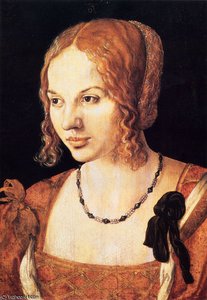
1493. Oil On Canvas.

§ 1Catalogue data


§ 2Abstract
컬렉션 상세 정보
Albrecht Dürer’s iconic 1493 ‘Self-Portrait’ captures a moment of elegant sophistication in black and white, showcasing the artist's masterful technique. Discover this timeless Renaissance masterpiece and bring its beauty into your home.
 상세 보기
상세 보기
작가 소개
독일 르네상스를 대표하는 알브레히트 뒤러! 섬세한 명암과 상징으로 가득한 '멜랑콜리아 I'와 자화상 등 혁신적인 판화 및 회화를 통해 북유럽 미술에 깊은 영향을 미친 거장입니다.
§ 3Commentary
A Portrait of Quiet Confidence: Albrecht Dürer's Self-Portrait
Albrecht Dürer’s 1493 self-portrait offers a rare and intimate glimpse into the mind of one of the most influential artists of the Northern Renaissance. Executed in stark black and white, this painting transcends mere representation; it is a carefully constructed statement of artistic ambition, personal identity, and burgeoning mastery. The image depicts a young Dürer, standing with an air of quiet confidence, his gaze directly engaging the viewer – a technique that immediately establishes a profound connection between artist and audience.
- Subject & Composition: The portrait focuses entirely on Dürer himself, presenting him as the central subject. His pose is deliberately formal, reflecting the conventions of portraiture at the time while subtly hinting at his intellectual curiosity. The inclusion of a plant in his hand adds an element of naturalism and perhaps symbolizes growth, knowledge, or the artist’s connection to the world around him.
- Technical Brilliance: Dürer's mastery of engraving and drawing is immediately apparent. The meticulous detail with which he renders the folds of his clothing, the texture of his hair, and the subtle nuances of his expression demonstrate a level of technical skill that was revolutionary for its time. The monochromatic palette amplifies this effect, forcing the viewer to focus entirely on form and line.
The Renaissance Mind: Context and Influences
Created in 1493, at the cusp of Dürer’s career, this self-portrait reflects the broader artistic currents of the Italian Renaissance, which had profoundly impacted Northern Europe. While Dürer remained firmly rooted in German traditions, he was deeply influenced by the humanist ideals and classical learning that were flourishing in Italy. This influence is evident in his intellectual pursuits – Dürer was a passionate collector of knowledge, studying mathematics, optics, and anatomy alongside his artistic practice. The portrait itself can be seen as an embodiment of this Renaissance spirit: a deliberate attempt to elevate the status of the artist and celebrate human achievement.
- Nuremberg’s Artistic Hub: Dürer's formative years were spent in Nuremberg, a thriving center of commerce and craftsmanship. This environment fostered a competitive spirit and encouraged innovation – qualities that undoubtedly contributed to Dürer’s success.
- Wolgemut’s Legacy: His early training under Michael Wolgemut, a master printmaker and illuminator, provided him with invaluable skills in woodcut and engraving, techniques he would later perfect.
Symbolism and Emotional Resonance
Beyond the technical brilliance, the portrait is laden with symbolic meaning. The red hat, a fashionable accessory of the period, could represent status or perhaps even Dürer’s ambition. The necklace suggests wealth and refinement, while the plant symbolizes growth and potential. Most importantly, Dürer's direct gaze invites us to contemplate his thoughts and feelings – a rare intimacy in portraiture of this era. The painting evokes a sense of quiet contemplation, intellectual rigor, and unwavering self-belief—qualities that defined Dürer’s extraordinary life and work.
- A Window into the Artist's Soul: This self-portrait is not simply a likeness; it is an assertion of Dürer’s identity as a creative genius, a scholar, and a man driven by an insatiable desire to understand and represent the world around him.
- Enduring Appeal: The painting’s timeless quality lies in its ability to connect with viewers across centuries – a testament to Dürer's artistic vision and his profound understanding of human nature.
Perfecting the Masterpiece: Reproduction Options
AllPaintingsStore offers meticulously crafted hand-painted reproductions of Albrecht Dürer’s ‘Self-Portrait,’ capturing every nuance of detail and tonal subtlety from the original engraving. Our skilled artisans employ traditional techniques, ensuring a faithful recreation that will grace your walls with timeless beauty. Choose from a range of sizes to perfectly complement your interior design aesthetic. Own a piece of art history – experience the legacy of Dürer firsthand.
질의응답
알브레히트 뒤러의 "Self-Portrait"은(는) 누구에게 선물하기 좋을까요?
알브레히트 뒤러의 "Self-Portrait"은(는) Anniversary을(를) 위한 선물로, 특히 Statement에 추천합니다. 작품의 복제본을 선물용으로 전하실 수 있습니다.
알브레히트 뒤러의 "Self-Portrait"의 저작권 상태는 어떻게 설명되나요?
알브레히트 뒤러의 "Self-Portrait"은(는) 퍼블릭 도메인 - 저작권 보호 기간이 만료되었습니다 상태입니다. 저작권 보호 기간은 작가가 사망한 1528년부터 기산됩니다.
"Self-Portrait"이(가) 제작되었을 당시 알브레히트 뒤러의 나이는 어떻게 되었나요?
알브레히트 뒤러은(는) 22세에 "Self-Portrait"을(를) 제작했습니다. 작가는 1471년에 태어났으며, 이 작품의 제작 연도는 1493년입니다.




 프린트 판매로 전환


 가로 또는 세로 중 어느 한 면이라도 105cm(약 41인치)를 초과하는 작품이나 복제화의 경우, 프레임은 분해된 키트 형태로 배송됩니다. 이는 안전한 배송을 보장하고 운송 중 발생할 수 있는 손상을 방지하기 위함입니다.