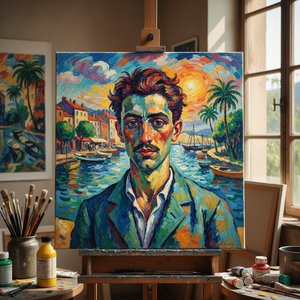
1905. Acrylic On Canvas. 필라델피아 미술관.

§ 1카탈로그 정보


§ 2추상
수집품 상세 설명
Experience Henri Matisse and André Derain’s revolutionary Fauvist masterpiece, ‘A Dialogue of Color,’ a vibrant exploration of artistic collaboration through bold pigment and dynamic composition – perfect for art lovers seeking a unique statement piece.
 더 보기
더 보기
작가 프로필
앙드레 드랭(1880-1954): 야수파의 주요 창시자이자 대담한 색채와 표현주의적 스타일로 유명합니다. 대표작 '콜리우르 산', 런던 연작을 통해 현대 미술에 큰 영향을 미쳤습니다.
§ 3해설
Henri Matisse and André Derain: A Dialogue of Color
The painting “Henri Matisse and André Derain,” completed in 1905 by Henri Matisse and André Derain, stands as a cornerstone of Fauvist art—a movement that irrevocably altered the course of European painting. More than just a portrait of two prominent artists, it’s an exploration of artistic collaboration and a testament to the transformative power of color as expressive language.
Matisse, already establishing himself as a visionary innovator, approached Derain with a proposition: to capture their friendship through a bold experiment in pigment. Departing from Impressionistic subtleties, they deliberately rejected blending colors on the palette, opting instead for juxtaposing pure hues—scarlet reds, ochre yellows, and deep browns—directly onto the canvas. This technique, championed by Matisse himself, prioritized visual impact over accurate representation, prioritizing emotion and sensation.
The composition itself is deceptively simple. Two men sit in chairs positioned near a beach, bathed in diffused sunlight. However, it’s the color scheme that dominates the viewer's gaze. The dominant red of Derain’s turban immediately draws attention, creating a visual anchor against which Matisse’s muted tones—primarily greens and browns—provide contrast. This deliberate imbalance isn’t merely stylistic; it symbolizes the dynamic interplay between their personalities – Derain’s assertive presence countered by Matisse’s contemplative gaze.
Historically, “Henri Matisse and André Derain” emerged during a period of fervent artistic debate. Impressionism had begun to wane, paving the way for movements like Neo-Impressionism and Symbolism. Yet, Fauvism pushed boundaries even further, rejecting academic conventions altogether. Matisse and Derain’s decision to prioritize color above form was seen as rebellious—a defiant assertion of artistic freedom against the constraints of tradition.
Beyond its formal innovations, the painting resonates with a profound emotional depth. The serene setting evokes memories of childhood summers, while the figures themselves convey a sense of quiet contemplation and companionship. Matisse’s masterful brushstrokes capture not just physical likeness but also intangible qualities—the warmth of friendship, the beauty of nature, and the enduring spirit of artistic exploration.
The painting's influence extends far beyond its time. It served as an inspiration for subsequent generations of artists who sought to harness color’s expressive potential. Today, reproductions of “Henri Matisse and André Derain” continue to captivate audiences worldwide, demonstrating the timeless appeal of this seminal work.
질의응답
"Henri Matisse"이(가) 제작될 당시 앙드레 데랭의 나이는 몇 세였나요?
앙드레 데랭은(는) 1905년에 "Henri Matisse"을(를) 제작했을 당시 25세였습니다. 이 나이는 작가의 출생 연도인 1880을(를) 기준으로 계산되었습니다.
Fauvist Movement 양식의 작품 "Henri Matisse"은 어느 나라에서 유래되었나요?
"Henri Matisse"은 프랑스 출신의 앙드레 데랭가 Fauvist Movement 운동의 흐름 속에서 제작한 작품입니다. 작가의 출신 배경은 이 작품을 프랑스 예술가들이 선보인 Fauvist Movement 양식과 연결해 줍니다.
앙드레 데랭의 "Henri Matisse"의 색감은 얼마나 강렬한가요?
앙드레 데랭의 "Henri Matisse"은(는) Vivid의 색채 강도를 보여줍니다.


 프린트 판매로 전환


 가로 또는 세로 중 어느 한 면이라도 105cm(약 41인치)를 초과하는 작품이나 복제화의 경우, 프레임은 분해된 키트 형태로 배송됩니다. 이는 안전한 배송을 보장하고 운송 중 발생할 수 있는 손상을 방지하기 위함입니다.