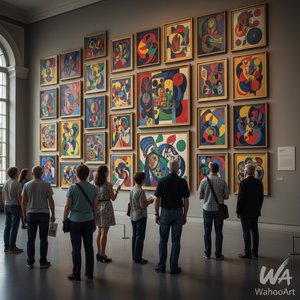
1946. Acrylic On Canvas. 더 헤프워스 웨이크필드.

§ 1카탈로그 정보


본 작품은 저작권법의 보호를 받습니다.
이 페이지에 표시된 작품은 저작권법의 보호를 받으며, 이에 따라 동일한 복제품을 제작하거나 판매하는 것은 법으로 금지되어 있습니다. 이러한 권리 보호는 다음과 같은 국제 협약에 따라 시행됩니다. 베른 협약 또한 다음에서 명시하는 법률을 포함한 국내법에 의해 보호됩니다. 미국 저작권법 제17조.
저희는 존중을 담은 합법적인 대안으로서, 원작에서 영감을 받은 맞춤형 수제 유화 작품을 제공합니다. 저희의 숙련된 전문 화가들은 원작의 스타일, 분위기, 예술적 정수를 면밀히 연구하여, 그 자체로 독창적인 창작물이면서도 원작과 동일한 감동을 불러일으키는 새로운 작품을 만들어냅니다.
이 방식은 저작권 보호를 받는 예술 작품을 복제하거나 그대로 재현하는 것이 아니기에 저작권 규정을 완벽히 준수합니다. 대신, 이는 창의적인 재해석의 과정을 거칩니다. 즉, 원작에서 영감을 받되 원작과 동일하지 않은 새로운 회화 작품을 의미합니다.
 더 알아보기
§ 2추상
수집품 상세 설명
Barbara Hepworth's 'Turning Forms' (1946) is a seminal work of modern sculpture, characterized by its geometric simplicity and exploration of spatial relationships. Created during Hepworth's residency in St Ives, Cornwall, the sculpture exemplifies her commitment to abstraction and utilizes polished bronze to convey dynamism and visual harmony.
작가 프로필
대바라 바바라 헵워스(1903-1975)의 모더니즘 조각을 탐험하세요. 추상 미술의 선구자인 헵워스의 작품은 '오벌 폼'과 '투 폼' 등을 통해 초현실주의와 추상을 결합합니다. 헵워스 웨이크필드에서 그녀의 유산을 발견하세요.
§ 3해설
Turning Form: An Exploration of Barbara Hepworth’s Sculptural Vision
Barbara Hepworth (1903–1975) stands as an icon of British Modernism, her sculptures embodying a radical departure from traditional representational art and establishing herself as one of the foremost female artists of her era. This essay delves into Hepworth's artistic journey, examining her formative influences, groundbreaking techniques, and enduring legacy—particularly her seminal work, *Turning Form*, created in 1946.Early Influences and Artistic Development
Born in Wakefield, Yorkshire, Hepworth’s early life was marked by a profound connection to the landscape of her childhood – specifically the rugged beauty of the Pennines. This formative experience instilled within her an unwavering fascination with organic forms and textures, shaping her artistic sensibilities from the outset. Studying at Leeds School of Art and subsequently earning a prestigious scholarship to the Royal College of Art in London, Hepworth honed her skills in sculpture alongside fellow artists like Henry Moore, forging a collaborative spirit that would characterize much of their careers. Her embrace of abstraction—influenced by movements such as Surrealism and Constructivism—represented a bold assertion of artistic freedom against prevailing conventions.Technique and Material Exploration: The Essence of Hepworth’s Style
Hepworth's sculptural practice was distinguished by her meticulous attention to detail and her masterful manipulation of materials, primarily stone – Galway limestone being particularly favored for monumental commissions like *Turning Form*. Unlike Moore’s more tactile approach, Hepworth prioritized precision and geometric abstraction, employing techniques such as carving and polishing to achieve surfaces that appeared deceptively smooth despite their underlying complexity. Her method involved painstakingly removing material from blocks of stone, guided by an intuitive understanding of form and space—a process she described as “more interesting than modelling,” emphasizing the importance of responding directly to the inherent qualities of the chosen medium. The resulting sculptures possessed a remarkable stillness and serenity, reflecting Hepworth’s belief that art should communicate profound emotional truths without resorting to overt symbolism.Symbolism and Conceptual Depth: Interpreting *Turning Form*
*Turning Form*, created in 1946 during Hepworth's relocation to St Ives—a pivotal moment in her artistic life—is arguably her most celebrated masterpiece. The sculpture comprises two interlocking forms, meticulously carved from Galway limestone, which appear to defy gravity and simultaneously embody notions of balance and dynamism. While Hepworth herself resisted interpretations laden with explicit symbolism, scholars have discerned references to geological processes – specifically erosion – mirroring the sculptor’s own engagement with the natural world. More broadly, *Turning Form* speaks to themes of transformation and resilience—suggesting that beauty can emerge from apparent instability and fragmentation. Its contemplative stillness invites viewers to contemplate the relationship between form and space, prompting reflection on fundamental questions about perception and existence.Hepworth's Legacy: An Enduring Influence on Contemporary Art
Barbara Hepworth’s contribution to Modern sculpture transcends mere stylistic innovation; she fundamentally altered artistic discourse by prioritizing conceptual depth alongside formal elegance. Her unwavering commitment to exploring the expressive potential of abstract forms continues to inspire artists today, demonstrating the enduring relevance of her vision—a testament to her profound understanding of art's capacity to communicate emotion and intellect simultaneously. Hepworth’s sculptures remain treasured objects of contemplation and admiration, embodying a timeless aesthetic that speaks to our deepest sensibilities.질의응답
바바라 헤퍼워스의 "Turning Form"의 색감은 선명한가요, 아니면 차분한가요?
바바라 헤퍼워스의 "Turning Form"은(는) Muted의 채도와 Monochromatic의 색채 강도를 보여줍니다.
학생들을 위한 바바라 헤퍼워스의 "Turning Form" 관련 팩트시트가 있나요?
바바라 헤퍼워스의 "Turning Form"에 대한 학습 가이드 페이지를 이용하실 수 있습니다. 이 페이지는 학생들과 수업용으로 제작된, 인쇄 가능한 작품 정보 시트를 제공합니다.
바바라 헤퍼워스의 "Turning Form"의 휘도는 어느 정도인가요?
바바라 헤퍼워스의 "Turning Form"의 기록된 휘도는 Luminous입니다.


 프린트 판매로 전환


 가로 또는 세로 중 어느 한 면이라도 105cm(약 41인치)를 초과하는 작품이나 복제화의 경우, 프레임은 분해된 키트 형태로 배송됩니다. 이는 안전한 배송을 보장하고 운송 중 발생할 수 있는 손상을 방지하기 위함입니다.