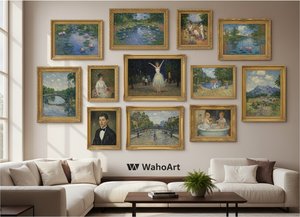
Acrylic On Canvas.

§ 1카탈로그 정보

§ 2추상
수집품 상세 설명
 더 보기
더 보기
작가 프로필
찰나의 빛과 색채를 포착한 인상주의 거장 클로드 모네의 세계를 만나보세요. '수련'과 '짚단' 등 그의 상징적인 풍경화를 통해 예술적 정수를 경험할 수 있습니다.
§ 3해설
A Window into Impressionism: Examining Claude Monet’s Untitled (2803)
Claude Monet, a name synonymous with Impressionism, wasn't merely a painter of landscapes; he was a chronicler of fleeting moments, a poet of light and color. Born in Paris on November 14, 1840, his early life took an unexpected turn when his family relocated to Le Havre, Normandy, at the age of five. While initially destined for a commercial career by his father, young Claude’s innate artistic talent quickly surfaced, manifesting first in charcoal caricatures sold locally – a testament to both his skill and entrepreneurial spirit. However, it was his encounter with Eugène Boudin that proved pivotal. Boudin didn't just teach Monet *how* to paint; he instilled within him the revolutionary idea of painting en plein air—directly from nature—a practice that would define his entire artistic journey. Monet’s formal training began in Paris, briefly at the Académie Suisse and later under Charles Gleyre. It was here he forged lasting friendships with fellow artists like Pierre-Auguste Renoir and Camille Pissarro, establishing a core group dedicated to exploring new artistic horizons. This collaborative spirit fueled their experimentation with innovative techniques—particularly the layering of thin glazes—allowing them to capture the subtle nuances of atmospheric conditions and transforming ordinary scenes into shimmering visions of beauty. The influence of Boudin’s insistence on painting outdoors is palpable in Monet's oeuvre, shaping his approach to capturing the ephemeral qualities of light and color as they dance across surfaces like water or foliage.The Composition: A Study in Atmosphere
“Untitled (2803)” exemplifies Monet’s masterful command of composition. The portrait depicts a woman seated indoors, bathed in diffused light emanating from a window behind her. Her gaze is downward, conveying a sense of introspection and quiet contemplation—a characteristic trait found throughout Monet's oeuvre. Notably, the inclusion of a curtain serves as more than just a decorative element; it acts as a crucial tool for creating depth and simulating the effects of ambient illumination. This technique—known as chiaroscuro—was championed by Leonardo da Vinci centuries earlier but was reinvigorated by Impressionists like Monet who sought to represent reality as perceived by the eye, prioritizing tonal variations over precise delineation. The subtle interplay between light and shadow contributes significantly to the painting's emotional resonance.Symbolism and Emotional Resonance
While seemingly simple in its depiction, “Untitled (2803)” speaks volumes about the artistic sensibilities of its time. The woman’s posture suggests vulnerability and contemplation—themes frequently explored by Impressionist artists who aimed to convey psychological states alongside visual impressions. Furthermore, the muted palette—dominated by greens and browns—reflects the prevailing mood of tranquility and understated elegance. Monet's deliberate choice of colors isn’t merely aesthetic; it aligns with the broader philosophical currents of Impressionism, which questioned traditional artistic conventions and prioritized subjective experience over objective representation. The painting invites viewers to consider not just what is seen but how it *feels*.Technique: Mastering Light Through Glazes
Monet's technique—characterized by the application of thin layers of translucent pigment known as glazes—is central to achieving his signature luminous effect. These glazes allow light to penetrate through subsequent layers, creating a shimmering depth and vibrancy that surpasses what could be achieved with opaque paints alone. This painstaking process demanded considerable patience and precision but yielded results that captured the fleeting beauty of natural light in ways previously unimaginable. As demonstrated by Norman Garstin’s work at Tate & Penlee House, Monet's dedication to plein air painting cemented his legacy as one of the most influential artists of the 19th century—a true pioneer of Impressionism and a champion of capturing the essence of visual experience.Further Exploration: Musée Marmottan Monet
To truly appreciate the brilliance of Claude Monet’s artistic vision, a visit to Musée Marmottan Monet in Paris is indispensable. Housing the largest collection of Monet paintings globally, including “Impression, Sunrise,” this museum offers unparalleled insight into his stylistic evolution and artistic philosophy. Explore masterpieces alongside Napoleonic art—a testament to Monet's enduring influence on the landscape of modern art.질의응답
"untitled (2803)"은(는) Impressionism 사조를 대표하는 유명한 작품인가요?
카탈로그 내 Impressionism 작품들 중 "untitled (2803)"은(는) Iconic로 기록되어 있습니다.
증강 현실(AR) 기능을 통해 클로드 모네의 "untitled (2803)"를 제 방에 미리 배치해 볼 수 있나요?
클로드 모네의 "untitled (2803)"의 AR로 미리보기 페이지에서는 증강 현실(AR) 기술을 통해 호환 가능한 기기에서 작품이 사용자의 공간에 배치된 모습을 미리 확인할 수 있습니다.
"untitled (2803)"의 Impressionism 양식에는 어떤 정서적 어조가 담겨 있나요?
"untitled (2803)"은 Impressionism 운동의 흐름 속에서 Reflective 정서를 담아내고 있습니다.


 프린트 판매로 전환


 가로 또는 세로 중 어느 한 면이라도 105cm(약 41인치)를 초과하는 작품이나 복제화의 경우, 프레임은 분해된 키트 형태로 배송됩니다. 이는 안전한 배송을 보장하고 운송 중 발생할 수 있는 손상을 방지하기 위함입니다.