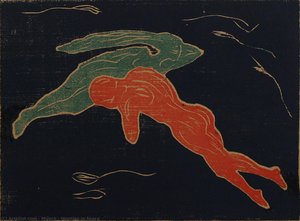
1896. Acrylic On Canvas.

§ 1카탈로그 정보


§ 2추상
수집품 상세 설명
 더 보기
§ 3해설
Hans Jaeger: A Study in Somber Reflection
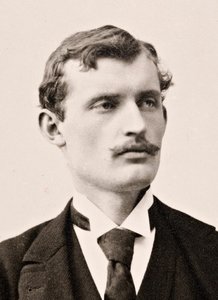
Edvard Munch’s “Hans Jaeger,” painted in 1896, stands as a cornerstone of Expressionism—a movement that sought to convey raw emotion and psychological experience rather than objective representation. This portrait isn't merely a depiction of two men; it’s an embodiment of anxiety, introspection, and the pervasive melancholy characteristic of Munch’s artistic vision.
- Composition & Perspective: The artwork employs a tightly cropped composition focusing on the upper torso and head of the central figure, subtly accentuated by a second man positioned behind him. Background elements are deliberately blurred, directing the viewer's gaze inward toward the subjects themselves—a technique that reinforces the feeling of confinement and emphasizes the psychological drama unfolding before us. Munch’s flattened perspective contributes to this sense of unease, mirroring the emotional landscape of his time.
- Color Palette & Technique: Presented in monochrome – black and white – “Hans Jaeger” utilizes a masterful grayscale palette that maximizes tonal contrast. Bold hatching and cross-hatching techniques dominate the execution, layering textures onto the canvas to capture the palpable feeling of apprehension. Munch’s loose brushwork prioritizes emotional expression over meticulous realism, mirroring the spirit of Expressionism.
- Formal Elements & Symbolism: The distorted shapes—particularly the man's face—reflect Munch’s stylistic preoccupation with conveying inner turmoil. Lines are agitated and dynamic, channeling fear and uncertainty. The somber gaze of the subject speaks volumes about existential anxieties – a theme central to Munch’s broader exploration of human psychology and mirroring the societal anxieties prevalent in late 19th-century Europe.
- Historical Context: Created during Munch's formative years as an artist, “Hans Jaeger” reflects the burgeoning influence of Symbolism alongside Expressionism. The painting captures a moment of quiet contemplation amidst a backdrop of social and intellectual ferment—a testament to Munch’s ability to distill profound emotion into visual form.
- Emotional Impact: Ultimately, “Hans Jaeger” succeeds in conveying an overwhelming sense of melancholy and apprehension. It invites viewers to confront uncomfortable truths about human vulnerability and the inescapable presence of darkness within our inner lives – a legacy that continues to resonate powerfully with audiences today.
This striking reproduction captures the essence of Munch’s artistic genius, allowing you to experience the emotional depth and textural richness of this iconic masterpiece in your own home.
질의응답
"Hans Jaeger"은(는) 언제 제작되었으며, 어떤 미술 사조에 속하나요?
"Hans Jaeger"은(는) 1896년 Expressionism 사조의 흐름 속에서 제작되었습니다.
에드바르 뭉크의 다른 이름이나 별칭에는 무엇이 있나요?
에드바르 뭉크은(는) 에드바르 뮌히, 에드바르 앙겔손 Munch라는 이름으로도 활동하고 있습니다.
"Hans Jaeger"의 화풍은 작가가 활동했던 시대와 어떤 연관이 있나요?
에드바르 뭉크의 "Hans Jaeger"은(는) Expressionism 사조와 19세기 미술 시대의 만남을 보여줍니다.




 프린트 판매로 전환


 가로 또는 세로 중 어느 한 면이라도 105cm(약 41인치)를 초과하는 작품이나 복제화의 경우, 프레임은 분해된 키트 형태로 배송됩니다. 이는 안전한 배송을 보장하고 운송 중 발생할 수 있는 손상을 방지하기 위함입니다.