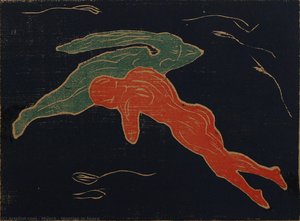
1909. Tempera.

§ 1Catalogue data


§ 2Abstract
컬렉션 상세 정보
Experience Edvard Munch's iconic 'The Sun,' a vibrant Expressionist masterpiece capturing hope and resilience against a backdrop of Norwegian landscape. Explore its symbolism & influence on modern art.
 상세 보기
상세 보기
작가 소개
표현주의의 선구자 에드바르 뭉크(1863-1944)를 만나보세요! '절규'를 비롯해 불안, 죽음, 사랑 등 심리적 주제를 탐구하는 작품들을 감상하세요. 현대 미술사에 큰 영향을 미친 노르웨이의 거장입니다.
§ 3Commentary
A Radiance of Existential Intensity
In the vast landscape of Expressionist masterworks, few pieces command the viewer's attention with such visceral energy as Edvard Munch’s “The Sun.” Completed in 1909, this monumental work transcends a mere depiction of a celestial body to become an unflinching portrait of psychological vulnerability. While many artists of his era sought to capture the fleeting light of the Impressionists, Munch turned his gaze inward, using the brilliance of the sun as a conduit for the turbulent currents of human consciousness. The painting presents a landscape bathed in an unsettling, searing light—a brilliance so intense that it feels almost invasive, leaving the world beneath it feeling acutely exposed and raw.
The composition is a masterclass in movement and dynamic tension. At its heart lies a sun that radiates outward in powerful, sweeping rays, acting as the gravitational center of the entire canvas. These rays do not merely illuminate; they seem to pulse with a life of their own, cutting through the sky and interacting with the jagged rocks and distant mountains that anchor the scene. A solitary bird drifts above this solar explosion, adding a sense of scale and a fleeting moment of organic grace to an otherwise overwhelming display of cosmic power. For the collector or interior designer, this piece offers a profound focal point, capable of injecting a sense of dramatic movement and transformative energy into any sophisticated space.
Technique and the Language of Color
Munch’s technical execution in “The Sun” is fundamental to its emotional resonance. Utilizing tempera on canvas, a medium celebrated for its luminous quality, the artist achieved a palette that vibrates with life. The dominant hue is a searing, unapologetic yellow—a color that represents not warmth or comfort, but an oppressive, blinding glare. This choice of color serves to heighten the sense of unease, mirroring the artist's ability to translate internal restlessness onto a physical surface. Through the use of thick impasto, Munch applied paint in heavy, textured layers, creating a tactile landscape where the brushstrokes themselves ripple and surge like waves of emotion.
This textural depth invites the eye to wander across the canvas, discovering the interplay between light and shadow within the thick ridges of pigment. The way the light catches the raised surfaces of the paint mimics the flickering nature of memory and sensation. For those seeking a high-quality reproduction, capturing these nuances of texture and the luminous glow of the yellow tones is essential to preserving the soul of the original work. It is this marriage of bold color and rugged technique that allows the painting to function not just as art, but as an experience of light and weight.
The Echoes of a Turbulent Soul
To truly appreciate “The Sun,” one must understand the shadows from which it emerged. Edvard Munch’s life was deeply marked by loss, shaped by the early deaths of his mother and sister to tuberculosis, and haunted by a familial struggle with mental illness. His art became a sanctuary for these anxieties, a way to process the fragility of human existence. In “The Sun,” we see a departure from the darker, more claustrophobic themes of his earlier works like The Scream, yet the underlying tension remains. The sun here is not a symbol of simple joy; it is a symbol of an inescapable truth, a light so bright that it leaves no corner for shadows to hide.
This duality makes the painting an extraordinary choice for modern interiors. It possesses the ability to illuminate a room both literally and metaphorically, offering a sense of profound strength and resilience. It speaks to the beauty found within struggle and the power of facing the light, no matter how overwhelming it may be. Owning a reproduction of such a significant piece allows one to surround themselves with the legacy of Expressionism—a movement dedicated to confronting uncomfortable truths through the sublime beauty of subjective experience.
질의응답
"The Sun"은(는) 에드바르 뭉크의 다른 작품들과 어떤 공통점을 지니고 있나요?
에드바르 뭉크의 작품 세계에서 "The Sun"은 personal trauma, symbolism, expressionist style, loss reflection, munch legacy라는 주제와 더불어 Expressionist Movement 양식을 보여줍니다.
에드바르 뭉크의 "The Sun"은 강렬한 대비를 사용하나요, 아니면 부드러운 조화를 이루고 있나요?
에드바르 뭉크의 "The Sun"의 색채 구성은 Balanced한 대비와 Discordant Palette한 조화를 동시에 보여줍니다.



 프린트 판매로 전환


 가로 또는 세로 중 어느 한 면이라도 105cm(약 41인치)를 초과하는 작품이나 복제화의 경우, 프레임은 분해된 키트 형태로 배송됩니다. 이는 안전한 배송을 보장하고 운송 중 발생할 수 있는 손상을 방지하기 위함입니다.