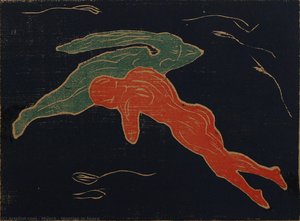
1897. Acrylic On Canvas. Tel Aviv Museum of Art.

§ 1Catalogue data


§ 2Abstract
컬렉션 상세 정보
 상세 보기
상세 보기
작가 소개
표현주의의 선구자 에드바르 뭉크(1863-1944)를 만나보세요! '절규'를 비롯해 불안, 죽음, 사랑 등 심리적 주제를 탐구하는 작품들을 감상하세요. 현대 미술사에 큰 영향을 미친 노르웨이의 거장입니다.
§ 3Commentary
A Descent into Darkness: Analyzing Edvard Munch’s “To the Forest”
The artwork, Edvard Munch's "To the Forest," stands as a haunting testament to the anxieties of the fin de siècle—a period marked by profound societal shifts and an increasing awareness of psychological complexities. Executed in 1897, this lithograph print embodies Munch’s signature Expressionist style, prioritizing emotional intensity over realistic representation. It's more than just a depiction of a woodland scene; it’s a visceral exploration of fear, isolation, and the yearning for connection amidst overwhelming darkness.- Subject Matter: The composition centers around two figures intertwined within a dense forest—a stark contrast between human intimacy and the oppressive grandeur of nature. Munch deliberately eschews detailed observation, opting instead to convey feeling through distorted forms and unsettling color palettes.
- Style & Technique: Munch’s Expressionism rejects Impressionistic ideals of capturing fleeting moments; rather, it seeks to express inner turmoil directly onto canvas. Lithography—a printing process utilizing stone or metal plates—was chosen for its ability to reproduce tonal variations with remarkable precision, mirroring the artist's preoccupation with conveying mood and atmosphere.
- Color Palette & Lighting: Dominating hues are deep greens and browns, reflecting the gloom of the forest but also hinting at decay. Subtle streaks of gold and blue serve as visual anchors, providing a fragile glimmer of hope against the pervasive darkness—a deliberate juxtaposition that underscores the emotional core of the piece. The diffused lighting reinforces the sense of mystery and unease, mirroring the psychological state of the figures depicted.
- Symbolism & Emotional Impact: The forest itself functions as a potent symbol of isolation and dread – an archetype frequently revisited in Munch’s oeuvre. More crucially, the embrace between the two individuals represents a desperate plea for solace and reassurance amidst existential anxieties. It speaks to universal themes of vulnerability and longing, resonating powerfully with viewers who recognize themselves within its melancholic beauty.
- Historical Context: Created during Munch's formative years, “To the Forest” reflects the broader intellectual currents of the time—particularly Nietzsche’s proclamation that "God is dead," which fueled a crisis of faith and spurred artists to grapple with questions of morality and meaning. Munch’s work anticipates the psychological explorations championed by Freud and Jung, cementing its place as an early landmark in modern art's preoccupation with the subconscious mind.
질의응답
"To the Forest"에서 대비와 조화는 어떻게 어우러지나요?
에드바르 뭉크의 "To the Forest"의 색채 분석은 Serene한 대비와 Strong Color Unity한 조화를 보여줍니다.
"To the Forest"의 색감을 고려했을 때, 어느 공간에 전시하는 것이 가장 좋을까요?
에드바르 뭉크의 "To the Forest"의 Earthy 색조는 추천 공간인 Living Room과 완벽하게 어우러집니다.
에드바르 뭉크의 "To the Forest"은(는) 잘 알려진 작품인가요?
"To the Forest"은(는) Iconic 등급으로 분류됩니다.


 프린트 판매로 전환


 가로 또는 세로 중 어느 한 면이라도 105cm(약 41인치)를 초과하는 작품이나 복제화의 경우, 프레임은 분해된 키트 형태로 배송됩니다. 이는 안전한 배송을 보장하고 운송 중 발생할 수 있는 손상을 방지하기 위함입니다.