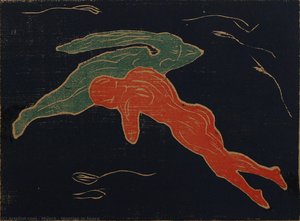
Acrylic On Canvas.

§ 1카탈로그 정보

§ 2추상
수집품 상세 설명
Explore 'untitled (1997)' by Edvard Munch, a poignant lithograph capturing intimacy and melancholy amidst a rainy backdrop. Discover Expressionism's emotional intensity.
 더 보기
더 보기
작가 프로필
표현주의의 선구자 에드바르 뭉크(1863-1944)를 만나보세요! '절규'를 비롯해 불안, 죽음, 사랑 등 심리적 주제를 탐구하는 작품들을 감상하세요. 현대 미술사에 큰 영향을 미친 노르웨이의 거장입니다.
§ 3해설
A Whisper in the Rain: Decoding Munch’s Intimate Lithograph
Edvard Munch's untitled lithograph from 1997 is not merely an image; it’s a captured breath, a fleeting moment of human connection rendered with stark emotional honesty. The work depicts a couple locked in a close embrace amidst what appears to be falling rain, a scene imbued with both tenderness and a profound sense of melancholy. It's a piece that resonates deeply, drawing the viewer into an intimate world where solace is sought and perhaps only momentarily found. The monochromatic palette—a symphony of blacks, whites, and grays—amplifies this emotional weight, stripping away any distraction and focusing attention on the raw vulnerability of the figures. The lithographic technique itself contributes to the artwork’s atmosphere; the grainy texture suggests not just the rain but also a sense of impermanence, as if the scene could dissolve at any moment.The Language of Lines and Shadows
Munch masterfully employs line and form to convey his emotional intent. Strong vertical lines dominate the background, visually representing the relentless fall of rain or perhaps a textured surface that mirrors the turmoil within. These lines aren’t merely descriptive; they create a sense of confinement, suggesting the couple is sheltered—or trapped—within their embrace. In contrast, the figures themselves are defined by flowing, curved lines, emphasizing their bodies and clothing as they lean into one another. The simplification of forms, characteristic of Munch's Expressionist style, isn’t about inaccuracy but rather a distillation of essence. He doesn’t aim to replicate reality; he seeks to capture the *feeling* of being human, of longing, of finding comfort in another amidst life’s uncertainties. A fainter figure lurking in the background adds another layer of complexity—a suggestion of loneliness or perhaps an observer witnessing this private moment. The limited perspective and flatness contribute to a sense of immediacy, as if we are standing right alongside the couple, sharing their intimate space.Echoes of a Troubled Soul: Munch’s Historical Context
To understand this lithograph fully, one must consider the life and artistic journey of Edvard Munch. Born in 1863, his childhood was marked by tragedy—the loss of his mother and sister to tuberculosis cast a long shadow over his psyche. This early exposure to death and illness fueled a lifelong preoccupation with mortality, anxiety, and psychological distress, themes that permeate his entire oeuvre. Munch’s artistic development coincided with the rise of Expressionism, a movement that rejected traditional representational art in favor of conveying subjective emotions and inner experiences. He was deeply influenced by philosophers like Hans Jæger, who encouraged him to explore his own “soul painting,” rejecting conventional norms and embracing raw emotional honesty. Works like *The Scream* cemented Munch’s place as a pioneer of this movement, but even in quieter pieces like this untitled lithograph, we see the same exploration of human vulnerability and existential angst. The rain itself can be interpreted symbolically—a cleansing force, a representation of sadness, or perhaps a metaphor for the uncertainties of life.A Timeless Resonance: Emotional Impact and Modern Appeal
The power of Munch’s work lies in its universality. While rooted in his personal experiences, the emotions he portrays – loneliness, longing, the search for connection – are timeless and resonate with audiences across generations. This lithograph is not simply a depiction of two people embracing; it's an exploration of the human condition itself. The intimacy of the scene invites viewers to project their own feelings onto the figures, creating a deeply personal experience. For those seeking to add depth and emotional resonance to an interior space, a reproduction of this work offers more than just aesthetic appeal—it provides a window into the complexities of the human heart. It’s a piece that sparks conversation, encourages introspection, and reminds us of our shared vulnerability and need for connection in a world often characterized by isolation. The stark beauty of its monochrome palette also lends itself well to various interior styles, from minimalist modern spaces to more traditionally decorated rooms, adding a touch of sophisticated melancholy and artistic depth.질의응답
"untitled (1997)" 프린트의 권장 용도는 무엇인가요?
에드바르 뭉크의 "untitled (1997)"의 복제본은 Accent에 활용하시기에 좋습니다. 이는 작품의 주제와 분위기, 그리고 색감을 고려한 제안입니다.
에드바르 뭉크의 "untitled (1997)"의 프린트를 어디에서 구매할 수 있나요?
"untitled (1997)" 작품은 코튼 캔버스 또는 아카이브용 캔버스지에 인쇄된 파인 아트 프린트를 통해 만나보실 수 있습니다. 주문은 파인 아트 프린트 페이지에서 원하시는 사이즈를 선택하여 진행하실 수 있습니다.
"untitled (1997)"의 색감은 얼마나 선명한가요?
에드바르 뭉크의 "untitled (1997)"의 색채는 Muted의 채도와 Monochromatic의 강도를 보여줍니다.


 프린트 판매로 전환


 가로 또는 세로 중 어느 한 면이라도 105cm(약 41인치)를 초과하는 작품이나 복제화의 경우, 프레임은 분해된 키트 형태로 배송됩니다. 이는 안전한 배송을 보장하고 운송 중 발생할 수 있는 손상을 방지하기 위함입니다.