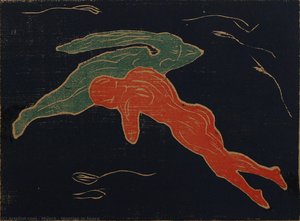
Acrylic On Canvas.

§ 1카탈로그 정보


§ 2추상
수집품 상세 설명
Experience Edvard Munch's iconic 'untitled (246)' – a haunting black & white depiction of a woman with red hair and her cat, capturing raw emotion and psychological depth.
 더 보기
더 보기
작가 프로필
표현주의의 선구자 에드바르 뭉크(1863-1944)를 만나보세요! '절규'를 비롯해 불안, 죽음, 사랑 등 심리적 주제를 탐구하는 작품들을 감상하세요. 현대 미술사에 큰 영향을 미친 노르웨이의 거장입니다.
§ 3해설
A Descent into Anguish: Unpacking Edvard Munch’s “Untitled (246)”
Edvard Munch's "Untitled (246)," a haunting black and white depiction of a woman cradling a cat, isn’t merely a portrait; it’s a visceral embodiment of the anxieties that defined the artist’s life and, by extension, much of modern experience. Painted in 1893 during a period of intense personal turmoil, this work transcends simple representation to become a profound meditation on grief, vulnerability, and the inescapable shadow of mortality. The painting's power lies not just in its subject matter but in Munch’s masterful manipulation of line, color (or rather, the absence thereof), and composition – elements that converge to create an atmosphere thick with unspoken sorrow.
Munch’s artistic journey was inextricably linked to his own personal tragedies. The early deaths of his mother and sister from tuberculosis cast a long shadow over his childhood, instilling in him a lifelong preoccupation with illness, loss, and the fragility of human existence. This deeply rooted emotional landscape is palpably present in “Untitled (246).” The woman’s face, rendered with an almost skeletal simplicity, conveys a profound sense of weariness and despair. Her eyes, vacant yet intensely focused, seem to stare into some distant, unbearable memory. The cat, nestled securely within her arms, offers a fleeting moment of tenderness – perhaps a symbolic representation of comfort or the last vestige of connection in a world increasingly defined by isolation.
Expressionist Techniques and the Power of Line
“Untitled (246)” is a quintessential example of Munch’s signature Expressionistic style. Rejecting academic realism, he prioritized conveying inner emotional states through distorted forms and exaggerated lines. Notice how the woman's body is elongated and contorted, her limbs seemingly adrift in space. The cat, too, is rendered with an unsettling fluidity, its form dissolving into a hazy suggestion of feline presence. Munch’s use of thick, swirling brushstrokes adds to the painting’s sense of unease and instability, mirroring the turbulent emotions he sought to capture.
The deliberate absence of color – the monochrome palette of black, white, and shades of gray – is crucial to the work's impact. This starkness amplifies the emotional intensity, stripping away any superficial distractions and forcing the viewer to confront the raw core of the scene. The limited tonal range creates a dramatic chiaroscuro effect, emphasizing the contours of the figures and casting them in an almost theatrical light. It’s as if Munch is illuminating not just the physical form but also the hidden depths of the woman's soul.
Symbolism and the Frieze of Life
“Untitled (246)” belongs to a series known as “The Frieze of Life,” a group of paintings that explored fundamental human experiences – love, anxiety, death, melancholy, and jealousy. Within this context, the painting can be interpreted as a representation of grief and the enduring struggle to find solace in the face of loss. The cat itself is often seen as a symbol of comfort and companionship, offering a brief respite from the overwhelming sadness. However, its presence also subtly underscores the isolation inherent in grief – a reminder that even in moments of tenderness, one remains fundamentally alone.
Furthermore, the painting’s composition echoes themes explored in Munch's broader artistic output. The woman’s posture suggests a state of passive resignation, mirroring the vulnerability and helplessness often associated with mourning. The overall effect is profoundly unsettling, prompting viewers to contemplate their own experiences with loss, loneliness, and the inevitable passage of time. It’s a work that demands introspection and rewards repeated viewing, revealing new layers of meaning with each encounter.
A Timeless Reflection on Human Emotion
“Untitled (246)” remains a powerfully resonant artwork over a century after its creation. Its enduring appeal lies in its ability to tap into universal human emotions – grief, vulnerability, and the search for connection. Reproductions of this iconic image continue to captivate audiences worldwide, serving as a poignant reminder of the complexities of the human condition. Whether displayed in a private collection or a public gallery, “Untitled (246)” offers a profound glimpse into the artistic genius of Edvard Munch and his unflinching exploration of the darkest corners of the human psyche.
질의응답
"untitled (246)"은 어떤 종류의 작품인가요?
카탈로그에서 에드바르 뭉크의 "untitled (246)"은(는) WallArt로 분류되어 있습니다. 이 카테고리를 통해 유사한 작품들을 찾아보실 수 있습니다.
에드바르 뭉크의 "untitled (246)"의 이미지를 자유롭게 복제할 수 있나요?
저작권과 관련하여, "untitled (246)"은(는) 퍼블릭 도메인 - 저작권 보호 기간이 만료되었습니다 상태입니다.
"untitled (246)"의 복제 작품은 집 안 어느 공간에 잘 어울릴까요?
"untitled (246)"의 복제본은 Living Room에 잘 어울립니다.


 프린트 판매로 전환


 가로 또는 세로 중 어느 한 면이라도 105cm(약 41인치)를 초과하는 작품이나 복제화의 경우, 프레임은 분해된 키트 형태로 배송됩니다. 이는 안전한 배송을 보장하고 운송 중 발생할 수 있는 손상을 방지하기 위함입니다.