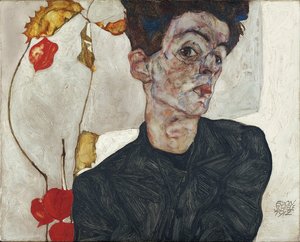
1910. Acrylic On Canvas, 313.0 x 449.0 cm. 레오폴드 박물관.

§ 1Catalogue data
 Acrylic On Canvas
- WallArt
- Expressionist Movement
 1910
1910 313.0 x 449.0 cm
 레오폴드 박물관
§ 2Abstract
컬렉션 상세 정보
 상세 보기
상세 보기
작가 소개
에곤 실레는 표현주의 화가로 독특한 기법과 심리적 깊이를 통해 인간 내면의 불안과 고통을 드러냈습니다. 클림트의 영향 아래 그의 작품은 예술계에 혁명적인 변화를 가져왔으며, 오늘날까지도 관객들에게 깊은 감동을 선사합니다.
§ 3Commentary
A Portrait of Vulnerability: Exploring Egon Schiele’s ‘Nude Self-Portrait’
The painting “Nude Self-Portrait” by Austrian Expressionist Egon Schiele stands as a haunting testament to the artist's preoccupation with mortality and psychological exploration. Completed in 1910, this deceptively simple composition—measuring an imposing 313 x 449 cm—holds within it layers of profound symbolism and technical mastery that continue to captivate audiences today. Currently housed at the Leopold Museum in Vienna, Austria, Schiele’s self-portrait transcends mere representation; it delves into the artist's inner turmoil and confronts viewers with an unflinching gaze upon the human condition.The Expressionist Style: Distortion and Emotion
Schiele’s artistic vision firmly rooted in Expressionism prioritized conveying emotion over objective accuracy. Unlike Impressionists who sought to capture fleeting moments of light, Schiele deliberately distorted forms—particularly the nude figure—to express inner feelings of anxiety and isolation. The elongated torso, angular limbs, and compressed musculature contribute to a palpable sense of unease, mirroring the artist’s own psychological state during this period. This stylistic choice wasn't merely aesthetic; it was a conscious effort to communicate the anxieties inherent in confronting one's own vulnerability.Technique: Charcoal and Pastel – A Delicate Balance
Schiele employed charcoal and pastel on paper as his medium, achieving remarkable textural contrast. The stark black of the charcoal outlines defines the contours of the body with precision, while delicate pastel washes imbue the skin tones with subtle luminescence. This combination allows for a nuanced depiction of flesh—a material Schiele frequently explored in his work—revealing both its physicality and its fragility. The artist’s meticulous attention to detail underscores his desire not just to portray the figure but also to capture its psychological essence, highlighting the expressive potential of seemingly understated materials.Historical Context: Vienna at the Turn of the Century
Vienna in 1910 was a city undergoing significant social and intellectual transformation—the Austro-Hungarian Empire faced challenges from burgeoning nationalist sentiments, and artistic movements like Symbolism and Futurism wrestled with new ideas about representation. Schiele’s work reflects this atmosphere of uncertainty and disillusionment, aligning itself with the broader Expressionist movement's rejection of bourgeois ideals and embrace of subjective experience. The artist’s exploration of themes such as sexuality and death speaks to anxieties prevalent in Viennese society at the time—a period marked by repression and a fascination with taboo subjects.Symbolism: The Penis – A Bold Assertion
Perhaps the most striking element of “Nude Self-Portrait” is the prominent depiction of Schiele’s penis drawn on his torso. This deliberate inclusion transcends mere anatomical representation; it functions as a potent symbol of vulnerability, desire, and confronting one's own mortality. In Expressionist art, symbols often serve to convey deeper meanings beyond the literal surface. The drawing represents not only physical sexuality but also an acknowledgement of inescapable human limitations—a confrontation with the inevitability of death that permeates Schiele’s oeuvre. It is a bold gesture that challenges conventional notions of beauty and invites contemplation on the complexities of human existence.Emotional Impact: Confrontation and Reflection
“Nude Self-Portrait” compels viewers to confront uncomfortable truths about themselves and the human condition. The artist's gaze—direct, unflinching, and imbued with palpable emotion—forces us to contemplate our own mortality and vulnerability. Schiele’s work isn’t designed for passive admiration; it demands active engagement and invites introspection. It remains a powerfully evocative image that continues to resonate with audiences today, serving as a reminder of the enduring power of art to provoke thought and inspire emotional response.질의응답
"Nude Self-Portrait"에서 대비와 조화는 어떻게 어우러지나요?
에곤 실레의 "Nude Self-Portrait"의 색채 구성은 Gentle한 대비와 Unified Palette한 조화를 동시에 보여줍니다.
"Nude Self-Portrait"의 뒤에 숨겨진 예술가와 화풍은 무엇인가요?
"Nude Self-Portrait"은(는) Expressionist Movement 양식으로 에곤 실레가 제작하였습니다. 작가와 미술 사조는 해당 작품의 전통을 나타냅니다.
에곤 실레의 "Nude Self-Portrait"의 방문객들은 어디에서 오나요?
에곤 실레의 "Nude Self-Portrait"의 통계 페이지에서는 해당 작품의 월간 방문 수, 작가의 가장 많이 조회된 작품과의 비교, 그리고 방문자 유입 경로 등 공개 방문 통계를 제공합니다.


 프린트 판매로 전환


 가로 또는 세로 중 어느 한 면이라도 105cm(약 41인치)를 초과하는 작품이나 복제화의 경우, 프레임은 분해된 키트 형태로 배송됩니다. 이는 안전한 배송을 보장하고 운송 중 발생할 수 있는 손상을 방지하기 위함입니다.