

Acrylic On Canvas.

§ 1Catalogue data

§ 2Abstract
컬렉션 상세 정보
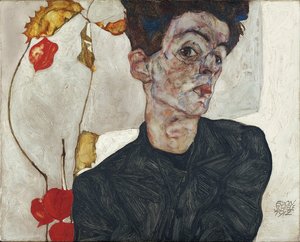
Explore Egon Schiele's haunting 'Untitled (5265)' – a black & white depiction of life, death, and longing. Witness the raw emotion and psychological depth of this iconic Expressionist masterpiece. Reproduction available now.
 상세 보기
상세 보기
작가 소개
에곤 실레는 표현주의 화가로 독특한 기법과 심리적 깊이를 통해 인간 내면의 불안과 고통을 드러냈습니다. 클림트의 영향 아래 그의 작품은 예술계에 혁명적인 변화를 가져왔으며, 오늘날까지도 관객들에게 깊은 감동을 선사합니다.
§ 3Commentary
A Portrait of Anxiety: Unpacking Egon Schiele’s “Untitled (5265)”
Egon Schiele's "Untitled (5265)," a stark black and white depiction of a provincial town scene, isn’t merely a snapshot; it’s a meticulously crafted distillation of the artist’s deeply felt anxieties about mortality, isolation, and the precariousness of human existence. Painted during a turbulent period in his life – just before his untimely death in 1918 – this work embodies the core tenets of Expressionism, prioritizing emotional intensity over realistic representation. The photograph itself presents a somewhat faded, almost vintage quality, reminiscent of an early 20th-century illustration or perhaps a forgotten newsprint image, lending it an immediate sense of historical weight and quiet melancholy.
The composition is deceptively simple: a cluster of buildings – houses, shops, and possibly a small public space – populate the foreground. Scattered throughout this urban landscape are figures: individuals going about their daily routines, some standing in contemplation, others engaged in seemingly mundane activities like walking or perhaps waiting. Two automobiles, symbols of modernity and progress, punctuate the scene, adding an element of tension to the otherwise static tableau. A fire hydrant, a small detail that nonetheless grounds the image in a recognizable reality, subtly anchors the scene while simultaneously hinting at vulnerability – a potential source of disruption within this carefully constructed composition.
The Shadow of Schiele’s Biography
To fully appreciate “Untitled (5265),” it's crucial to understand the context of Egon Schiele’s life. Born in Tulln an der Donau, Austria, in 1890, his early years were marked by profound loss and instability. His father, a railway station master, succumbed to syphilis when Schiele was just fourteen – a tragedy that irrevocably shaped the artist's worldview and fueled a lifelong preoccupation with themes of death, decay, and the fragility of human life. Raised primarily by his mother and then under the watchful eye of his uncle, Schiele’s childhood lacked conventional stability, fostering within him an independent spirit tempered by a deep-seated sense of loneliness and vulnerability. The early loss of his sister Elvira further compounded these emotional wounds, contributing to the pervasive atmosphere of melancholy that permeates much of his work.
This biographical backdrop is powerfully reflected in “Untitled (5265).” The figures within the painting seem lost and disconnected, their faces largely obscured, suggesting a profound sense of isolation. The muted tones and lack of vibrant color contribute to this feeling of detachment, creating an atmosphere of quiet desperation. The artist’s own struggles with mental health and his self-destructive tendencies are subtly woven into the fabric of the image, making it a poignant reflection of his internal turmoil.
Expressionist Techniques & Symbolic Resonance
Schiele's masterful use of line is immediately apparent in “Untitled (5265).” The figures are rendered with bold, angular strokes that convey both movement and a sense of unease. His lines aren’t meant to depict reality faithfully; instead, they serve as conduits for emotional expression, capturing the artist’s subjective experience of the world. The flattened perspective and simplified forms further emphasize this expressive intent, pushing the image beyond mere representation and into the realm of psychological portraiture.
The inclusion of the cars is particularly significant. While representing modernity, they also subtly introduce a sense of alienation – individuals trapped within their own private worlds, disconnected from one another. The fire hydrant, a commonplace object, becomes a symbol of potential disruption, hinting at the fragility of order and the ever-present threat of chaos. The overall composition feels deliberately unbalanced, mirroring the emotional instability that characterized Schiele’s life and work.
A Window into the Soul: Reproduction & Interpretation
AllPaintingsStore offers meticulously crafted hand-painted reproductions of “Untitled (5265),” allowing art lovers to experience the raw emotion and psychological depth of this iconic image. Each reproduction is created by skilled artists who painstakingly recreate Schiele’s distinctive style, capturing the nuances of his line work and the evocative atmosphere of the original painting. Whether displayed in a contemporary interior or as part of a classic collection, this artwork offers a powerful glimpse into the mind of one of the 20th century's most tormented yet brilliant artists – a testament to Schiele’s enduring legacy and his profound exploration of the human condition.
질의응답
"untitled (5265)" 작품을 파인 아트 프린트로 구매할 수 있나요?
에곤 실레의 "untitled (5265)"의 프린트는 해당 파인 아트 프린트 페이지에서 바로 주문하실 수 있습니다: 코튼 캔버스 또는 아카이브용 캔버스지에 인쇄된 파인 아트 프린트
에곤 실레의 "untitled (5265)"에서 예술 사조와 시대상은 어떻게 맞닿아 있나요?
"untitled (5265)"은(는) Expressionist Anxiety 사조에 속하며, 작가는 근대 미술 시대에 활동했습니다.
"untitled (5265)" 프린트의 권장 용도는 무엇인가요?
"untitled (5265)" 프린트의 권장 용도는 Statement입니다.


 프린트 판매로 전환


 가로 또는 세로 중 어느 한 면이라도 105cm(약 41인치)를 초과하는 작품이나 복제화의 경우, 프레임은 분해된 키트 형태로 배송됩니다. 이는 안전한 배송을 보장하고 운송 중 발생할 수 있는 손상을 방지하기 위함입니다.


