

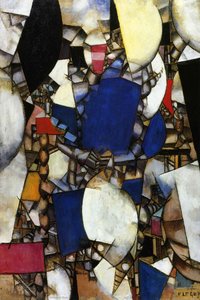
1911. Acrylic On Canvas.

§ 1카탈로그 정보


§ 2추상
수집품 상세 설명
 더 보기
더 보기
작가 프로필
레제는 입체주의와 '튜브즘'의 선구자! 기계 시대의 역동성을 담은 대담한 회화로 팝 아트에 큰 영향을 미쳤습니다. 현대 도시, 산업 이미지, 인간 형태를 단순화하여 표현한 독창적인 작품들을 만나보세요.
§ 3해설
Trouville: A Snapshot of Modern Impressionism
Fernand Léger’s “Trouville” (1949) isn't merely a depiction of a seaside town; it’s a distillation of the spirit of the burgeoning modernist movement, capturing a moment frozen in time with remarkable precision and emotional resonance. Executed in monochrome – a deliberate choice reflecting Léger’s fascination with geometric abstraction – this drawing transcends simple representation to convey a palpable sense of dynamism and urban energy. Léger's signature style, Tubism, prioritizes simplified forms and rhythmic lines, mirroring the influence of Cubism on his artistic vision. The scene unfolds against a backdrop of weathered buildings bathed in muted blues and yellows, colors that subtly evoke the Mediterranean light characteristic of Trouville’s coastal landscape.- Style: Tubism – Léger's innovative approach to Cubism championed geometric abstraction while retaining recognizable elements of the subject matter.
- Medium: Charcoal on paper – The artist favored charcoal for its ability to achieve tonal variations and convey texture, lending an immediacy to the composition.
- Composition: Léger skillfully employs overlapping planes and intersecting lines to create a sense of depth and movement, mirroring the rhythm of industrial life.
- Symbolism: The clock symbolizes time and progress – themes central to Léger's exploration of modernity and its relationship to humanity.
- Historical Context: Created during World War II, “Trouville” reflects Léger’s desire to express optimism and resilience amidst the devastation of conflict.




 프린트 판매로 전환


 가로 또는 세로 중 어느 한 면이라도 105cm(약 41인치)를 초과하는 작품이나 복제화의 경우, 프레임은 분해된 키트 형태로 배송됩니다. 이는 안전한 배송을 보장하고 운송 중 발생할 수 있는 손상을 방지하기 위함입니다.


