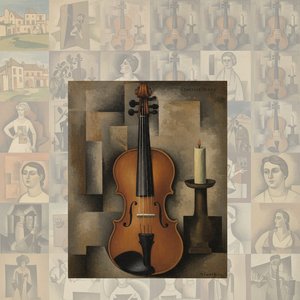
Acrylic On Canvas.

§ 1Catalogue data


본 작품은 저작권법의 보호를 받습니다.
이 페이지에 표시된 작품은 저작권법의 보호를 받으며, 이에 따라 동일한 복제품을 제작하거나 판매하는 것은 법으로 금지되어 있습니다. 이러한 권리 보호는 다음과 같은 국제 협약에 따라 시행됩니다. 베른 협약 또한 다음에서 명시하는 법률을 포함한 국내법에 의해 보호됩니다. 미국 저작권법 제17조.
저희는 존중을 담은 합법적인 대안으로서, 원작에서 영감을 받은 맞춤형 수제 유화 작품을 제공합니다. 저희의 숙련된 전문 화가들은 원작의 스타일, 분위기, 예술적 정수를 면밀히 연구하여, 그 자체로 독창적인 창작물이면서도 원작과 동일한 감동을 불러일으키는 새로운 작품을 만들어냅니다.
이 방식은 저작권 보호를 받는 예술 작품을 복제하거나 그대로 재현하는 것이 아니기에 저작권 규정을 완벽히 준수합니다. 대신, 이는 창의적인 재해석의 과정을 거칩니다. 즉, 원작에서 영감을 받되 원작과 동일하지 않은 새로운 회화 작품을 의미합니다.
 상세 보기
상세 보기§ 2Abstract
컬렉션 상세 정보
Georges Braque’s "Bistre Bird" is a pivotal Cubist study of avian form & flight. Explore fragmented shapes, earthy tones, and the dawn of modern art's revolutionary perspective. Hand-painted reproduction.
§ 3Commentary
Georges Braque’s “Bistre Bird”: A Study in Form and Flight
Georges Braque's "Bistre Bird," a captivating study in avian form, offers a glimpse into the artist’s pivotal role in the development of Cubism. Painted around 1908-1912 – a period of intense experimentation and collaboration with Pablo Picasso – this work transcends mere representation, becoming a profound exploration of perception and spatial relationships. The painting depicts a bird in mid-flight, its wings outstretched as if caught in an eternal moment of propulsion. Its plumage is rendered in shades of brown—a “bistre” hue that lends the piece a quiet dignity and earthy resonance – contrasting beautifully against the vibrant blue expanse of the sky. Noticeably, Braque doesn’t aim for photographic realism; instead, he dissects the bird's form into fragmented geometric shapes, mirroring the core tenets of Cubism. This approach wasn’t born in isolation; Braque’s early training as a house painter instilled within him an acute awareness of structure and perspective – skills that would prove invaluable as he dismantled traditional artistic conventions.
The Dawn of Cubism: Deconstructing Reality
“Bistre Bird” is inextricably linked to the revolutionary movement of Cubism, a style that emerged in Paris around 1907. Braque and Picasso, driven by a shared desire to challenge established notions of perspective and representation, began to break down objects into their constituent parts and reassemble them on the canvas from multiple viewpoints simultaneously. This wasn’t simply an aesthetic choice; it was a philosophical one, reflecting a growing interest in scientific theories of optics and the way our eyes perceive depth. The painting exemplifies this approach – the bird's wings are not presented as a single, continuous surface but rather as a series of overlapping planes, each rendered with careful attention to light and shadow. The background sky is similarly fragmented, suggesting an infinite space beyond the confines of the canvas. This deliberate distortion of reality aimed to capture the essence of an object – its underlying structure – rather than merely imitating its appearance.
Influences and Techniques: Cézanne’s Legacy
Braque's artistic journey leading up to "Bistre Bird" was profoundly shaped by the work of Paul Cézanne, a Post-Impressionist painter whose emphasis on geometric forms and multiple perspectives served as a crucial precursor to Cubism. Cézanne’s meticulous studies of landscapes and still lifes, particularly his exploration of how light interacts with solid objects, deeply influenced Braque's approach to composition and form. The artist spent considerable time studying Cézanne’s retrospective exhibition in 1907, recognizing the profound impact it would have on the avant-garde movement. Technically, Braque employed a technique known as “Analytical Cubism,” characterized by monochromatic color palettes – predominantly browns, grays, and ochres – and a focus on dissecting objects into their basic geometric components. The brushstrokes are often subtle and precise, contributing to the painting’s overall sense of controlled fragmentation.
Symbolic Resonance: Flight, Freedom, and Observation
Beyond its formal innovations, “Bistre Bird” carries a potent symbolic weight. The act of flight itself represents freedom, aspiration, and transcendence – themes that resonated deeply with the artists of the early 20th century. The bird’s poised stance suggests both vulnerability and strength, inviting contemplation on the delicate balance between observation and interpretation. Braque's choice of “bistre,” a muted brown tone, adds to this sense of quiet introspection. It evokes the earth, grounding the soaring image while simultaneously hinting at the vastness of the sky. Ultimately, "Bistre Bird" is not simply a depiction of a bird in flight; it’s an invitation to engage with the complexities of perception and the enduring power of art to transform our understanding of the world.
질의응답
브라크의 "Bistre bird"은(는) 무엇을 묘사하고 있으며, 어떤 분위기를 담고 있나요?
"Bistre bird"은(는) bird flight, blue sky, brown bird, composition, movement, aviary, braque을(를) 보여주며, 기록된 분위기는 Earthy입니다.
"Bistre bird"에서 대비와 조화는 어떻게 어우러지나요?
브라크의 "Bistre bird"의 색채 구성은 Statement한 대비와 Discordant Palette한 조화를 동시에 보여줍니다.
"Bistre bird"은(는) 저작권 보호 대상이 아닌가요?
브라크의 "Bistre bird"은(는) 여전히 저작권의 보호를 받고 있습니다 상태입니다. 이 상태에 따라 해당 작품 이미지의 복제 가능 여부가 결정됩니다.


 프린트 판매로 전환


 가로 또는 세로 중 어느 한 면이라도 105cm(약 41인치)를 초과하는 작품이나 복제화의 경우, 프레임은 분해된 키트 형태로 배송됩니다. 이는 안전한 배송을 보장하고 운송 중 발생할 수 있는 손상을 방지하기 위함입니다.