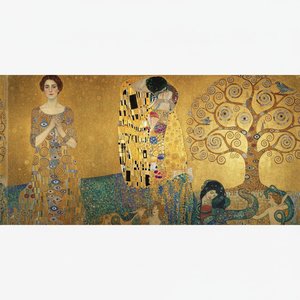
1882. Acrylic On Canvas. 알베르티나 박물관.

§ 1Catalogue data


§ 2Abstract
컬렉션 상세 정보
 상세 보기
상세 보기
작가 소개
고스트 아르누보의 거장 구스타프 클림트! 《키스》와 관능적인 초상화로 유명하며, 금박을 활용한 화려하고 상징적인 작품 세계를 만나보세요. 빈 세세션 운동의 선구자로서 오스트리아 미술사에 큰 족적을 남겼습니다.
§ 3Commentary
A Glimpse Behind the Veil: Gustav Klimt’s Composition Design for “Composition Design for”
Gustav Klimt's "Composition Design for," dated 1882, isn’t merely a preparatory sketch; it’s a tantalizing window into the genesis of one of his most iconic paintings. This drawing, rendered with a confident hand and a nascent understanding of the opulent style that would define his career, offers a remarkably intimate view of Klimt's creative process – a world of swirling patterns, veiled figures, and the shimmering promise of gold. The work itself is deceptively simple in its execution, yet brimming with the seeds of the complex symbolism and decorative intensity that would characterize his mature oeuvre. It’s a testament to Klimt’s early experimentation, a crucial stepping stone on his path toward revolutionizing Viennese art.
Born in Baumgarten near Vienna in 1862, Klimt's artistic lineage was inextricably linked to the world of craftsmanship. His father, Ernst Klimt, a gold engraver, instilled within young Gustav not just an appreciation for intricate detail and luxurious materials – qualities vividly reflected in the drawing’s subtle layering of charcoal – but also a deep understanding of how surfaces could be manipulated to create illusion and depth. This familial connection to the decorative arts would prove profoundly influential, shaping Klimt's later embrace of gold leaf and his exploration of patterns as vehicles for emotional expression. The transient upbringing that followed, marked by frequent moves within Vienna, undoubtedly sharpened his observational skills, allowing him to capture the nuances of human interaction with a remarkable sensitivity.
The Dance of Form and Figure
The drawing depicts a group of figures engaged in various activities – seated on a bench, standing in conversation, seemingly lost in their own thoughts. The arrangement is deliberately loose, prioritizing gesture and atmosphere over precise representation. Klimt isn’t striving for photographic realism; instead, he's capturing the *feeling* of a social gathering, the unspoken dynamics between individuals. Notice how he uses overlapping forms to create a sense of spatial ambiguity – figures seem to emerge from and recede into one another, blurring the boundaries between foreground and background. This technique anticipates Klimt’s later development of his signature flattened picture plane, where decorative elements become integral to the narrative.
The seated figure, positioned centrally, is particularly intriguing. Their posture suggests a moment of contemplation or perhaps even melancholy. The surrounding figures, though less defined, contribute to the overall mood of quiet intimacy. Klimt’s masterful use of shading and line work subtly reveals their forms, hinting at clothing, facial features, and body language without resorting to detailed rendering. This restraint is deliberate; it allows the viewer's imagination to fill in the gaps, creating a more personal connection with the scene.
Symbolism and the Dawn of Ornamentation
Even in this preliminary sketch, traces of Klimt’s future symbolic language begin to emerge. The use of geometric patterns – particularly evident in the suggestion of drapery and architectural elements – foreshadows his later obsession with ornamentation. These aren't merely decorative flourishes; they represent a deeper engagement with themes of sexuality, spirituality, and the duality of masculine and feminine energies. The potential for gold, so central to Klimt’s mature work, is already palpable in the drawing’s subtle tonal variations and the suggestion of shimmering surfaces.
Considering the historical context – Vienna at the turn of the 20th century was a hub of artistic innovation, grappling with issues of modernity, sexuality, and social change – “Composition Design for” can be seen as a reflection of these turbulent times. Klimt’s work challenged conventional notions of beauty and representation, paving the way for new forms of artistic expression. The drawing itself embodies this spirit of experimentation, offering a glimpse into an artist on the cusp of greatness.
Bringing Klimt to Your Space: A High-Quality Reproduction
AllPaintingsStore offers meticulously crafted hand-painted reproductions of Gustav Klimt’s “Composition Design for,” capturing the essence of this pivotal work with unparalleled fidelity. Our artists utilize traditional techniques and archival-quality materials to ensure that each reproduction faithfully replicates the drawing's delicate details, nuanced tonal range, and atmospheric depth. Whether you are an art collector, interior designer seeking a touch of Viennese elegance, or simply an admirer of Klimt’s genius, our reproductions provide a beautiful and authentic way to experience this remarkable piece of art history. Explore the collection today and bring the captivating world of Gustav Klimt into your home.
질의응답
클림트의 "Composition Design for"의 채도와 강도는 어떠한가요?
클림트의 "Composition Design for"의 색채는 Subtle Color의 채도와 Balanced의 강도를 보여줍니다.
"Composition Design for" 작품의 권장 인쇄 방식은 무엇인가요 - 크기와 방향은 어떻게 되나요?
"Composition Design for" 작품의 권장 인쇄 설정은 Large 크기와 Landscape 방향입니다.
"Composition Design for"을(를) 정의하는 팔레트와 주된 색상은 무엇인가요?
클림트의 "Composition Design for"은(는) Monochrome 색조의 팔레트를 사용하며, Putty (#e6ceb2)이(가) 주된 색상을 이룹니다.


 프린트 판매로 전환


 가로 또는 세로 중 어느 한 면이라도 105cm(약 41인치)를 초과하는 작품이나 복제화의 경우, 프레임은 분해된 키트 형태로 배송됩니다. 이는 안전한 배송을 보장하고 운송 중 발생할 수 있는 손상을 방지하기 위함입니다.