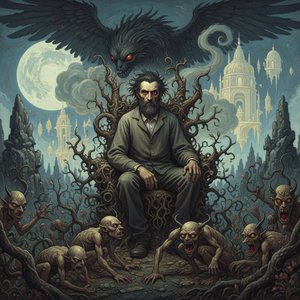
1865. Acrylic On Canvas.

§ 1카탈로그 정보


§ 2추상
수집품 상세 설명
Explore Gustave Moreau's 'After' (1865), a captivating Symbolist masterpiece depicting a winged figure and dragon locked in mythical struggle. Discover its rich symbolism & historical context.
 더 보기
더 보기
§ 3해설
A Realm of Myth and Shadow: Unveiling Gustave Moreau’s ‘After’
Gustave Moreau's 1865 illustration, ‘After,’ is not merely an image; it’s an immersion into a world steeped in myth, foreboding, and the sublime beauty of struggle. Dominated by a palette of somber greys and earthy browns, the work depicts a winged figure locked in combat atop a serpentine dragon – a scene that resonates with primal energies and timeless narratives. It is a piece that demands attention, not through vibrant color, but through an intricate web of line, texture, and symbolic weight.
Bridging Eras: Style and Technique
Moreau occupies a fascinating position in art history, standing as a pivotal figure in the burgeoning Symbolist movement while simultaneously drawing deeply from artistic traditions of the past. His style echoes the meticulous detail and narrative focus found within medieval illuminated manuscripts and Renaissance masterpieces, yet he infuses this historical aesthetic with a distinctly macabre sensibility. Executed primarily in pen and ink, ‘After’ showcases an extraordinary mastery of draftsmanship. The artist employs painstaking hatching and cross-hatching to build rich textures and create a sense of depth despite the somewhat flattened perspective. Angular shapes – evident in the dragon's scales, the figure’s armor, and the wings – provide a striking counterpoint to the flowing curves of the serpent’s body, amplifying the visual tension. This interplay between sharp definition and organic form is central to Moreau’s unique aesthetic.
The Language of Symbols: Mythological Resonance
At its heart, ‘After’ presents a classic mythological trope: the battle between a heroic figure and a dragon. However, for Moreau, this was never simply an illustration of legend; it was an opportunity to explore profound symbolic themes. The dragon, often representing chaos, primal forces, or even evil itself, is confronted by a warrior embodying order, courage, and perhaps divine authority. Scattered celestial bodies in the background elevate the conflict to a cosmic scale – a struggle not merely between earthly powers but of universal principles. Moreau was deeply inspired by mythology, literature—Shakespeare and the Bible being prominent sources—and history, reinterpreting these narratives through his unique Symbolist lens. The resolute expression on the figure’s face hints at unwavering determination, while the dragon's menacing form underscores the gravity of the challenge. It is a visual representation of an eternal conflict, a testament to the enduring power of myth.
A Reaction Against Modernity: Historical Context and Emotional Impact
Gustave Moreau lived during a period of rapid industrialization and societal change in 19th-century France. His art was, in many ways, a reaction against the perceived materialism of modern life, a yearning for deeper meaning through allegory and evocative imagery. As a leading figure in Symbolism, he rejected the realism and naturalism that dominated much of the artistic landscape, instead seeking to express subjective experience, imagination, and spiritual themes. ‘After’ evokes a powerful emotional response – one of foreboding, tension, and perhaps even awe. The somber color palette and dramatic composition create an atmosphere of mystery and intrigue. This artwork would be a striking addition to various interior design schemes, particularly those leaning towards gothic, Victorian, or eclectic styles. Consider pairing it with rich, jewel-toned fabrics and antique furniture; its monochromatic nature allows for versatility in complementing both warm and cool color palettes. Its dramatic presence would be especially effective within a library, study, or dining room—spaces that invite contemplation and conversation.
질의응답
거스타브 모로아의 "After"에는 어떤 모습이 담겨 있나요?
거스타브 모로아의 "After"에 담긴 주제: mythology, symbolism, fantasy, dragon, battle, foreboding, allegory, power
"After"의 Symbolism에는 어떤 국가적 배경이 담겨 있나요?
"After"은 프랑스 출신의 거스타브 모로아가 Symbolism 운동의 흐름 속에서 제작한 작품입니다. 작가의 출신 배경은 이 작품을 프랑스 예술가들이 선보인 Symbolism 양식과 연결해 줍니다.
거스타브 모로아의 "After"은 밝은 느낌의 작품인가요, 아니면 어두운 느낌의 작품인가요?
거스타브 모로아의 "After"의 측정된 수치는 다음과 같습니다: 밝기 balanced, 휘도 Soft Shadow.


 프린트 판매로 전환


 가로 또는 세로 중 어느 한 면이라도 105cm(약 41인치)를 초과하는 작품이나 복제화의 경우, 프레임은 분해된 키트 형태로 배송됩니다. 이는 안전한 배송을 보장하고 운송 중 발생할 수 있는 손상을 방지하기 위함입니다.