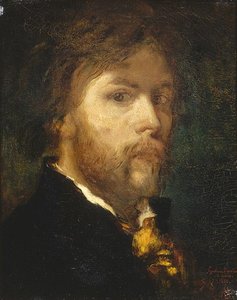
1850. Oil On Canvas, 41.0 x 32.0 cm.

§ 1Catalogue data

- 41.0 x 32.0 cm


§ 2Abstract
컬렉션 상세 정보
 상세 보기
상세 보기
§ 3Commentary
A Window Into the Soul: Gustave Moreau’s Self-Portrait
Gustave Moreau's "Self-Portrait," painted in 1850, isn’t merely a depiction of an artist; it’s a profound meditation on the human condition, rendered with the meticulous detail and evocative symbolism that would come to define his enduring legacy. This oil on canvas, measuring a modest 41 x 32 cm, currently resides within the Musée National Gustave-Moreau in Paris—a fitting home for a work so deeply rooted in introspection and artistic exploration. Moreau, a pivotal figure bridging the Romanticism of his predecessors with the nascent Symbolist movement, invites us into a world where reality is filtered through layers of dream, myth, and personal feeling.
The painting immediately establishes an atmosphere of quiet intensity. Moreau himself appears framed within a richly textured interior, reminiscent of a dimly lit study or perhaps a scholar’s chamber. His long hair, cascading down his shoulders, and the carefully groomed beard suggest a deliberate cultivation of intellectualism and a connection to the past. The black suit, a formal garment signifying status and discipline, is unexpectedly offset by a vibrant yellow tie—a bold splash of color that hints at hidden passions and perhaps even a touch of rebellion against conventional norms. His direct gaze, unwavering and almost challenging, compels the viewer to confront not just an image, but a presence.
The Language of Symbolism
Moreau’s artistic approach was fundamentally rooted in symbolism—a deliberate rejection of the objective representation favored by earlier movements. He wasn't interested in simply *showing* something; he sought to *evoke* it through carefully chosen details and layered meanings. The setting itself is laden with symbolic weight. The architectural elements, though vaguely reminiscent of classical structures, possess an unsettling quality—they seem both familiar and subtly distorted, reflecting the artist’s own internal landscape. Moreau frequently drew inspiration from mythology, religion, and folklore, weaving these narratives into his work to explore universal themes of love, loss, beauty, and mortality.
The yellow tie, a recurring motif in Moreau's oeuvre, is particularly significant. It represents not just color but also illumination, knowledge, and even the divine—a subtle nod to the artist’s own pursuit of spiritual understanding through his art. The overall composition feels deliberately unbalanced, creating a sense of unease and inviting the viewer to actively engage with the painting’s enigmatic narrative.
Technique and Historical Context
Moreau's technique is characterized by its meticulous detail and rich color palette. He employed a glazing method—applying thin layers of paint that build up depth and luminosity over time—to create an almost velvety surface. This painstaking process reflects his commitment to capturing not just the appearance but also the *essence* of his subjects. Painted in 1850, this work represents a crucial moment in Moreau’s artistic development, as he was beginning to establish his unique style and explore the possibilities of Symbolist imagery.
The painting emerged during a period of significant social and intellectual upheaval—the mid-19th century. The rise of industrialization, coupled with growing anxieties about modernity, fueled a desire for escape into realms of imagination and spirituality. Moreau’s work perfectly captured this mood, offering a refuge from the harsh realities of the world through the beauty and mystery of his symbolic visions. He was a key figure in fostering an environment where art could be more than just representation; it could become a vehicle for exploring the deepest recesses of the human psyche.
Bringing Moreau’s Vision Home
AllPaintingsStore offers exquisite, hand-painted reproductions of Gustave Moreau's "Self-Portrait," allowing you to experience the depth and complexity of this iconic work in your own space. These meticulously crafted reproductions capture not only the visual details but also the emotional resonance of the original painting. Whether you’re an art collector, a design enthusiast, or simply someone seeking a piece that speaks to the soul, a AllPaintingsStore reproduction of Moreau's "Self-Portrait" is a timeless addition to any collection. Discover more and order your high-quality reproduction at AllPaintingsStore.com
질의응답
"Self-Portrait"에서 매체와 움직임은 어떻게 결합되어 있나요?
"Self-Portrait"에서 Oil On Canvas 기법은 Symbolist Movement 사조와 만납니다.
거스타브 모로아의 "Self-Portrait"에는 어떤 기법이 사용되었나요?
거스타브 모로아은(는) "Self-Portrait" 작품에 Oil On Canvas 기법을 사용했습니다. 이 기법은 원작의 재료적 특성을 잘 보여줍니다.
거스타브 모로아의 "Self-Portrait"의 제작 연도와 화풍은 무엇인가요?
"Self-Portrait"은(는) 1850년에 Symbolist Movement 사조의 흐름 속에서 제작되었습니다.


 프린트 판매로 전환


 가로 또는 세로 중 어느 한 면이라도 105cm(약 41인치)를 초과하는 작품이나 복제화의 경우, 프레임은 분해된 키트 형태로 배송됩니다. 이는 안전한 배송을 보장하고 운송 중 발생할 수 있는 손상을 방지하기 위함입니다.