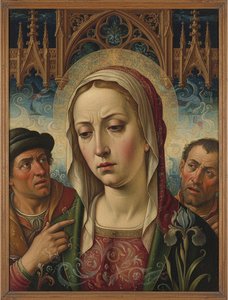
1467. Acrylic On Canvas, 33.0 x 23.0 cm. 쿤스트히스토리스체 박물관.

§ 1Catalogue data
 Acrylic On Canvas
- WallArt
- Northern Renaissance
 1467
1467 33.0 x 23.0 cm
 쿤스트히스토리스체 박물관
§ 2Abstract
 상세 보기
상세 보기
작가 소개
15세기 플랑드르 르네상스 화가 위고 반 데르 고에스는 극사실주의와 강렬한 감정 표현으로 유명합니다. '포르티나리 제단화'를 통해 이탈리아 르네상스 회화에도 큰 영향을 미쳤으며, 종교화에서 인간 내면의 심리를 섬세하게 묘사했습니다.
§ 3Commentary
Hugo van der Goes’s “The Fall”: A Testament to Northern Renaissance Mastery
“The Fall,” painted between 1467 and 1468 by Hugo van der Goes, stands as an unparalleled achievement of Early Netherlandish art—a monumental depiction of the biblical narrative that transcends mere illustration, embodying profound psychological depth and masterful artistic execution. Housed within the Kunsthistorisches Museum in Vienna, Austria, this oil on oak panel masterpiece continues to captivate viewers with its breathtaking realism and enduring symbolic resonance.Composition and Technique: A Symphony of Light and Shadow
Van der Goes’s compositional brilliance is immediately apparent. He presents a dramatic tableau featuring Adam and Eve after their transgression against God's commandment—a scene fraught with emotion and imbued with an astonishing level of detail. The artist skillfully employs chiaroscuro, manipulating light and shadow to sculpt the figures and landscape alike, creating a palpable sense of three-dimensionality that was revolutionary for its time. Each brushstroke meticulously renders musculature, skin texture, and drapery folds, demonstrating Van der Goes’s unwavering commitment to anatomical accuracy—a hallmark of his distinctive style. The oak panel itself serves as an integral element of the artwork's aesthetic impact, grounding the scene in materiality and enhancing its visual presence.Symbolism: Decoding Layers of Meaning
Beyond its technical prowess, “The Fall” is rich in symbolism that speaks to fundamental theological concepts. The serpent, coiled around the Tree of Knowledge, embodies temptation and deceit—a recurring motif within Christian iconography. Eve’s gaze towards Adam reflects vulnerability and remorse as she confronts the consequences of her actions. The apple itself symbolizes forbidden knowledge and represents humanity's loss of innocence. Furthermore, the lush foliage surrounding the figures underscores the idyllic beauty of Eden before the Fall, serving as a poignant reminder of what has been irrevocably lost. Van der Goes’s deliberate use of color—primarily earthy tones—contributes to the painting’s somber mood, mirroring the spiritual anguish experienced by Adam and Eve.Historical Context: Pioneering Realism in a Turbulent Era
Created during the height of the Northern Renaissance, “The Fall” represents a pivotal moment in artistic history. Unlike its Italian counterparts, which often prioritized idealized beauty and mythological grandeur, Flemish painting—particularly under Van der Goes’s influence—embraced realism with unprecedented fervor. Rogier van der Weyden and Jan van Eyck, contemporaries of Van der Goes, had already established new standards for detail and naturalism; however, Hugo van der Goes elevated these achievements to an entirely different level. The painting reflects the intellectual ferment of the period, fueled by humanist scholarship and a renewed interest in classical art—a confluence that propelled artists toward exploring human psychology and conveying emotional intensity with unparalleled sensitivity.Emotional Impact: A Profound Reflection on Human Condition
“The Fall” continues to resonate powerfully with audiences today because it confronts fundamental questions about morality, faith, and the human condition. The painting’s depiction of Adam and Eve's despair captures the universal experience of regret and remorse—a timeless reminder that even in moments of transgression, humanity retains a capacity for compassion and vulnerability. Its masterful execution elevates it beyond mere narrative illustration, transforming it into an enduring meditation on spiritual struggle and the consequences of disobedience. Viewing this artwork evokes contemplation and invites viewers to consider the complexities of human behavior and the enduring power of symbolism.- Artist: Hugo van der Goes
- Date: 1467-68
- Medium: Oil on Oak Panel
- Location: Kunsthistorisches Museum, Vienna
For more information on Hugo Van Der Goes and his works, visit AllPaintingsStore.com and explore our collection of handmade oil painting reproductions.
질의응답
"The Fall"의 제작 기법은 무엇인가요?
위고 반 데르 고스의 "The Fall"의 재료는 Acrylic On Canvas입니다. 복제화는 이 기법의 질감을 그대로 구현하는 것을 목표로 합니다.
"The Fall"은(는) 저작권 보호 대상이 아닌가요?
위고 반 데르 고스의 "The Fall"은(는) 퍼블릭 도메인 - 저작권 보호 기간이 만료되었습니다 상태입니다. 이 상태에 따라 해당 작품 이미지의 복제 가능 여부가 결정됩니다.
위고 반 데르 고스의 "The Fall"의 엑스레이(X-ray) 이미지를 볼 수 있을까요?
위고 반 데르 고스의 "The Fall"의 X선 분석 페이지는 엑스레이 스타일의 뷰를 포함하여 작품 이미지의 11개 광학 레이어를 슬라이드하며 살펴볼 수 있는 인터랙티브 뷰어를 제공합니다.


 프린트 판매로 전환


 가로 또는 세로 중 어느 한 면이라도 105cm(약 41인치)를 초과하는 작품이나 복제화의 경우, 프레임은 분해된 키트 형태로 배송됩니다. 이는 안전한 배송을 보장하고 운송 중 발생할 수 있는 손상을 방지하기 위함입니다.