100일 환불 보장 전 세계 무료 배송
449,587작품들 30,613아티스트들 4,660박물관 32언어 설정
Catalogue entry

Vegetables on the Table

1927. Oil. 기타큐슈 시립 미술관.

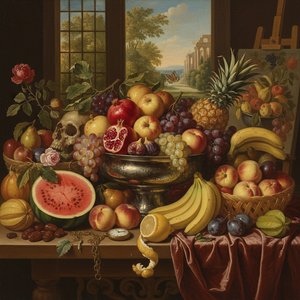
Fig. 1. Narashige Koide, Vegetables on the Table, 1927. Shown as the reproduction you are specifying: , .

§ 1Catalogue data

§ 2Abstract

컬렉션 상세 정보

A vibrant still life of nature's bounty featuring colorful fruits and flowers by Japanese modernist pioneer Narashige Koide, offering a timeless glimpse into 1927 avant-garde beauty for your collection.

작가 소개

Discover Narashige Koide (1887-1931), a pioneer of Hanshinkan Modernism in Japanese yōga painting. Explore evocative portraits, striking nudes & his innovative approach bridging Nihonga tradition and Western styles.

§ 3Commentary

A Symphony of Stillness: The Bounty of Narashige Koide

In the quiet corners of early 20th-century modernism, few works capture the humble elegance of daily life as poignantly as Narashige Koide’s 1927 masterpiece, Vegetables on the Table. This evocative still life serves as a profound meditation on texture, color, and the simple abundance of nature. At first glance, the viewer is greeted by a vibrant arrangement of life: the sun-kissed curves of oranges and apples, the elongated grace of bananas, and a central vase of flowers that acts as the composition's beating heart. Set against a deep, atmospheric blue background, the subjects do not merely sit upon the table; they emerge from the shadows with a sculptural presence that commands the room.

The brilliance of this piece lies in Koide’s ability to bridge the gap between the delicate sensibilities of Nihonga—the traditional Japanese style he studied in his youth—and the bold, structural experimentation of Western Yōga painting. There is a rhythmic balance at play here, where the placement of two humble bowls and a solitary cup creates a sense of domestic harmony. For the discerning collector or interior designer, this painting offers more than just visual interest; it provides a focal point of stability and warmth. The interplay between the cool, receding blue backdrop and the warm, tactile fruits creates a chromatic tension that breathes life into any sophisticated space.

Beyond its aesthetic charm, Vegetables on the Table carries a deeper symbolic weight, reflecting the era's fascination with finding beauty in the mundane. During a period of intense cultural transition in Japan, Koide utilized the still life genre to explore form and light, stripping away the unnecessary to focus on the essential. The arrangement feels both spontaneous and meticulously curated, suggesting that even in the most ordinary objects, there exists an eternal, artistic truth. Each brushstroke contributes to a sense of weight and volume, inviting the viewer to reach out and touch the velvety skin of a peach or the smooth surface of a ceramic bowl.

For those seeking to infuse their homes with a sense of historical depth and quiet luxury, a high-quality reproduction of this work offers an unparalleled opportunity. It is a piece that transcends mere decoration, acting as a window into the soul of Japanese modernism. Whether placed in a sunlit dining room to echo its themes of nourishment or in a contemporary study to provide a classical counterpoint to modern furniture, Koide’s vision remains timeless. To possess this image is to hold a fragment of 1927—a moment of stillness captured forever in a dance of color and light.

질의응답

Narashige Koide의 "Vegetables on the Table"의 이미지를 자유롭게 복제할 수 있나요?

Narashige Koide의 "Vegetables on the Table"의 저작권 정보: 해당 작품은 퍼블릭 도메인 - 저작권 보호 기간이 만료되었습니다 상태입니다. 이는 이미지 복제 가능 여부를 결정하는 기준이 됩니다.

"Vegetables on the Table"은(는) Narashige Koide의 다른 작품들과 어떤 공통점을 지니고 있나요?

"Vegetables on the Table"은(는) Narashige Koide의 다른 작품들과 마찬가지로 Modernism 양식과 더불어 western painting techniques, nihonga tradition influence, japanese modernism exploration, hanshinkan modernism movement, still life composition라는 작가의 반복되는 주제 의식을 공유합니다.

"Vegetables on the Table"을(를) 전체 화면 슬라이드쇼로 감상할 수 있나요?

"Vegetables on the Table"의 슬라이드쇼는 작품의 슬라이드쇼 페이지에서 감상하실 수 있습니다.

§ 4The artist

Narashige Koide

Narashige Koide

1887 - 1931, Japan

Quick facts about Narashige Koide

  • Full Name: Narashige Koide
  • Nationality: Japanese
  • Date Of Birth: 1887
  • Date Of Death: 1931
  • Place Of Birth: None, Japan
  • Notable Artworks:
    • N’s Family
    • Boy with a Lamp
    • Nude with white cloth
    • Nude on a bed
  • Artistic Movement Or Style: Hanshinkan Modernism, Yōga
  • Artists Or Movements Influenced By This Artist: Japanese Modern Art

작가 소개

A Pioneer of Modern Japanese Painting: The Life and Art of Narashige Koide

Narashige Koide, born in Osaka in 1887, emerged as a pivotal figure in the evolution of early 20th-century Japanese art. His brief but intensely productive career bridged the traditions of Nihonga – traditional Japanese painting – with the burgeoning influence of Western artistic styles, particularly in portraiture and the daring exploration of the nude form. Koide’s story is one of a restless innovator, constantly seeking to define a uniquely Japanese modernism, grappling with both aesthetic heritage and the allure of European avant-garde movements.

From his youth, an inclination towards art was evident, leading him to study Nihonga during his elementary and middle school years. However, Koide harbored a deep fascination with Western painting techniques, a desire that initially led to rejection from the Western Arts department of the Tokyo School of Fine Art in 1907. Accepted into the Nihonga program instead, he continued to pursue oil painting independently, recognizing its potential for expressing modern sensibilities. This duality – a grounding in Japanese artistic principles coupled with an ambition to master Western methods – would become a defining characteristic of his oeuvre.

The Rise of Hanshinkan Modernism and Early Success

After graduating from the Tokyo School of Fine Art in 1914, Koide returned to Osaka, immersing himself in the artistic ferment of the Kansai region. This period saw the emergence of what would become known as Hanshinkan Modernism – a movement characterized by its embrace of Western styles while retaining a distinctly Japanese aesthetic sensibility. Koide quickly became a leading voice within this burgeoning scene. His breakthrough came with “N’s Family” (1919), a yōga-style portrait that garnered significant attention and ultimately won the prestigious Chōgyū Prize at the Sixth Nikakai Exhibition. This work, now recognized as an Important Cultural Property of Japan, showcased Koide's ability to synthesize Western compositional techniques with Japanese themes and emotional depth.

The success of “N’s Family” propelled Koide into the spotlight, securing commissions and allowing him further artistic exploration. His subsequent works, such as "Boy with a Lamp" (1923), displayed a growing mastery of light and shadow, influenced by Impressionism and Post-Impressionism, yet imbued with a uniquely Japanese sensitivity to form and atmosphere. He wasn’t merely imitating Western styles; he was adapting them, filtering them through his own cultural lens.

Experimentation and the Pursuit of Form

Koide's artistic curiosity extended beyond traditional painting mediums. He experimented with various techniques, including painting on glass, demonstrating a willingness to push boundaries and challenge conventional norms. A trip to France from 1921-1922 further broadened his horizons, exposing him to the latest developments in European art. Upon his return, he established an atelier in Osaka in 1924, fostering a creative environment that attracted other artists and contributed to the vibrant artistic community of the region.

However, it was in his later years, particularly after moving to Ashiya in 1926, that Koide truly distinguished himself. He became renowned for his depictions of the female nude – a subject considered daringly modern for its time in Japan. Paintings like “Nude with White Cloth” (1929) and “Nude on a Bed” (1930) were not simply exercises in anatomical study; they were explorations of form, light, and emotion, imbued with a subtle sensuality that set them apart from their Western counterparts. He earned the nickname "Rafu no Narashige" – Narashige of the Nudes – reflecting his prominence in this genre.

Legacy and Lasting Influence

Tragically, Narashige Koide’s life was cut short by illness in 1931 at the age of just 43. Despite his relatively brief career, he left an indelible mark on Japanese art history. He played a crucial role in establishing Hanshinkan Modernism as a significant force and paved the way for future generations of artists to explore Western styles while remaining rooted in their own cultural heritage.

Koide’s work continues to resonate today, captivating viewers with its blend of technical skill, emotional depth, and innovative spirit. His paintings are held in prestigious collections such as the National Museum of Modern Art, Tokyo, and the Ohara Museum of Art, ensuring that his legacy will endure for years to come. He remains a testament to the power of artistic vision and the enduring quest to forge a uniquely modern Japanese aesthetic.

Notable Works

  • N’s Family (1919), Ohara Art Museum, National Important Cultural Property
  • Boy with a Lamp (1923), National Museum of Modern Art, Tokyo, Japan
  • Nude with White Cloth (1929), National Museum of Modern Art, Tokyo, Japan
  • Nude on a Bed (1930), Ohara Museum of Art, Tokyo, Japan

§ 5Comparanda

§ 6Questions

주요 정보

  • Year: 1927
  • Artist: Narashige Koide

§ 7Cite this entry

AllPaintingsStore.com, “Narashige Koide, Vegetables on the Table (1927)”, https://allpaintingsstore.com/ko/art/narashige-koide-vegetables-on-the-table-D68LVT-en/ArtistReproduction/ (accessed 4 10월 2026).

§ 8The reproduction

핸드메이드 유화 복제화

작가가 직접 캔버스에 손으로 그린 유화 작품으로, 원하는 크기와 액자로 맞춤 제작해 드립니다. ( 프린트 판매로 전환 디지털 이미지 판매 채널로 전환)

It is specified on the order sheet in the margin; the present state of that sheet reads as follows.

Vegetables on the Table

재현 매체

복제본 규격

-

최정상급 시니어 아티스트

더욱 세밀한 묘사와 정교함, 그리고 충분한 제작 시간

-

복제화 액자 옵션

-

-

가로 또는 세로 중 어느 한 면이라도 105cm(약 41인치)를 초과하는 작품이나 복제화의 경우, 프레임은 분해된 키트 형태로 배송됩니다. 이는 안전한 배송을 보장하고 운송 중 발생할 수 있는 손상을 방지하기 위함입니다.

전문가 조립 권장 - 본 제품은 DIY용이 아닙니다.
해당 키트는 숙련된 전문 프레임 제작자가 목공용 풀(별도 구매), 캔버스 스트레칭 플라이어 및 풀이 마르는 동안 나무 틀의 수평을 유지할 클램프를 사용하여 캔버스를 팽팽하게 고정하고 조립해야 합니다. 잘못된 조립이나 불균형한 캔버스 장력은 작품에 영구적인 손상을 입힐 수 있으며, 이로 인한 손상은 보증 범위에 포함되지 않습니다.

  • 모든 고형목재 부재가 포함되어 있으며, 정확한 크기로 정밀하게 재단되었습니다.

  • 제공된 나사를 사용하여 조립하며, 모서리 접합부용 목공용 풀은 포함되어 있지 않으므로 제작자께서 별도로 준비해 주셔야 합니다.

  • 전문가용 도구가 필요하며 키트에 포함되어 있지 않습니다: 캔버스 스트레칭 플라이어(텐셔너)와 접착제가 마르는 동안 나무 틀의 수평을 유지하기 위한 클램프가 필요합니다.

주의사항:
모서리 접합부에는 목공용 풀이 필요하며, 풀이 완전히 마를 때까지 클램프로 바(bar)를 고정해야 합니다. 또한 조립된 프레임에 캔버스를 팽팽하게 당기려면 캔버스 스트레칭 플라이어가 필요합니다. 이 제품들 중 어느 것도 키트에 포함되어 있지 않습니다. 이 사이즈를 주문하시기 전에 숙련된 전문 액자 제작업체를 미리 섭외하시기 바랍니다.

캡션

-

-

보호용 바니시

유광 바니시(색감을 선명하게 하며 빛과 습기로부터 보호함)

-

내 작품 맞춤 설정

변경 가능한 예시: 얼굴을 고객의 사진으로 교체, 반려동물 추가(예: 고양이를 강아지로 변경), 배경에 숨겨진 메시지 삽입, 배경 풍경 또는 요소 변경.

-

긴급 배송

전 세계 배송()은 기존 5주의 표준 기간 대신 3~4주 내에 완료됩니다. (1 11월). 품질에는 어떠한 타협도 하지 않습니다.

-

빠른 배송

지역 일반 배송: 약 5주 소요 (8 11월).

기본 배송비 포함

총 결제 금액

₩ 347940

Included with every order

  • 전 세계 무료 특급 배송
  • 고품질 린넨 캔버스
  • 배송 전 과정 보험 적용
  • 관세 환급 보장 서비스
  • 원본 색상 일치 보장
  • 제조 결함 발견 시 100일 이내 반품 가능
  • 100% 환불 보장
  • 다량 구매 할인 혜택
Order sheet