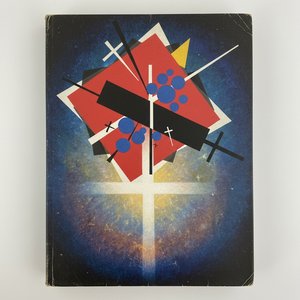
1916. Collage.

§ 1카탈로그 정보


§ 2추상
수집품 상세 설명
A dynamic collage of overlapping red, blue, and yellow rectangles and black lines that creates a rhythmic sense of movement on paper.
 더 보기
작가 프로필
러시아 아방가르드의 선구자 올가 로자노바(1886-1918)를 만나보세요. 절대주의, 입체미래주의, 네오프리미티비즘을 생동감 넘치는 추상 예술로 완벽하게 결합한 그녀의 영향력 있는 '색채 회화' 스타일과 유산을 탐구해보세요.
§ 3해설
Identification of Non-objective Composition
The gaze meets Non-objective Composition, a work that exists as a collage on paper. Created by the artist Olga Rozanova, this piece emerges from the year 1916. It presents a world where the physical boundaries of the medium begin to shift, inviting a sense of wonder at how simple materials can suggest such complex, rhythmic movement.
In this specific arrangement, Olga Rozanova moves away from the recognizable world. The paper holds layers of shapes that seem to float and intersect, creating a tension between the flat surface and a perceived depth. It is a moment of pure abstraction, where the artist's hand is felt through the careful placement of geometric forms and the interplay of color.
Visual Elements and Compositional Structure
A large yellow rectangle anchors the center of the space, acting as a steady focal point amidst a shifting field of geometry. Around this central weight, smaller rectangles in red, blue, and purple drift through the composition. These shapes do not sit still; they suggest a rhythmic movement, as if caught in a moment of sudden, silent transit. The arrangement creates a complex structure, a pattern of intersecting energies that defines the very essence of Suprematist thought.
Diagonal lines in black and white cut through the arrangement, slicing across the colored forms to add a sense of dynamism. These sharp intersections disrupt the stillness, creating a tension between the solid blocks of color and the fleeting paths of the lines. The composition relies on simple, non-representational shapes, including arcs and rectangles, to build its internal logic. This interplay of elementary forms builds a sense of depth and perspective, blurring the line between a flat surface and a three-dimensional space.
Technique and Material Application
The work exists as a collage on paper, a choice that immediately disrupts the traditional expectations of a flat canvas. Through this method, the artist engages in a textural play between translucency and opacity, allowing light and layers to interact in unexpected ways. One moment, a shape appears solid and heavy; the next, it seems to drift with a ghostly, see-through quality. This tension creates a sense of depth that defies the physical limitations of the paper itself.
As the eye moves across the surface, the boundaries between a two-dimensional illusion and a three-dimensional surface begin to blur. The arrangement of elements is not dictated by a recognizable scene, but is instead organized by the visual weight and the specific relationship of color. Shapes seem to float or collide, held in place by an invisible equilibrium of hue and form. This structural logic relies entirely on how the colors pull against one another, creating a rhythmic movement that feels both spontaneous and carefully measured.
Artistic Context and Movement
The canvas breathes within the radical atmosphere of Suprematism, a movement that seeks to strip away the distractions of the material world. Here, the artist moves beyond the recognizable, trading the familiar shapes of life for a language of pure feeling. This work emerges from a period of intense experimentation in the early 20th century, where the boundaries of what a painting can represent are being pushed to their absolute limits. It exists at a threshold, acting as a precursor to the painterly abstractions that will define much of the coming century.
The composition pulses with a tension between sharp angles and bold colors. These geometric elements do not merely sit upon the surface; they interact to create a sense of rhythm and movement. By utilizing simple, non-representational shapes like arcs and rectangles, the work participates in a larger search for a "zero point" of painting. This pursuit of spiritual geometry aims to connect the viewer directly to an inner experience, bypassing rational thought through the sheer power of color and form.
Historical Significance and Influence
This work acts as a vital bridge, pointing toward the profound abstractions that would later define the era. By incorporating simple, non-representational shapes like arcs and rectangles, the piece offers a glimpse into the evolution of the Russian avant-garde. It helps shift the movement toward the aesthetic stance of Suprematism, moving away from the recognizable world and toward a new visual language. The way these elementary, overlapping forms interact suggests a departure from traditional representation, signaling a shift in how space and color might function on a surface.
The influence of these geometric arrangements reaches into the very core of early 20th-century abstraction. The incorporation of such simple shapes serves as an inspiration for the turn toward non-objective abstraction seen in 1915. This piece functions as a precursor to later painterly abstractions, marking a moment where the boundaries between two-dimensional illusion and a non-representational surface begin to blur. It captures a transition where the focus moves from the object itself to the pure relationship between color and form.
질의응답
"Non-objective Composition"은(는) 올가 로자노바의 평소 작업 세계를 잘 보여주는 작품인가요?
"Non-objective Composition"은(는) yellow rectangle, red rectangle, blue rectangle, purple shape, black lines, white lines, light background을(를) 묘사하고 있는 반면, 올가 로자노바의 기존 주제들은 cubo-futurism and futurism, suprematism and pure abstraction, russian avant-garde movement, shift to non-objective art, precursor to color painting입니다. 이 두 가지를 비교해 보면 해당 작품이 작가의 통상적인 소재와 어떻게 연관되는지 알 수 있습니다.
올가 로자노바의 "Non-objective Composition"은 밝은 느낌의 작품인가요, 아니면 어두운 느낌의 작품인가요?
올가 로자노바의 "Non-objective Composition"의 측정된 수치는 다음과 같습니다: 밝기 brilliant, 휘도 Bright Balance.
"Non-objective Composition"의 작가와 제작 연도는 어떻게 되나요?
"Non-objective Composition"의 작가는 올가 로자노바이며, 제작 연도는 1916년입니다.


 프린트 판매로 전환


 가로 또는 세로 중 어느 한 면이라도 105cm(약 41인치)를 초과하는 작품이나 복제화의 경우, 프레임은 분해된 키트 형태로 배송됩니다. 이는 안전한 배송을 보장하고 운송 중 발생할 수 있는 손상을 방지하기 위함입니다.