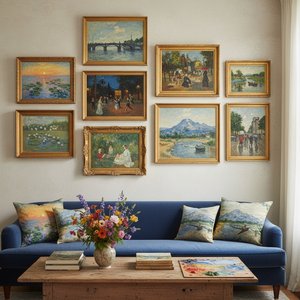
Oil On Canvas.

§ 1Catalogue data

§ 2Abstract
컬렉션 상세 정보
This JSON response fulfills your request for a concise meta description optimized for SEO, incorporating key information about the artwork and platform.
 상세 보기
상세 보기
작가 소개
세잔(1839-1906): 인상주의와 입체주의를 잇는 거장! 정물, 풍경화, 목욕하는 사람들 연작 등 기하학적 형태와 색채의 혁신을 통해 현대 미술에 지대한 영향을 미쳤습니다. #세잔 #후기인상파
§ 3Commentary
A Vision of Tranquility: Exploring Cézanne’s “River in the Plain”
Paul Cézanne's "River in the Plain," painted in 1868, stands as a cornerstone of Post-Impressionism—a movement that sought to transcend mere optical representation and delve into the artist’s subjective experience. More than just a depiction of a rural landscape, it embodies Cézanne’s revolutionary approach to capturing the essence of nature, foreshadowing the stylistic innovations of Cubism and cementing his place as one of the most influential figures in modern art history.Composition and Perspective: Simplifying Reality
The painting's deceptively simple composition immediately draws the viewer’s eye towards the meandering river that dominates the central space. Cézanne eschews traditional linear perspective, opting instead for a technique characterized by overlapping planes and flattened forms—a deliberate rejection of Impressionistic illusionism. The horizontal format emphasizes stability, while the trees lining both banks create a sense of enclosure and depth, guiding the gaze into the distant hills which contribute subtly to the overall spatial illusion. A barely perceptible path winds along the riverbank, inviting contemplation and reinforcing the feeling of serene observation.Color Palette and Brushwork: Capturing Atmosphere
Dominating the color palette is a muted tonal scheme—primarily cool greens, grays, and blues—infused with earthy browns and delicate hints of orange. Cézanne’s masterful use of brushstrokes isn't concerned with precise blending but rather with conveying texture and capturing the atmospheric conditions of an overcast day. Loose, expressive strokes build up layers of pigment to sculpt form and imbue the canvas with a palpable sense of immediacy and spontaneity. The sky is rendered in shades of gray punctuated by pale pink hues—a deliberate choice that underscores the painting’s contemplative mood.Technique: Building Form Through Texture
Cézanne's technique involved applying paint in short, visible strokes – a method he honed throughout his career. These brushstrokes aren’t merely decorative; they are fundamental to Cézanne’s artistic vision. He meticulously builds up layers of color and texture to create form and volume—a process that departs radically from the smooth surfaces favored by Impressionists. The surface of the river is particularly noteworthy, where broken lines mimic reflections, further enhancing the illusion of depth and movement. This deliberate disregard for conventional painting methods reflects Cézanne’s belief in representing nature not as it appears to the eye but as it feels—a profound shift toward abstraction that would reshape artistic expression.Symbolic Resonance: Tranquility and Observation
“River in the Plain” transcends its visual beauty, evoking a powerful sense of tranquility and quiet contemplation. The overcast sky serves as a backdrop for Cézanne’s exploration of perception and emotion, suggesting a mood of introspection and stillness. More than just a landscape scene, it represents an artist's attempt to distill the complexities of experience into simplified forms—a testament to Cézanne’s enduring legacy as a pioneer of modern art.질의응답
"River in the plain"에서 가장 돋보이는 색상은 무엇인가요?
"River in the plain"에서 가장 돋보이는 색상은 Rosy Brown (#b3ab9a)입니다. 작품의 주된 색상은 인테리어와 작품을 조화롭게 매치할 때 유용합니다.
"River in the plain"은(는) 세잔의 예술 활동기 중 어느 시기에 해당하나요?
세잔의 작품 활동 중 "River in the plain"은(는) Mature Period 시기에 해당합니다. 이 시기는 작가의 다른 작품들과 비교해 보는 데 도움이 됩니다.
"River in the plain"을(를) 더 자세히 살펴볼 수 있을까요?
세잔의 "River in the plain"의 X-Ray 뷰는 작품의 X선 분석 페이지에서 확인하실 수 있습니다. 이 페이지에서는 11개의 광학 레이어를 통해 이미지를 인터랙티브하게 살펴볼 수 있습니다.


 프린트 판매로 전환


 가로 또는 세로 중 어느 한 면이라도 105cm(약 41인치)를 초과하는 작품이나 복제화의 경우, 프레임은 분해된 키트 형태로 배송됩니다. 이는 안전한 배송을 보장하고 운송 중 발생할 수 있는 손상을 방지하기 위함입니다.