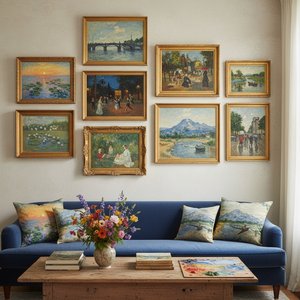
Acrylic On Canvas.

§ 1카탈로그 정보

§ 2추상
수집품 상세 설명
 더 보기
더 보기
작가 프로필
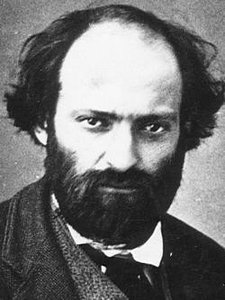
세잔(1839-1906): 인상주의와 입체주의를 잇는 거장! 정물, 풍경화, 목욕하는 사람들 연작 등 기하학적 형태와 색채의 혁신을 통해 현대 미술에 지대한 영향을 미쳤습니다. #세잔 #후기인상파
§ 3해설
A Pioneer of Modern Vision: Exploring Cézanne’s “Untitled (1610)”
Paul Cézanne, born in Aix-en-Provence in 1839, represents a pivotal moment in artistic history – the decisive step away from Impressionism's fleeting sensations and toward Cubism’s fractured perspectives. His career wasn’t marked by immediate recognition; instead, it unfolded as a deliberate process of artistic discovery, punctuated by periods of introspection and critical skepticism that ultimately yielded an enduring legacy reshaping modern art itself. Raised in a family enjoying considerable financial stability, Cézanne benefited from privileges uncommon for aspiring artists, affording him the freedom to pursue his passion without the pressures of commercial considerations. Despite initial inclinations toward law encouraged by his father’s ambitions, Cézanne remained captivated by the transformative power of painting and abandoned legal studies to dedicate himself entirely to this vocation. Early influences included Romanticism—particularly the monumental murals he undertook in the Jas de Bouffan country house—and Realism, grounding him in observation of the natural world. However, it was through these foundational experiences that Cézanne began to forge his own distinctive path.The Landscape as Meditation
“Untitled (1610)” exemplifies Cézanne’s revolutionary approach to landscape painting. Unlike Impressionists who sought to capture the ephemeral effects of light and atmosphere, Cézanne aimed for something deeper – a distillation of essence. The photograph reveals a serene mountainous vista bathed in diffused sunlight, punctuated by a modest field at its base. Scattered trees contribute to the composition, their placement subtly guiding the viewer’s gaze upwards toward the dominant feature: a towering mountain range crowned with snow-capped peaks piercing through the clouds. This isn't merely a depiction of scenery; it’s an embodiment of Cézanne’s belief that nature possesses an inherent stability and permanence beyond what is immediately perceptible.Technique and Innovation: Cézanne’s Geometric Approach
Cézanne’s technique distinguishes him from his contemporaries. He eschewed the blending brushstrokes favored by Impressionists, opting instead for deliberate, angular marks that suggest underlying geometric forms. These forms—cylinders, cones, cubes—are not rendered realistically but rather serve as structural anchors within the painting, creating a sense of solidity and depth. The artist meticulously built up layers of paint, applying thick impasto – heavily textured surface – to convey volume and texture. This technique wasn’t simply about visual accuracy; it was about conveying Cézanne's intellectual understanding of how objects exist in three dimensions.Symbolism Beyond Representation
While Cézanne deliberately avoided overtly symbolic imagery, his work resonates with profound philosophical ideas. The mountain range itself symbolizes resilience and permanence—a counterpoint to the fleeting beauty captured by Impressionists. Furthermore, Cézanne’s simplified forms can be interpreted as representing a quest for underlying order amidst apparent chaos. He sought to capture not just what he saw but also what he *felt*, conveying an emotional response to the grandeur of nature that transcends mere visual description.A Legacy Enduring Influence
“Untitled (1610)” stands as a testament to Cézanne’s transformative impact on subsequent generations of artists. His pioneering use of geometric abstraction paved the way for Cubism and Surrealism, fundamentally altering artistic conventions. Today, reproductions of this artwork continue to inspire designers and collectors alike, offering a glimpse into Cézanne's visionary approach to art – an enduring reminder that true beauty lies not in capturing fleeting impressions but in revealing the underlying structure of reality.질의응답
세잔의 "untitled (1610)"의 수작업 복제화를 판매하는 곳이 어디인가요?
세잔의 "untitled (1610)"의 수작업 복제화는 주문 제작 방식으로 수작업 유화 복제화 페이지에서 직접 주문하실 수 있습니다: 리넨 캔버스에 손으로 직접 그린 유화 복제화
"untitled (1610)"의 작가는 누구이며, 어떤 화풍인가요?
세잔은(는) Post-Impressionism 운동의 흐름 속에서 "untitled (1610)"을(를) 제작했습니다.
"untitled (1610)"은(는) 무엇을 묘사하고 있으며, 어떤 분위기를 풍기나요?
세잔의 "untitled (1610)"은(는) Serene한 분위기 속에서 landscape, mountains, sky, trees, field, snowcapped peaks, atmospheric perspective을(를) 묘사합니다. 작품의 주제와 분위기가 어우러져 하나의 완성된 세계를 보여줍니다.


 프린트 판매로 전환


 가로 또는 세로 중 어느 한 면이라도 105cm(약 41인치)를 초과하는 작품이나 복제화의 경우, 프레임은 분해된 키트 형태로 배송됩니다. 이는 안전한 배송을 보장하고 운송 중 발생할 수 있는 손상을 방지하기 위함입니다.