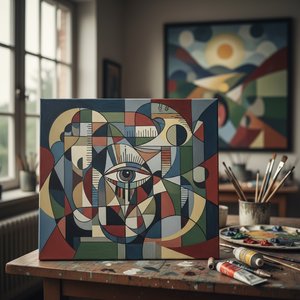
Acrylic On Canvas.

§ 1카탈로그 정보


§ 2추상
수집품 상세 설명
Explore "Jumper" by Paul Klee: a vibrant abstract masterpiece featuring dynamic figures and bold colors. A captivating example of Klee's unique style, blending Expressionism, Cubism & Surrealism.
 더 보기
더 보기
작가 프로필
파울 클레는 표현주의와 쿠비즘 등 다양한 예술 사조에 영향을 받은 스위스 화가로, 독특한 색채 이론과 음악적 감성을 담은 작품들로 미술사에 영감을 불어넣었습니다. 그의 대표작은 아름다운 정원 풍경화와 기발한 상징으로 가득 찬 그림들이며, 현대 미술의 아이콘으로 기억됩니다.
§ 3해설
A Dance of Form and Color: Unveiling Paul Klee’s “Jumper”
Paul Klee's "Jumper" is not merely a painting; it’s an invitation into a world where playful abstraction meets profound emotional resonance. The artwork immediately draws the eye to a central figure, seemingly caught in a moment of joyous liberation – a leap, a dance, or perhaps a symbolic jump towards the unknown. Arms outstretched, this solitary form becomes a focal point within a vibrant tapestry of color and shape. Klee doesn’t offer us realistic representation; instead, he presents an emotional landscape rendered through geometric forms and a strikingly bold palette. The dominant red circle in the background isn't simply a compositional element but acts as a dynamic force, radiating energy and perhaps symbolizing passion or even a contained intensity that contrasts with the figure’s outward expression. Scattered around this central motif are smaller figures, hinting at community, interaction, or the complexities of human existence within a larger framework. They aren’t merely background details; they contribute to the painting's overall sense of depth and narrative ambiguity.Klee’s Artistic Journey: From Munich to Modernism
To understand “Jumper,” one must consider Paul Klee’s remarkable artistic evolution. Born in 1879 in Münchenbuchsee, Switzerland, to a musical family, Klee was steeped in creativity from an early age. Initially drawn to drawing, he quickly moved beyond representational art, seeking instead to express inner feelings and spiritual concepts through form and color. His studies at the Academy of Fine Arts in Munich laid a foundation, but it was his experiences – particularly a pivotal journey to Tunisia in 1914 – that truly ignited his artistic vision. The intense light and vibrant hues of North Africa profoundly impacted his use of color, pushing him towards bolder palettes and more abstract compositions. Klee wasn’t confined by any single movement; he absorbed influences from Art Nouveau, Symbolism, Expressionism, Cubism, and Surrealism, synthesizing them into a uniquely personal style. He became deeply involved with the Bauhaus school, where he taught painting and explored theories of color and form – ideas that are clearly visible in the harmonious yet unconventional arrangements within “Jumper”.Decoding the Symbols: A Language of Shapes and Hues
Klee’s art is often described as a visual poetry, rich with symbolism open to interpretation. In "Jumper," the very act of leaping can be seen as a metaphor for aspiration, freedom, or even spiritual transcendence. The smaller figures surrounding the central form might represent societal constraints, personal relationships, or simply the multitude of forces that shape an individual’s journey. Klee's use of color is equally significant. Red, often associated with energy and passion, dominates the background, while other hues create a sense of balance and harmony. He wasn’t interested in mimicking nature; he sought to evoke emotions through color, believing that each shade possessed its own inherent spiritual quality. The geometric shapes – circles, squares, and lines – aren't arbitrary either. They represent Klee’s attempt to reduce the world to its essential forms, revealing underlying structures and patterns.“Jumper” as a Reflection of the Human Condition
Ultimately, “Jumper” is a powerful meditation on the human condition. It speaks to our innate desire for freedom, our search for meaning, and our complex relationship with the world around us. The painting’s ambiguity invites viewers to project their own emotions and experiences onto the canvas, creating a deeply personal connection with the artwork. Its enduring appeal lies in its ability to transcend cultural boundaries and speak to universal themes of hope, resilience, and the joy of being alive. For those seeking an artwork that is both visually stimulating and emotionally resonant, “Jumper” offers a captivating glimpse into the mind of one of the 20th century’s most innovative artists – a piece destined to inspire contemplation and conversation for generations to come.질의응답
폴 클레의 "Jumper"과(와) 비슷한 느낌의 작품을 어떻게 찾을 수 있나요?
"Jumper"와 유사한 작품들은 해당 작품의 유사한 작품들 페이지에서 확인하실 수 있습니다.
"Jumper"의 화풍은 작가가 활동했던 시대와 어떤 연관이 있나요?
폴 클레의 "Jumper"은(는) 작가의 근대 미술 시대 중 Art Nouveau 사조에 속합니다.
"Jumper"은(는) 폴 클레의 예술적 발전 단계 중 어느 시기를 나타냅니까?
폴 클레의 작품 세계에서 "Jumper"은(는) Mature Period 시기의 작품입니다. 이 시기는 작가의 다른 작품들과 비교해 보는 데 유용한 지표가 됩니다.


 프린트 판매로 전환


 가로 또는 세로 중 어느 한 면이라도 105cm(약 41인치)를 초과하는 작품이나 복제화의 경우, 프레임은 분해된 키트 형태로 배송됩니다. 이는 안전한 배송을 보장하고 운송 중 발생할 수 있는 손상을 방지하기 위함입니다.