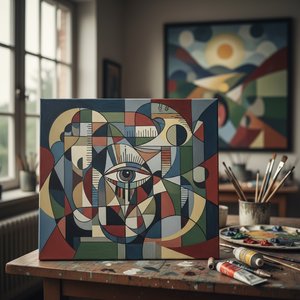
1937. 캔버스 위 아크릴 물감, 121.0 x 110.0 cm. Kunsthaus Zürich.

§ 1카탈로그 정보

- 121.0 x 110.0 cm


§ 2추상
수집품 상세 설명
Discover Paul Klee (1879-1940): Swiss-German artist blending Expressionism, Cubism & Surrealism. Explore his color theory, Bauhaus influence, and playfully insightful art.
 더 보기
더 보기
작가 프로필
파울 클레는 표현주의와 쿠비즘 등 다양한 예술 사조에 영향을 받은 스위스 화가로, 독특한 색채 이론과 음악적 감성을 담은 작품들로 미술사에 영감을 불어넣었습니다. 그의 대표작은 아름다운 정원 풍경화와 기발한 상징으로 가득 찬 그림들이며, 현대 미술의 아이콘으로 기억됩니다.
§ 3해설
Paul Klee’s ‘Super-Chess’: A Geometric Dance of Power and Victory
Paul Klee’s first ‘square pictures’ emerged during his formative years as an instructor at the Bauhaus in Weimar and Dessau—a pivotal moment that irrevocably shaped his artistic trajectory. Among his most striking compositions, ‘Super-Chess,’ created in 1937, stands out as a monumental testament to abstract geometric exploration and imbued with subtle layers of symbolic meaning. This large square painting isn’t merely a depiction of chess; it's an ambitious meditation on dominance, conflict, and the triumph of intellect over instinct—themes that resonate powerfully within its deceptively simple visual language.Composition and Structure: Order Amidst Chaos
The artwork utilizes a masterful square format as its foundational element, establishing a rigid grid structure that governs the arrangement of its constituent parts. This deliberate choice reflects Klee’s fascination with order and precision, yet simultaneously juxtaposes it against the inherent dynamism of abstract art. Vertical columns punctuate the grid, drawing the eye upwards towards the central focal point—the scarlet ‘super-king,’ positioned prominently on the right side of the canvas. The careful positioning of these columns contributes to a sense of visual tension, mirroring the strategic maneuvering inherent in the game it represents.Color Palette and Texture: Monochrome Harmony with Vibrant Contrast
The color palette is remarkably restrained, primarily consisting of black, white, grey, red, blue, and pink—a deliberate selection that underscores Klee’s commitment to tonal exploration. The dominant monochrome checkerboard provides a neutral backdrop against which the bolder hues – particularly the crimson ‘super-king’ and the azure columns – erupt with arresting vibrancy. Subtle variations in color intensity within the grid squares introduce a delicate textural element, hinting at depth without abandoning the overall flatness characteristic of Klee's aesthetic. This understated texture adds to the artwork’s visual richness and invites contemplation.Style and Technique: Bauhaus Influence and Geometric Abstraction
‘Super-Chess’ exemplifies Klee’s signature abstract style—a hallmark of his Bauhaus period—characterized by geometric forms, simplified shapes, and a playful manipulation of color. Executed on burlap canvas using oil paint, visible brushstrokes contribute to the artwork's tactile quality, conveying a sense of spontaneity and immediacy despite its meticulously planned composition. The influence of Bauhaus principles is palpable in the artwork’s emphasis on functional design and reductive visual language—a stylistic decision that aligns perfectly with Klee’s broader artistic vision.Historical Context and Symbolism: Fascist Echoes and Triumph Over Adversity
Created during a period fraught with political upheaval – namely, the ascendancy of Nazi Germany – ‘Super-Chess’ has been interpreted as bearing subtle references to the totalitarian ferment of the late 1930s. The artwork's depiction of a king defeating his opponent’s pieces can be seen as an allegory for overcoming obstacles and asserting control—a motif that resonates deeply within Klee’s personal worldview. As early as 1933, the regime forced Klee to abandon his teaching post, prompting him to relocate to Bern, marking a significant turning point in his artistic life. The confiscation of over one hundred works by German museums solidified the Nazi’s disdain for Klee's art—a testament to its uncompromising intellectual integrity and refusal to conform to prevailing aesthetic conventions.Conclusion: An Enduring Legacy of Geometric Elegance
‘Super-Chess,’ therefore, transcends mere visual representation; it embodies a profound exploration of artistic principles and philosophical ideas. Its enduring appeal lies in its ability to convey complex concepts—power dynamics, conflict resolution, and ultimately, the triumph of intellect—through deceptively simple geometric forms and harmonious color combinations. It remains a captivating exemplar of Paul Klee’s groundbreaking contribution to abstract art, securing his place as one of the most influential figures of the twentieth century.질의응답
폴 클레의 "Super-Chess"은(는) 언제 제작되었나요?
폴 클레의 "Super-Chess"은(는) 1937년에 제작되었습니다.
"Super-Chess"은(는) Abstract 사조를 대표하는 유명한 작품인가요?
폴 클레의 "Super-Chess"은(는) 인지도 있음 수준의 인지도를 지닌 Abstract 사조의 작품입니다.
"Super-Chess"은(는) 어떤 화풍에 속하나요?
"Super-Chess"은(는) Abstract 양식의 작품입니다. 이 사조는 해당 작품이 속한 예술적 전통을 나타냅니다.


 프린트 판매로 전환


 가로 또는 세로 중 어느 한 면이라도 105cm(약 41인치)를 초과하는 작품이나 복제화의 경우, 프레임은 분해된 키트 형태로 배송됩니다. 이는 안전한 배송을 보장하고 운송 중 발생할 수 있는 손상을 방지하기 위함입니다.