

.

§ 1카탈로그 정보
§ 2추상
작가 프로필
Discover Simon de Vlieger’s stunning marine paintings! Dutch artist known for realistic ship depictions & dramatic seascapes from the 17th century.
.
Discover Simon de Vlieger’s stunning marine paintings! Dutch artist known for realistic ship depictions & dramatic seascapes from the 17th century.
1601 - 1653
Born in Rotterdam around 1601, Simon Jacobsz. de Vlieger emerged as a pivotal figure in the burgeoning world of Dutch maritime painting during the 17th century. His life was marked by a constant relocation – initially residing in his birthplace, then moving to Delft and finally settling in Amsterdam and Weesp – reflecting the dynamic shifts within the artistic landscape of the Netherlands. De Vlieger’s career spanned nearly half a century, culminating in his death in Weesp in 1653, leaving behind a legacy profoundly influencing subsequent generations of maritime artists.
Early influences on de Vlieger's work were deeply rooted in the style of Jan Porcellis, a contemporary known for his monochrome depictions of ships at sea. However, unlike Porcellis’s restrained palette and simplified forms, de Vlieger embraced a more vibrant and realistic approach to color. He meticulously rendered the intricate details of ship rigging, hull construction, and the tumultuous conditions of the ocean – elements that would become hallmarks of his distinctive style. This shift represented a significant departure from the prevailing artistic trends, paving the way for a new era in Dutch marine painting.
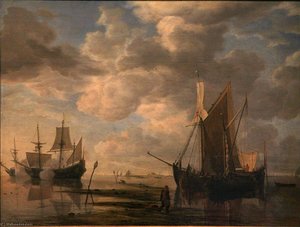
De Vlieger’s oeuvre encompassed a remarkably diverse range of subjects. He skillfully captured both dramatic scenes of storms and shipwrecks – often rendered with an almost violent energy – and more tranquil depictions of ships in harbor or engaged in everyday activities. His ability to convey the power of nature, combined with his meticulous attention to detail, resulted in paintings that were not only visually stunning but also imbued with a sense of realism and immediacy. He wasn’t simply painting ships; he was capturing the essence of maritime life, the challenges faced by sailors, and the beauty of the open sea.
Beyond his contributions to marine art, de Vlieger demonstrated versatility as a designer. He created tapestries depicting historical events, designed intricate etchings, and even contributed to the decoration of sacred spaces, including stained glass windows for the Nieuwe Kerk in Amsterdam and an organ screen for the St. Laurenskerk in Rotterdam. This multifaceted talent underscores his position as a respected artist within the broader artistic community.
De Vlieger’s impact on the development of Dutch maritime painting is undeniable. He moved away from the monochrome style favored by earlier artists like Jan Porcellis and Willem van de Velde the Elder, introducing a more nuanced use of color and a heightened level of realism. His detailed depictions of rigging and ship construction served as a model for subsequent generations of painters, including his own pupils: Willem van de Velde the Younger, Adriaen van de Velde, and Jan van de Cappelle. Jan van der Cappelle, in fact, amassed an impressive collection of over 1300 prints by de Vlieger, highlighting the artist’s considerable popularity during his lifetime.
One particularly noteworthy example of de Vlieger's work is a painting depicting a fisherman dragging nets to shore, which was later acquired by Joanna Six, wife of Simon van der Stel, and eventually found its way to Groot Constantia in the Cape of Good Hope. This journey across continents demonstrates the far-reaching influence of his art and its appreciation even in distant lands. His work wasn’t merely admired; it was actively sought after and displayed as a testament to Dutch artistic excellence.
A landscape painting demonstrating his ability to integrate maritime elements into broader compositions.
Simon de Vlieger's legacy endures as one of the most important and influential figures in Dutch maritime art. His innovative approach to color, his meticulous attention to detail, and his ability to capture both the drama and serenity of the sea continue to inspire artists today.

AllPaintingsStore.com, “Simon Jacobsz De Vlieger, Forest”, https://allpaintingsstore.com/ko/art/simon-jacobsz-de-vlieger-forest-AQQTHL-en/ (접속일 6 10월 2026).
작가가 직접 캔버스에 손으로 그린 유화 작품으로, 원하는 크기와 액자로 맞춤 제작해 드립니다. ( 프린트 판매로 전환 디지털 이미지로 전환)
주문서 여백에 명시되어 있으며, 해당 주문서의 현재 상태는 다음과 같습니다.
Forest
복제본 크기
더욱 세밀한 묘사와 정교함, 그리고 충분한 제작 시간
-
가로 또는 세로 중 어느 한 면이라도 105cm(약 41인치)를 초과하는 작품이나 복제화의 경우, 프레임은 분해된 키트 형태로 배송됩니다. 이는 안전한 배송을 보장하고 운송 중 발생할 수 있는 손상을 방지하기 위함입니다.
전문가 조립 권장 - 본 제품은 DIY용이 아닙니다.
해당 키트는 숙련된 전문 프레임 제작자가 목공용 풀(별도 구매), 캔버스 스트레칭 플라이어 및 풀이 마르는 동안 나무 틀의 수평을 유지할 클램프를 사용하여 캔버스를 팽팽하게 고정하고 조립해야 합니다. 잘못된 조립이나 불균형한 캔버스 장력은 작품에 영구적인 손상을 입힐 수 있으며, 이로 인한 손상은 보증 범위에 포함되지 않습니다.
모든 원목 부재가 포함되어 있으며, 조립에 딱 맞게 정밀하게 재단되었습니다.
제공된 나사와 함께, 별도로 준비해야 하는 모서리 접합부용 목공용 풀을 사용하여 조립합니다. (목공용 풀은 포함되어 있지 않으므로 제작자께서 직접 준비해 주셔야 합니다.)
전문가용 도구가 필요하며 키트에 포함되어 있지 않습니다: 캔버스 스트레칭 플라이어(텐셔너)와 접착제가 마르는 동안 나무 틀의 수평을 유지하기 위한 클램프가 필요합니다.
주의사항:
모서리 접합부에는 목공용 풀이 필요하며, 풀이 완전히 마를 때까지 클램프로 바(bar)를 고정해야 합니다. 또한 조립된 프레임에 캔버스를 팽팽하게 당기려면 캔버스 스트레칭 플라이어가 필요합니다. 이 제품들 중 어느 것도 키트에 포함되어 있지 않습니다. 이 사이즈를 주문하시기 전에 숙련된 전문 액자 제작업체를 미리 섭외하시기 바랍니다.
-
유광 바니시(색감을 선명하게 하며 빛과 습기로부터 보호함)
변경 가능한 예시: 얼굴을 고객의 사진으로 교체, 반려동물 추가(예: 고양이를 강아지로 변경), 배경에 숨겨진 메시지 삽입, 배경 풍경 또는 요소 변경.
전 세계 배송()은 기존 5주의 표준 기간 대신 3~4주 내에 완료됩니다. (3 11월). 품질에는 어떠한 타협도 하지 않습니다.
전 세계 배송(): 약 5주 소요 (10 11월).
모든 주문에 포함되는 혜택
 더 보기
더 보기


 가로 또는 세로 중 어느 한 면이라도 105cm(약 41인치)를 초과하는 작품이나 복제화의 경우, 프레임은 분해된 키트 형태로 배송됩니다. 이는 안전한 배송을 보장하고 운송 중 발생할 수 있는 손상을 방지하기 위함입니다.


