작가 소개
Suzuki Kiitsu: A Master of Refined Beauty in the Rinpa School
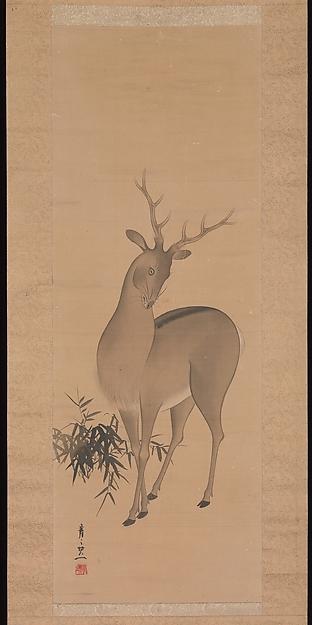
Suzuki Kiitsu (1796-1858) stands as a compelling figure within the Japanese art world, a painter whose legacy has undergone a remarkable resurgence in recent decades. Born in Tokyo during the late Edo period, his life’s work is inextricably linked to the Rinpa school of painting – a movement renowned for its emphasis on meticulous detail, illusionistic space, and a refined aesthetic rooted in Chinese landscape traditions. Initially considered a somewhat peripheral member of this influential group, Kiitsu's talent has been increasingly recognized, culminating in significant exhibitions in Tokyo, Hyogo, and Kyoto between 2016 and 2017, firmly establishing his place as a master of the Edo Rinpa style. His most celebrated achievements lie in his breathtaking folding screens – *byōbu* – which he often reimagined from the works of his predecessors, demonstrating both deep respect for tradition and a distinctive creative voice.
The Foundations of a Painter: Training and Influences
Kiitsu’s artistic journey began under the tutelage of Sakai Hoitsu (1761–1828), a pivotal figure in the Rinpa school and considered by many to be its most important successor. This formative period instilled within Kiitsu a profound understanding of Rinpa's core principles: the meticulous rendering of textures, the use of layered colors to create depth and luminosity, and an appreciation for the beauty of nature. However, unlike Hoitsu, who was known for his grand, sweeping landscapes, Kiitsu’s style leaned towards a more intimate and refined approach. He absorbed the techniques of other masters within the school, including Tawaraya Sōtatsu (c. 1570 – c. 1640), renowned for his dynamic compositions, and Ogata Kōrin (1658–1716), celebrated for his vibrant depictions of flowers and birds. Notably, Kiitsu’s training wasn't solely through formal instruction; he actively sought to learn from and emulate the works of these established artists, developing a distinctive style that blended their influences while retaining his own artistic identity. This dedication to studying and interpreting the work of others is a hallmark of the Rinpa school and profoundly shaped Kiitsu’s creative process.
The Art of the *Byōbu*: Masterpieces of Illusion
Kiitsu's true mastery lies in his creation of *byōbu* folding screens – elaborate, multi-panel artworks designed to be displayed in aristocratic interiors. These screens were not merely decorative objects; they represented a sophisticated form of art that combined painting, lacquerwork, and gold leaf. Kiitsu’s *byōbu* are particularly renowned for their illusionistic depth and the subtle interplay of color and texture. His “Morning Glories” (1801) and “Mountain Stream in Summer and Autumn” (circa 1832-1836) stand as prime examples, showcasing his ability to create a sense of three-dimensional space on a two-dimensional surface. The "Mountain Stream" pair, measuring an impressive 165.8 by 363.2 centimeters, depicts a serene landscape with flowing streams, cypress groves, lilies, and a cherry tree laden with autumn leaves. The screens are described as possessing “somehow strangely unreal” qualities, evoking a feeling of hyperrealism through the meticulous rendering of details and the masterful use of color. The rhythmic feel of the motifs and the brilliance of the blues and greens against the gold ground, particularly evident in works inspired by Ogata Kōrin’s *Irises*, further demonstrate Kiitsu's technical skill and his ability to capture the essence of nature with remarkable precision.
A Legacy of Pupils and a Distinct School
Despite not being formally recognized as Hoitsu’s direct successor, Suzuki Kiitsu exerted considerable influence on subsequent generations of Edo Rinpa artists. He acted as a mentor, training many young painters who went on to establish their own distinct styles within the school. This informal apprenticeship system led to the development of what is sometimes referred to as the “Kiitsu School of Edo Rinpa,” characterized by its refined aesthetic and meticulous attention to detail. Kiitsu’s emphasis on studying and reinterpreting the works of his predecessors, combined with his own creative vision, created a unique artistic lineage that continued long after his death in 1858. His work continues to be studied and admired for its technical brilliance, its evocative depiction of nature, and its enduring contribution to Japanese art history.
Notable Works and Lasting Significance
Among Kiitsu’s most celebrated works are the “Wind God and Thunder God” (紙本金地著色風神雷神図), a pair of silk sliding doors depicting the deities Raijin and Fujin, and his stunning “Morning Glories.” The "Wind God and Thunder God" stands out due to its innovative use of eight sliding doors, departing from the traditional two-screen format. These works are now housed in prestigious collections such as the Nezu Museum in Tokyo, where they are occasionally exhibited, offering visitors a rare opportunity to appreciate the artistry of this often-overlooked master. Suzuki Kiitsu’s legacy extends beyond his individual creations; he represents a pivotal moment in the evolution of the Rinpa school, demonstrating its capacity for innovation and artistic growth while upholding its core principles of beauty, precision, and reverence for nature.




 프린트 판매로 전환
 상세 보기
상세 보기


 가로 또는 세로 중 어느 한 면이라도 105cm(약 41인치)를 초과하는 작품이나 복제화의 경우, 프레임은 분해된 키트 형태로 배송됩니다. 이는 안전한 배송을 보장하고 운송 중 발생할 수 있는 손상을 방지하기 위함입니다.


