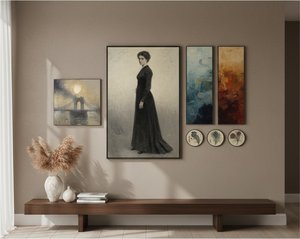
1841. Acrylic On Canvas. Royal College of Physicians of London.

§ 1카탈로그 정보


§ 2추상
수집품 상세 설명
Admire "James Hope" by Thomas Phillips (1841), a captivating portrait of a distinguished gentleman. Explore the artist's masterful technique and historical context within the Royal College of Physicians.
 더 보기
더 보기
작가 프로필
토마스 필립스는 19세기 영국 초상화 및 역사 화가로, 바이런 경을 비롯한 저명인물들의 사실적인 묘사와 로맨틱주의 스타일로 유명합니다. 왕립 아카데미 화가로서 중요한 역할을 했습니다.
§ 3해설
A Portrait of Intellectual Intensity: James Hope by Thomas Phillips
Thomas Phillips’s “James Hope,” painted in 1841, is more than simply a likeness; it's a carefully constructed tableau of Victorian intellect and restrained emotion. The portrait captures James Hope (1801-1841), a prominent English physician and cardiologist, not as a flamboyant figure, but as a man deeply engaged with the complexities of his profession and the world around him. Phillips, a master of the British portrait style, eschews dramatic gestures or overtly expressive features, instead favoring a subtle yet profound exploration of Hope’s inner life.
The painting's composition is remarkably restrained. Hope sits in a simple, dark-toned chair, his gaze fixed directly on the viewer – an act of directness that immediately establishes a connection. His hands, resting calmly on his lap, are rendered with meticulous detail, hinting at both intellectual prowess and a quiet dignity. The background is deliberately muted, almost entirely devoid of distraction, drawing all attention to the subject himself. This deliberate lack of ornamentation speaks volumes about Phillips’s approach: he believed that true character resided not in outward display but in the subtle nuances of expression and demeanor.
The Language of Victorian Portraiture
Phillips was a key figure in the development of Victorian portraiture, a style characterized by its realism, psychological depth, and often, a sense of moral seriousness. He inherited much from his mentor, Benjamin West, but he developed a distinctive approach that prioritized capturing the inner life of his subjects. Unlike earlier portraits which frequently emphasized wealth or social status, Phillips sought to reveal something deeper about the individual’s character – their intellect, their values, and perhaps even their anxieties.
The painting's palette is deliberately subdued, dominated by dark browns, grays, and greens. This somber coloration contributes to the overall sense of introspection and gravitas. The use of light is equally strategic; it highlights Hope’s face and hands, drawing the viewer’s eye to these points of focus while leaving the rest of the composition in shadow. This chiaroscuro effect – the dramatic contrast between light and dark – was a hallmark of Phillips's technique and creates a powerful sense of depth and atmosphere.
Symbolism and Context
“James Hope” must be viewed within the context of 19th-century British society, a period marked by rapid scientific advancement, social reform, and a growing emphasis on education and intellectual pursuits. Hope’s profession as a physician reflected this era's burgeoning interest in science and medicine, and his portrait serves as a testament to the rising status of the medical profession. The serious expression on Hope’s face suggests a man deeply committed to his work, burdened perhaps by the responsibility of caring for others.
Furthermore, the painting can be interpreted through the lens of Victorian moral philosophy. The restrained demeanor and thoughtful gaze reflect the Victorian ideal of self-control and intellectual rigor. Phillips was known for portraying subjects who embodied these values, suggesting that true virtue lay in cultivating one’s mind and resisting impulsive desires.
A Legacy of Psychological Realism
“James Hope” remains a compelling example of Victorian portraiture's ability to capture the complexities of human character. Phillips’s masterful use of light, color, and composition creates an image that is both visually striking and psychologically profound. It’s not merely a representation of a man; it’s a window into his soul – a testament to the enduring power of art to reveal the hidden depths of the human experience. Reproductions of this work offer a valuable opportunity to appreciate Phillips's skill and gain insight into the intellectual currents of Victorian England.
질의응답
"James Hope"의 원작은 어느 박물관에 소장되어 있나요?
토마스 필립스의 "James Hope"은(는) Royal College of Physicians of London, 런던, 영국에 전시되어 있습니다. 박물관 목록은 복제품이 아닌 원작을 기준으로 합니다.
토마스 필립스의 "James Hope"의 프린트 제품은 어디에서 구매할 수 있나요?
"James Hope" 작품은 코튼 캔버스 또는 아카이브용 캔버스지에 인쇄된 파인 아트 프린트를 통해 만나보실 수 있습니다. 주문은 파인 아트 프린트 페이지에서 원하시는 사이즈를 선택하여 진행하실 수 있습니다.
"James Hope"은(는) 몇 년도에, 어떤 사조의 작품인가요?
"James Hope"은(는) 1841년 Victorian Portraiture 사조의 작품으로 제작되었습니다. 제작 연도와 미술 사조는 미술사적 맥락에서 이 작품의 위치를 확고히 해줍니다.


 프린트 판매로 전환


 가로 또는 세로 중 어느 한 면이라도 105cm(약 41인치)를 초과하는 작품이나 복제화의 경우, 프레임은 분해된 키트 형태로 배송됩니다. 이는 안전한 배송을 보장하고 운송 중 발생할 수 있는 손상을 방지하기 위함입니다.