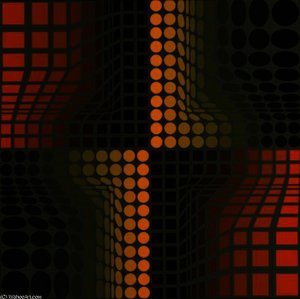
Acrylic On Canvas.

§ 1Catalogue data


본 작품은 저작권법의 보호를 받습니다.
이 페이지에 표시된 작품은 저작권법의 보호를 받으며, 이에 따라 동일한 복제품을 제작하거나 판매하는 것은 법으로 금지되어 있습니다. 이러한 권리 보호는 다음과 같은 국제 협약에 따라 시행됩니다. 베른 협약 또한 다음에서 명시하는 법률을 포함한 국내법에 의해 보호됩니다. 미국 저작권법 제17조.
저희는 존중을 담은 합법적인 대안으로서, 원작에서 영감을 받은 맞춤형 수제 유화 작품을 제공합니다. 저희의 숙련된 전문 화가들은 원작의 스타일, 분위기, 예술적 정수를 면밀히 연구하여, 그 자체로 독창적인 창작물이면서도 원작과 동일한 감동을 불러일으키는 새로운 작품을 만들어냅니다.
이 방식은 저작권 보호를 받는 예술 작품을 복제하거나 그대로 재현하는 것이 아니기에 저작권 규정을 완벽히 준수합니다. 대신, 이는 창의적인 재해석의 과정을 거칩니다. 즉, 원작에서 영감을 받되 원작과 동일하지 않은 새로운 회화 작품을 의미합니다.
 상세 보기
상세 보기§ 2Abstract
컬렉션 상세 정보
Vibrant abstract composition by Victor Vasarely, a key figure in Op Art, showcases dynamic geometric shapes and bold colors – yellow, orange, blue, and purple. Explore this captivating kinetic artwork and bring its visual energy into your space.
작가 소개
옵 아트의 선구자 빅터 바사렐리(1906-1997)를 만나보세요! 기하학적 추상과 착시 현상을 활용한 그의 작품은 현대 미술과 디자인에 큰 영향을 미쳤습니다. 'Zebra'와 같은 대표작 감상하세요.
§ 3Commentary
A Symphony of Geometric Perception: Exploring Victor Vasarely’s ‘Abstract Composition 6’
Victor Vasarely's “Abstract Composition 6” is more than just a colorful painting; it’s an invitation to reconsider the very nature of visual perception. Created by one of the foremost figures in Op Art, this vibrant work embodies the artist’s lifelong fascination with geometry and its impact on how we experience the world. Painted primarily in a dynamic palette of yellows, oranges, blues, and purples, the composition immediately draws the eye into a mesmerizing dance of shapes and patterns – triangles, squares, circles, and more – meticulously arranged to create an illusion of movement and depth. This isn't simply decorative art; it’s a rigorously constructed exploration of optical illusions, reflecting Vasarely’s deep engagement with scientific principles and his desire to translate mathematical concepts into tangible artistic forms.
The Genesis of Op Art: Bauhaus Roots and Kinetic Vision
Born in 1906 in Pécs, Croatia (then part of Austria-Hungary), Vasarely’s artistic trajectory began unexpectedly. Initially pursuing a medical degree, he abandoned this path in 1927 to embrace painting, ultimately finding his true calling within the burgeoning movement of Op Art – Optical Art. This pivotal shift was profoundly influenced by his studies at Sándor Bortnyik’s “Műhely” workshop, a school deeply rooted in the principles of functional design and geometric abstraction championed by the Bauhaus. The Bauhaus, with its emphasis on reducing form to its essential elements and exploring the relationship between art and industry, provided Vasarely with the theoretical framework for his groundbreaking work. He wasn't merely creating abstract images; he was attempting to capture the *effect* of visual perception – the way our eyes and brains interpret shapes and colors – a concept that would become central to Op Art’s success.
Technique and Illusion: A Masterclass in Visual Deception
Vasarely's technique was remarkably precise, relying on meticulous layering and the careful manipulation of color and scale. He employed a method he termed “static illusion,” creating the impression of movement through precisely controlled geometric forms. The seemingly random arrangement of shapes is, in fact, a carefully calculated system designed to trick the eye. Each element is rendered with exceptional clarity, contributing to the overall sense of depth and dynamism. The use of contrasting colors further enhances this effect, guiding the viewer’s gaze across the canvas and reinforcing the illusion of movement. This technique demanded not just artistic skill but also a deep understanding of optics and visual psychology – qualities that Vasarely possessed in abundance.
Symbolism and Emotional Resonance: Beyond Pure Geometry
While rooted in geometric abstraction, “Abstract Composition 6” possesses an undeniable emotional resonance. The vibrant colors evoke feelings of energy, excitement, and perhaps even a sense of wonder. Vasarely’s work isn't about representing the external world; it’s about exploring the internal landscape of perception itself. The dynamic composition can be interpreted as a reflection of the constant flux and change inherent in our experience – a visual representation of the ever-shifting patterns of thought and emotion. The piece invites contemplation on how we actively construct our reality through our sensory perceptions, making it a powerful statement about the subjective nature of vision.
질의응답
빅터 바사렐리의 "Abstract composition 6"은 강렬한 대비를 사용하나요, 아니면 부드러운 조화를 이루고 있나요?
빅터 바사렐리의 "Abstract composition 6"의 색채 구성은 Statement한 대비와 Discordant Palette한 조화를 동시에 보여줍니다.
빅터 바사렐리의 "Abstract composition 6"은 어떤 소재와 분위기를 결합하고 있나요?
빅터 바사렐리의 "Abstract composition 6"은(는) Calm한 분위기 속에서 abstract art, geometric shapes, color field, op art, victor vasarely, visual perception, dynamic design을(를) 묘사합니다. 작품의 주제와 분위기가 어우러져 하나의 완성된 세계를 보여줍니다.
빅터 바사렐리의 "Abstract composition 6"의 권장 인쇄 사이즈는 무엇인가요?
빅터 바사렐리의 "Abstract composition 6"의 권장 인쇄 사이즈는 Large입니다.


 프린트 판매로 전환


 가로 또는 세로 중 어느 한 면이라도 105cm(약 41인치)를 초과하는 작품이나 복제화의 경우, 프레임은 분해된 키트 형태로 배송됩니다. 이는 안전한 배송을 보장하고 운송 중 발생할 수 있는 손상을 방지하기 위함입니다.