Painting.

§ 1카탈로그 정보


본 작품은 저작권법의 보호를 받습니다.
이 페이지에 표시된 작품은 저작권법의 보호를 받으며, 이에 따라 동일한 복제품을 제작하거나 판매하는 것은 법으로 금지되어 있습니다. 이러한 권리 보호는 다음과 같은 국제 협약에 따라 시행됩니다. 베른 협약 또한 다음에서 명시하는 법률을 포함한 국내법에 의해 보호됩니다. 미국 저작권법 제17조.
저희는 존중을 담은 합법적인 대안으로서, 원작에서 영감을 받은 맞춤형 수제 유화 작품을 제공합니다. 저희의 숙련된 전문 화가들은 원작의 스타일, 분위기, 예술적 정수를 면밀히 연구하여, 그 자체로 독창적인 창작물이면서도 원작과 동일한 감동을 불러일으키는 새로운 작품을 만들어냅니다.
이 방식은 저작권 보호를 받는 예술 작품을 복제하거나 그대로 재현하는 것이 아니기에 저작권 규정을 완벽히 준수합니다. 대신, 이는 창의적인 재해석의 과정을 거칩니다. 즉, 원작에서 영감을 받되 원작과 동일하지 않은 새로운 회화 작품을 의미합니다.
 더 알아보기
§ 2추상
수집품 상세 설명
Victor Vasarely (1906-1997) was born Károly Vaszary in Pécs, Croatia. Initially pursuing medical studies at Eötvös Loránd University in Budapest, he abandoned medicine for painting in 1927 after enrolling at Sándor Bortnyik’s Műhely – a Bauhaus-influenced school. This formative experience instilled him with the principles of functional design and geometric abstraction, shaping his signature Op Art
작가 프로필
옵 아트의 선구자 빅터 바사렐리(1906-1997)를 만나보세요! 기하학적 추상과 착시 현상을 활용한 그의 작품은 현대 미술과 디자인에 큰 영향을 미쳤습니다. 'Zebra'와 같은 대표작 감상하세요.
§ 3해설
Geometric Composition and Color
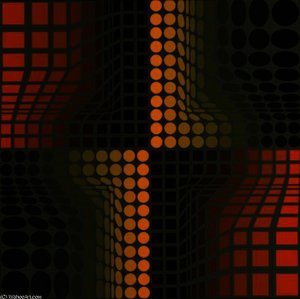
The artwork consists of four circles arranged in a square configuration. Each circle is assigned a specific color: blue, orange, yellow, and purple. These shapes are positioned at different points within the square frame. One circle occupies the left side, another is on the right, one is placed above, and the final circle is situated below the others. The composition relies on sharp edges and distinct color zones rather than blended transitions. The artist utilized a method called hydrostatic printing to apply pigment to the canvas, ensuring consistent color application and mathematical precision across the surface.
The arrangement of these circles follows a square motif, a recurring element in the artist's body of work. This specific layout utilizes Euclidean geometry to establish a sense of order. The interplay between the colored circles and the surrounding space creates a shimmering effect that shifts as the viewer's gaze moves across the canvas. This visual phenomenon is a result of the interaction between the specific hues and the eye's perception of light and shape.
The Mechanics of Perception
This piece belongs to the Op Art movement, which emerged in the wake of World War II. The movement focused on the psychological and neurological aspects of vision, using illusionistic effects to challenge how the brain interprets visual information. By employing a systematic methodology involving grids and mathematical principles, the work moves away from representational art. It does not attempt to mimic nature or provide a narrative. Instead, it functions as a visual experiment in how the retina processes high-contrast colors and geometric forms.
The intellectual foundation of the work draws from the Bauhaus movement's focus on functional design and the reductive abstraction of Piet Mondrian. It also incorporates Gestalt principles, which concern how the mind organizes visual stimuli into coherent patterns. The use of hydrostatic printing allowed for a level of accuracy that traditional brushwork could not achieve, emphasizing the mathematical nature of the composition. The result is a work that prioritizes the stimulation of the mind through controlled visual input, focusing on the mechanics of sight rather than the depiction of objects.
질의응답
빅터 바사렐리의 "Lain"은(는) 어떤 미술 사조에 속하나요?
"Lain"은(는) Geometric Abstraction 양식의 작품입니다. 이 사조는 해당 작품이 속한 예술적 전통을 나타냅니다.
빅터 바사렐리의 "Lain"은 미술사에서 어떤 위치를 차지하나요?
빅터 바사렐리의 "Lain"은(는) Modern 시대의 Geometric Abstraction 사조에 속하며, 이러한 요소들이 어우러져 미술사에서 이 작품이 갖는 위상을 완성합니다.


 프린트 판매로 전환


 가로 또는 세로 중 어느 한 면이라도 105cm(약 41인치)를 초과하는 작품이나 복제화의 경우, 프레임은 분해된 키트 형태로 배송됩니다. 이는 안전한 배송을 보장하고 운송 중 발생할 수 있는 손상을 방지하기 위함입니다.