A Life Immersed in Abstraction: The World of Anthony Whishaw
Born in London in 1930, Anthony Whishaw RA stands as a quietly resolute figure within the landscape of British art. His journey has been one of sustained exploration, a dedication to the possibilities of abstraction that resists easy categorization or adherence to prevailing trends. From his early years spent between England and Brazil – a formative period shaping his perspective – to his current status as a celebrated Royal Academician, Whishaw’s work embodies a commitment to allowing each canvas to dictate its own terms. He famously asserts that “each painting and work on paper makes its own separate demands,” a philosophy that underscores his intuitive approach and the deeply personal nature of his artistic process. This isn't an artist seeking to illustrate a pre-conceived notion, but rather one listening intently to the evolving language of paint, shape, and color.Early Influences and Artistic Foundations
Whishaw’s educational path laid a solid foundation for his future artistic endeavors. After attending Brunswick School in Sussex – an institution relocated to Cornwall during the upheaval of World War II – he continued his studies at Tonbridge School, where he was awarded a Judd Scholarship. This academic success paved the way for enrollment at Chelsea School of Art, followed by the prestigious Royal College of Art, graduating with first-class honors and receiving numerous accolades including the ARCA and RCA Travelling Scholarship. However, it was a journey to Spain in 1955 that proved particularly pivotal. Encountering Goya’s haunting ‘Black Paintings’ left an indelible mark on Whishaw, igniting a fascination with the darker currents of human experience and the expressive power of visual storytelling. This encounter wasn't merely about aesthetic appreciation; it was a confrontation with raw emotion and psychological depth that would resonate throughout his career. The influence isn’t necessarily visible in direct imitation, but rather in a shared willingness to confront complex themes and explore the boundaries of representation.Shaped Canvases and Evolving Techniques
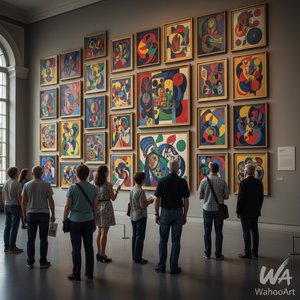
Whishaw is perhaps best known for his innovative use of shaped canvases – a deliberate departure from traditional rectangular formats. This wasn’t simply an aesthetic choice; it was a fundamental shift in how he conceived of the painting surface, seeking to create immersive and dynamic compositions that extended beyond the confines of the frame. These uniquely formed canvases invite viewers into the world of the artwork, blurring the boundaries between image and space. Initially working with oil paints, Whishaw embraced acrylics in the 1970s, recognizing their versatility and luminosity. This transition allowed for greater experimentation with texture and layering, contributing to the rich visual complexity that characterizes his work. His paintings often hover on the edge of figuration, suggesting forms and narratives without ever fully resolving into recognizable imagery. It’s a delicate balance between abstraction and allusion, inviting viewers to participate in the creation of meaning.Recognition and Enduring Legacy
Throughout his career, Anthony Whishaw has received significant recognition for his contributions to British art. Numerous solo exhibitions across the UK and internationally – including prestigious venues like the ICA, Kettle’s Yard, and the Barbican Centre – have showcased the breadth and depth of his artistic vision. He has been honored with a multitude of awards, including the Perth International Drawing Biennale Prize, the Bayer International Painting Prize, and the Korn Ferry Carre Oban International Picture of the Year. His election as an Associate Royal Academician in 1980 and a full Royal Academician in 1989 solidified his position within the British art establishment, and he continues to exhibit regularly at the Royal Academy’s Summer Exhibition. Beyond these accolades, Whishaw's lasting legacy lies in his unwavering commitment to artistic independence and his refusal to be defined by any single movement or style. He has influenced a generation of artists with his unique approach to abstraction, blending formal experimentation with profound explorations of memory, experience, and the elusive nature of perception. His work remains a testament to the power of art to evoke emotion, stimulate thought, and challenge our understanding of the world around us.A Continuing Dialogue
Anthony Whishaw’s contribution extends beyond the purely visual; it's an intellectual engagement with the very essence of painting. He doesn’t offer easy answers or readily digestible narratives. Instead, he presents a series of carefully considered explorations – a continuing dialogue between artist, canvas, and viewer. His paintings are not simply objects to be observed, but rather invitations to participate in a process of discovery. As he continues to work and exhibit, Whishaw remains a vital force in contemporary art, reminding us of the enduring power of abstraction to capture the complexities of human experience.질의응답
Anthony Whishaw의 작품 중 조회수가 가장 높은 것은 무엇인가요?
Anthony Whishaw의 작품에 관한 통계를 보여주는 통계 페이지가 본 웹사이트에 마련되어 있습니다.
특정 매체로 분류된 Anthony Whishaw의 모든 작품을 어떻게 찾을 수 있나요?
모든 매체 페이지에서는 Anthony Whishaw의 작품을 기법별로 모아볼 수 있습니다.
Anthony Whishaw의 작품을 색상별로 모아둔 곳은 어디인가요?
Anthony Whishaw의 작품은 작가의 색상별 인덱스 페이지에서 색상별로 살펴보실 수 있습니다.