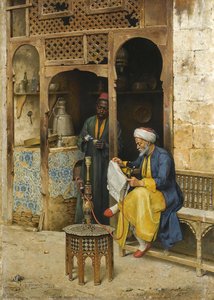
Arthur von Ferraris: A Hungarian Visionary of the Orient
Arthur von Ferraris (1856-1936) emerged from Budapest, Hungary, as a painter captivated by the exotic allure of the East – specifically Egypt and Persia. His artistic journey wasn’t merely about depicting landscapes; it was an attempt to capture the soul of cultures vastly different from his own upbringing, reflecting a burgeoning fascination with anthropology and comparative religion during the late 19th century. Unlike many artists of his time focused on grand narratives or idealized representations, Ferraris sought authenticity, meticulously observing daily life and striving for nuanced portrayals that conveyed both visual splendor and psychological depth.- Early Life & Education: Born into a wealthy family with connections to the Austro-Hungarian Empire, Ferraris received a privileged education emphasizing classical studies alongside artistic pursuits. He initially studied at Budapest University before embarking on independent travels throughout Europe, absorbing influences from Impressionism and Academic painting.
- Cairo Inspirations: Ferraris’s breakthrough came during his expeditions to Egypt between 1890 and 1905. These voyages profoundly impacted his artistic vision, fueling a series of paintings that immortalized Cairo's vibrant marketplaces, bustling streets, and religious ceremonies. He skillfully employed atmospheric perspective and luminous color palettes—techniques championed by Impressionists like Claude Monet—to convey the sensory experience of these locations.
- Notable Works & Patronage: Ferraris gained recognition within Hungarian artistic circles and enjoyed patronage from prominent figures, including Emperor Franz Joseph I. His paintings graced the walls of royal residences and were exhibited at prestigious salons in Paris and Vienna. Among his most celebrated pieces are “Blind Man At The Mosque” and “The Blind Man,” which exemplify his dedication to portraying marginalized individuals with compassion and dignity.
- Legacy & Influence: Arthur von Ferraris’s contribution to Orientalist painting extends beyond mere aesthetic beauty. He championed a humanist approach, prioritizing observation and psychological insight over romanticized clichés. His work continues to inspire artists today who strive for truthful depictions of cultures outside the Western canon. Moreover, Ferraris's meticulous attention to detail and masterful use of color solidified his place as one of Hungary’s foremost painters of the Belle Époque—a period marked by artistic innovation and intellectual curiosity.
질의응답
Arthur Von Ferraris의 작품을 사조별로 둘러볼 수 있나요?
모든 사조 페이지에서는 Arthur Von Ferraris의 작품을 예술 사조별로 모아 볼 수 있습니다.
Arthur Von Ferraris 작가 작품의 컬러 프로필은 어디에서 확인할 수 있나요?
본 웹사이트에 등록된 작품 전반에 나타나는 Arthur Von Ferraris의 색채 활용은 작가의 팔레트 지놈 페이지에서 확인하실 수 있습니다.
Arthur Von Ferraris은(는) 어느 시대에 활동했나요?
Arthur Von Ferraris은(는) 19th Century 시대에 활동했습니다. 이 시기는 역사적 맥락에서 작가의 활동 위치를 보여줍니다.