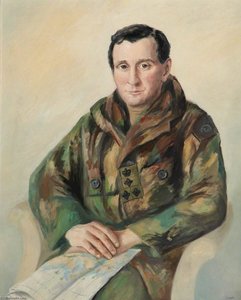
A Brush with Duty: The Portraits of Caroline Hobart
Caroline Hobart, also known as Caroline Osborne and Lady Caroline Hobart, occupies a unique space in the annals of British military art. While not formally trained as an artist for much of her life, she rose to prominence through a deeply personal project – documenting the officers who served during the 1982 Falklands War. Her portraits are far more than mere likenesses; they are intimate studies of character, imbued with a quiet dignity and a palpable sense of shared experience. Born into privilege, Hobart’s life took an unexpected turn when her husband, Major General Jeremy Osborne, was deployed to the South Atlantic during the conflict. Unable to be physically present on the islands, she found a powerful way to contribute: by painting portraits of those serving under his command. This act of artistic dedication transformed her from a society figure into a chronicler of a pivotal moment in British history.From Private Commission to National Record
Initially, Hobart’s undertaking was a deeply personal one – a means of connecting with and honoring the men fighting so far from home. She began by painting portraits of officers who were close friends and colleagues of her husband. Working quickly and efficiently, often from photographs provided by families or official sources, she developed a distinctive style characterized by its realism and attention to detail. The focus wasn’t on grand heroism or battlefield drama, but rather on the individual faces of those bearing the weight of responsibility and risk. As word spread throughout the task force, requests for portraits poured in. What started as a private commission rapidly evolved into an ambitious project to capture the likenesses of nearly all senior officers involved in the war effort.- A Unique Perspective: Hobart’s access granted her a rare and intimate view of military life during wartime, allowing for portraits that feel remarkably personal.
- Technical Approach: She primarily worked in oil on canvas, favoring a traditional approach to portraiture with meticulous attention to uniform detail and facial features.
- The Power of Likeness: Her paintings were not idealized representations but sought to capture the true character and spirit of each individual.
Symbolism in Service Dress: More Than Just a Uniform
Hobart’s portraits are notable for their consistent depiction of her subjects in full service dress. This wasn't simply a matter of military protocol; it was a deliberate artistic choice laden with symbolism. The uniforms, meticulously rendered, represent not only rank and regiment but also the shared identity, discipline, and sacrifice inherent in military service. The inclusion of combat kit – helmets, binoculars, even subtle signs of wear and tear – further grounds the portraits in the reality of the conflict. Each detail speaks to the challenges faced by these men, their readiness for action, and the weight of their responsibilities. The backgrounds are typically plain and uncluttered, drawing all attention to the sitter and allowing their character to emerge. The overall effect is one of quiet strength and understated dignity.Legacy and Historical Significance
The collection of portraits created by Caroline Hobart represents a remarkable historical record. Unlike official war artists who often focused on scenes of battle or its aftermath, Hobart’s work provides an unparalleled glimpse into the faces of leadership during a critical period in British history. The paintings offer a powerful counterpoint to the broader narrative of conflict, reminding viewers that wars are fought not by abstract forces but by individual men and women with their own hopes, fears, and vulnerabilities.- A Lasting Tribute: Her portraits served as a tangible reminder for families back home, offering solace and connection during a time of uncertainty.
- Documenting Leadership: The collection provides an invaluable visual record of the senior officers who played key roles in the Falklands War.
- A Shift in Perspective: Hobart’s work challenged traditional notions of war art, focusing on individual character rather than grand spectacle.
Continuing Impact: A Portraitist of a Generation
Though she continued to paint portraits after the Falklands War, it is her depictions of those who served during that conflict for which Caroline Hobart is best remembered. Her work has been exhibited widely and remains an important part of British military heritage. The paintings are not merely historical artifacts; they are powerful testaments to courage, duty, and the enduring human spirit. Hobart’s legacy lies in her ability to capture the essence of a generation of leaders who faced extraordinary challenges with quiet determination. Her portraits stand as a poignant reminder of the sacrifices made during the Falklands War and the individuals who served their country with unwavering commitment.질의응답
특정 주제에 따른 Caroline Hobart의 작품을 어떻게 찾을 수 있나요?
특정 주제의 Caroline Hobart 작품을 찾으려면 키워드별로 작품이 분류된 작가의 키워드별로 페이지를 이용해 보세요.
Caroline Hobart의 작품을 매체별로 찾아볼 수 있나요?
Caroline Hobart의 작품은 작가 페이지인 모든 매체에서 매체별로 둘러보실 수 있습니다.
Caroline Hobart의 작품들은 어떤 분위기를 담고 있나요?
아티스트의 무드 룸 페이지에서는 Caroline Hobart의 작품들을 분위기에 따라 큐레이션된 형태로 만나보실 수 있습니다.