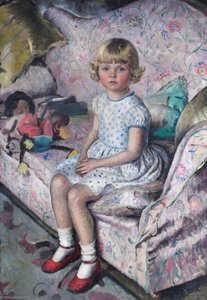
A Life in Lines and Layers
Cathleen Mann began her days in Newcastle upon Tyne, born to parents who lived through the brush and pigment. Her father, Harrington Mann, and her mother, Florence Sabine Pasley, were both portraitists, providing a childhood shaped by the quiet work of the studio. She learned to paint within her father's London studio, receiving early lessons that would later lead her to the Slade School of Fine Art and eventually to Paris. These formative years were marked by the steadying influence of Ethel Walker, another painter who continued to guide her even as Cathleen pursued her own studies.
The rhythms of her life changed with the arrival of the First World War. The studio was left behind for the work of an ambulance unit, a period that placed her in the middle of a much larger, more chaotic reality. When she returned to her art, her focus remained on the human form and the quiet details of life. She became known for portraits and landscapes, often capturing women and children with a careful eye for the subtle shifts in emotion. Her work found homes in the Victoria and Albert Museum, the Musée du Luxembourg, and the Royal Glasgow Institute of the Fine Arts.
The Dual Path of Paint and Film
During the 1930s, her hands were busy with more than just canvas. She moved into the world of British film, working as a costume designer. This period saw her contributing to the visual fabric of films such as:
- The Iron Duke (1935)
- Things to Come (1937)
- Backstage (1937)
- Forbidden Music (1936)
- The Show Goes On (1936)
- Evensong (1934)
- Chu Chin Chow (1934)
- The Wandering Jew (1933)
Her design work left a physical trace in the collections of the Victoria & Albert Museum. At the same time, her painting continued to evolve. In 1934, she produced Ballerina, an oil on canvas that shows a woman on a couch with a black cat nearby. Her later years brought a shift toward abstraction. Influenced by Matthew Smith, she began experimenting with landscapes of increasing abstraction, nude drawings, and sculpture. This period of experimentation followed the personal losses of 1953, when her husband, John Robert Follett, passed away.
Service and Legacy
The Second World War brought a different kind of responsibility. Mann served as an official war artist, painting portraits of officers and Allied commanders. These works were seen in London and traveled to America, sometimes appearing in the pages of Time magazine. Beyond the canvas, she used her position as the Marchioness of Queensberry to assist others during the bombing of 1940. She worked to secure transport by road and rail to move people to safety in the dock district of south West Ham.
Her career was defined by a movement between the structured world of portraiture and the fluid experimentation of her later years. She held memberships in both the Royal Institute of Oil Painters and the Royal Society of Portrait Painters. Her portraits, such as those of Sir Matthew Smith and Sir Eduardo Paolozzi, remain in the National Portrait Gallery in London. She died in 1959 in her studio on Montpelier Walk, Brompton.
Q&A
Cathleen Sabine Mann의 작품을 분위기별로 모아둔 곳은 어디인가요?
Cathleen Sabine Mann의 작품은 각 작품이 지닌 분위기에 따라 분류된 무드 룸 페이지에서 무드별로 감상하실 수 있습니다.
Cathleen Sabine Mann 작가는 어떤 사조의 작품 활동을 했나요?
Cathleen Sabine Mann의 작품은 작가의 모든 미술 사조 페이지에서 사조별로 만나보실 수 있습니다.
Cathleen Sabine Mann 작가의 작품에서 가장 자주 나타나는 색상은 무엇인가요?
Cathleen Sabine Mann의 팔레트 지놈에서는 작가의 작품 세계를 구성하는 컬러 프로필을 확인하실 수 있습니다.