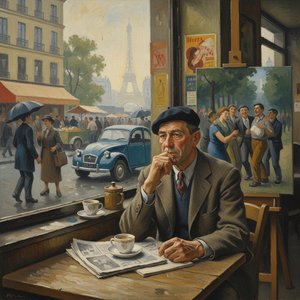
Romain Cazes: A Parisian Painter Rooted in Academic Tradition
Romain Cazes (1808–1881) was a French historical painter whose career unfolded against the backdrop of the Romantic era, yet he remained steadfastly committed to the principles of academic art—a distinction that defines his artistic legacy. Born at Saint-Béat, Haute-Garonne, Cazes’s formative years coincided with Ingres's ascendancy as the dominant figure in Parisian painting academies, shaping his artistic sensibilities and establishing a stylistic trajectory that would endure throughout his life. While contemporaries embraced expressive liberties and emotional intensity, Cazes prioritized meticulous observation and idealized representation—a conscious rejection of prevailing trends that nonetheless secured him a prominent place within the artistic canon of his time.- Early Life & Training: Cazes’s formal education began at Saint-Étienne School in Toulouse, where he honed his drawing skills under the tutelage of Jean-Baptiste Camille Bouchardy, a respected teacher known for his adherence to classical ideals. This early exposure instilled in him a profound appreciation for anatomical accuracy and compositional balance—elements that would become hallmarks of his artistic style.
- Influence of Ingres: Cazes’s relationship with Ingres proved pivotal. Recognizing Cazes's talent, Ingres took him on as a pupil, fostering a collaborative environment where stylistic refinement was paramount. The elder artist championed the pursuit of “art for art’s sake,” emphasizing beauty and intellectual rigor above narrative or moral didacticism—a philosophy that profoundly impacted Cazes’s artistic vision.
Notable Artistic Achievements & Style
Cazes achieved considerable renown during his lifetime, primarily through monumental murals adorning churches in Paris and provincial towns. His most celebrated works include “Les Douze Apôtres” at Saint-François Xavier Church and “Le Paralytique” at Notre-Dame de Clignancourt—impressive undertakings that showcased his mastery of fresco technique and his ability to convey spiritual grandeur with remarkable precision. These murals exemplify Cazes’s stylistic hallmark: a meticulous rendering of figures and draperies executed in tempera paint, utilizing subtle gradations of color and masterful shading to achieve an illusionistic depth rarely seen in Romantic art. His compositions are characterized by balanced symmetry and idealized poses—reflecting Ingres's influence and upholding the standards of academic painting.- Frescoes at Saint-François Xavier & Notre-Dame de Clignancourt: These monumental murals stand as testaments to Cazes’s artistic skill and dedication, capturing biblical narratives with breathtaking detail and conveying profound spiritual emotion through carefully crafted visual elements.
- Portraiture: Beyond his mural commissions, Cazes produced numerous portraits—often commissioned by prominent patrons—demonstrating his ability to capture the likeness of his subjects while simultaneously embodying classical ideals of beauty and dignity.
Symbolism & Artistic Context
Cazes’s artistic output is firmly rooted in the Romantic movement, yet he distinguishes himself from many of his contemporaries by prioritizing formal elegance over emotional fervor. Like Ingres, Cazes adhered to the tenets of “art for art’s sake,” rejecting sentimentalism and melodrama in favor of intellectual contemplation—a stance that aligns him with a broader artistic tradition concerned with aesthetic perfection rather than moral instruction. His meticulous attention to detail—particularly in depicting draperies and anatomical forms—reflects the influence of classical sculpture, where idealized beauty was considered paramount. Furthermore, Cazes’s stylistic choices underscore the enduring legacy of Renaissance art—a testament to his unwavering commitment to artistic principles that transcended temporal boundaries.Legacy & Historical Significance
Romain Cazes remains a significant figure in French art history—primarily recognized for his contribution to monumental fresco painting and his embodiment of academic artistic ideals. His murals at Saint-François Xavier and Notre-Dame de Clignancourt continue to inspire admiration for their technical virtuosity and expressive power, serving as enduring symbols of Parisian Baroque grandeur. Cazes’s unwavering devotion to classical aesthetics—coupled with his masterful execution—established him as a pivotal voice within the Romantic era, securing his place among the most respected artists of his time and ensuring that his work would be studied and appreciated for generations to come. His influence can be seen in subsequent generations of painters who sought to emulate Ingres’s stylistic rigor and uphold the standards of academic art—a testament to Cazes's enduring artistic legacy.Q&A
Cazes Romain의 작품을 분위기별로 모아둔 곳은 어디인가요?
Cazes Romain의 무드 룸에서는 작가의 작품들을 분위기별로 만나보실 수 있습니다.
Cazes Romain 작가의 작품을 감상할 수 있는 3D 가상 투어가 있나요?
Cazes Romain의 작품은 작가의 3D 갤러리 페이지 내 3D 갤러리에서 감상하실 수 있습니다.
Cazes Romain의 작품 중 몇 점을 둘러보실 수 있나요?
전체 작품 보기 페이지에서 Cazes Romain의 작품 작품 27점점을 만나보실 수 있습니다.