The Quiet Mastery of Ethelbert White
Ethelbert White, born in the Middlesex town of Isleworth in 1891, remains a profound yet understated figure in the tapestry of early twentieth-century British art. His journey was one of remarkable versatility, moving between the delicate precision of wood engraving and the expansive, atmospheric realms of oil and watercolour. Trained at the St John’s Wood Art School under the guidance of Leonard Walker, White developed a technical foundation that allowed him to navigate various mediums with an effortless grace. While many of his contemporaries sought the loud provocations of pure abstraction, White found his true calling in the quietude of the natural world, capturing the subtle shifts of light and the serene essence of the English landscape.
His early career was marked by a daring engagement with the avant-garde. In 1913, alongside luminaries such as Mark Gertler and C R W Nevinson, White embraced the energetic spirit of the Futurist movement. This period of experimentation, which included a bold collaborative depiction of Hampstead Heath for the AAA exhibition, showcased a willingness to challenge traditional boundaries and explore new visual languages. Yet, even amidst these modernistic explorations, the seeds of his later, more contemplative style were already being sown. His work began to reflect the structural influences of Cézanne, blending a modernist sense of composition with an enduring reverence for the organic forms of nature.
A Legacy in Line and Light
Beyond his canvases, White carved a significant niche in the history of British printmaking. In 1920, he transitioned into the intricate world of wood engraving, a move that would redefine much of his artistic output. As a founding member of the English Wood Engraving Society in 1925, he became a central figure in a movement that championed the modern style advocated by Noel Rooke. His engravings were noted for their unusual scale and their ability to translate complex textures into stark, beautiful contrasts. One of his most celebrated achievements in this medium was his illustration for Richard Jefferies' The Story of My Heart in 1923, a work that critics often cite as a landmark in the publication of modern wood-engraved books in Britain.
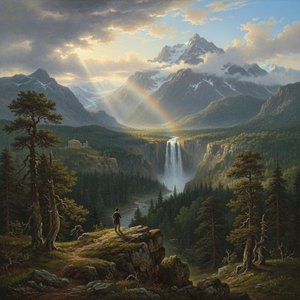
As his career progressed, White’s focus drifted back toward the expansive beauty of landscapes, though he never lost the precision learned from his printmaking years. His paintings—ranging from the lush, verdant Early Spring to the tranquil Woods—are characterized by a masterful command of tonal gradations and a restrained colour palette. He possessed a rare ability to convey deep emotion through subtle atmospheric effects, a quality that drew comparisons to the celebrated Paul Nash. Whether capturing the rugged coastlines of Cornwall or the soft light of an English garden, his work remains an invitation to pause and observe the quiet majesty of the earth.
Throughout his life, White’s presence in the British art establishment was both steady and respected. His memberships in prestigious organizations such as the following reflect his standing among the era's most significant creators:
- The London Group: Where he connected with modernist ideals and social commentary.
- The Royal Watercolour Society: A testament to his mastery of fluid, luminous mediums.
- The New English Art Club: Highlighting his place within the influential artistic circles of his time.
- The Society of Wood Engravers: Marking his vital contribution to the revival of printmaking.
By the time of his passing in 1972, Ethelbert White had left behind a body of work that serves as a bridge between the experimental fervor of the early twentieth century and a timeless, classical appreciation for the natural landscape. His ability to find the extraordinary within the ordinary continues to resonate, offering a sense of peace and a profound connection to the enduring beauty of the world around us.
Q&A
Ethelbert White 작가의 작품을 연도별로 어떻게 확인할 수 있나요?
Ethelbert White의 작품을 연도별로 정리하여 보여주는 작품 연대기 페이지입니다.
Ethelbert White 작가 작품의 컬러 프로필은 어디에서 확인할 수 있나요?
이 사이트에 등록된 작품 전반에 나타나는 Ethelbert White의 색채 활용은 작가의 팔레트 지놈 페이지에서 자세히 살펴보실 수 있습니다.
Ethelbert White의 작품들은 어떤 분위기를 담고 있나요?
Ethelbert White의 작품은 각 작품이 지닌 분위기에 따라 분류된 무드 룸 페이지에서 무드별로 감상하실 수 있습니다.