The Neapolitan Visionary: The Life and Art of Giuseppe Bonito
In the sun-drenched, vibrant landscape of eighteenth-century Naples, few artists captured the rhythmic pulse of urban life and the theatrical splendor of the era as intimately as Giuseppe Bonito. Born in 1707 in Castellammare di Stabia, Bonito emerged from a period of profound artistic transition, where the dramatic weight of the Baroque was beginning to soften into the playful elegance of the Rococo. His journey was shaped by the prestigious studio of Francesco Solimena, the titan of Neapolitan painting, whose influence provided Bonito with a rigorous foundation in composition and light. Within this creative crucible, Bonito developed a unique sensibility, moving beyond mere academic imitation to embrace a style that celebrated the textures of everyday existence and the whimsical charm of local folklore.
Bonito’s artistic development was marked by an extraordinary ability to blend high-court sophistication with the spirited energy of the streets. While he possessed the technical mastery required for grand religious commissions—such as his ambitious altarpieces for the Caserta Royal Palace—he found his true voice in the genre scene. He became a master of capturing the commedia dell’arte, populating his canvases with the iconic, masked figures of Italian theater. Through these characters, Bonito did more than just paint actors; he wove a narrative of Neapolitan identity, using theatricality to mirror the social complexities and cultural richness of his homeland. His work often serves as a window into a lost world, where the boundaries between performance and reality were beautifully blurred.
Royal Patronage and the Elegance of the Rococo
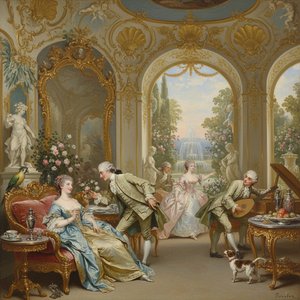
The ascent of Giuseppe Bonito was significantly propelled by the prestigious patronage of the Bourbon monarchs, who ruled over Naples and Spain. His talent for capturing both dignity and grace earned him a position as a court painter for Maria Amalia of Saxony between 1736 and 1742. During this period, his brushwork reflected the refined tastes of the Habsburg-Bourbon court, producing portraits that exuded an air of aristocratic sophistication. Yet, even amidst the splendor of royal palaces, Bonito never lost his connection to the common human experience. This duality is perhaps most evident in his celebrated works like The Music Lesson, where the intimacy of a private moment is elevated through masterful use of light and color.
In these genre paintings, Bonito utilized several key techniques to engage the viewer's emotions:
- Chiaroscuro and Light: He employed soft, warm lighting to create an atmosphere of intimacy, drawing the eye toward the delicate details of instruments and textiles.
- Narrative Detail: His canvases are rich with symbolic elements, from the intricate carvings of a harpsichord to the expressive gestures of figures engaged in courtship or storytelling.
- Color Palette: A sophisticated use of warm tones allowed him to evoke the heat and vitality of the Neapolitan climate, making his scenes feel lived-in and authentic.
Legacy and Historical Significance
The historical significance of Giuseppe Bonito lies in his role as a chronicler of the Neapolitan spirit. While much of the art history canon focuses on the monumental religious works of the Baroque, Bonito’s contribution to genre painting offers a vital, humanistic counterpoint. He captured the transition of an era, documenting the shift from the solemnity of the previous century to the lightheartedness and social fluidity of the Rococo. His ability to navigate between the grand scale of royal commissions and the subtle nuances of street life makes his oeuvre a comprehensive visual record of eighteenth-century Campania.
Though some of his works were historically subject to attribution disputes—often being confused with those of his contemporary, Gaspare Traversi—modern scholarship has helped to reclaim Bonito’s distinct identity. He remains a pivotal figure whose work continues to enchant collectors and historians alike, offering a profound glimpse into the heart of Naples. His legacy is not merely found in the museums that house his canvases, but in the enduring way he captured the eternal dance between the theatrical and the real.
Q&A
Giuseppe Bonito의 작품을 색상별로 찾아볼 수 있나요?
컬러 인덱스 페이지에서는 Giuseppe Bonito의 작품들을 색상별로 모아 보실 수 있습니다.
Giuseppe Bonito의 작품 전체 목록을 볼 수 있는 곳이 있나요?
이 사이트에 등록된 Giuseppe Bonito의 모든 작품은 작가의 전체 작품 보기 페이지에서 만나보실 수 있습니다.
Giuseppe Bonito의 작품은 얼마나 인기가 있나요?
Giuseppe Bonito의 방문 통계 페이지에서는 이 사이트에 등록된 작가의 작품들을 바탕으로 산출된 통계 정보를 제공합니다.