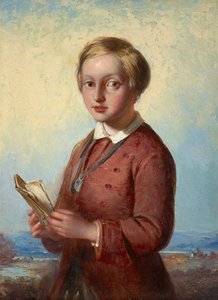
James Eckford Lauder (1811–1869): A Scottish Painter Inspired by Scott and Romanticism
James Eckford Lauder was a prominent Scottish artist of the Victorian era, renowned for his historical paintings and portraits that captured the spirit of his time—particularly influenced by the literary works of Sir Walter Scott. Born in 1811 at Silvermills, Edinburgh, he descended from a wealthy family with roots in the tannery trade, providing him with considerable financial stability to pursue his artistic ambitions. His elder brother, Robert Scott Lauder, fostered his passion for art early on, recognizing his talent and encouraging him to study diligently. ### Early Training and Artistic Influences Lauder’s formal education began at Edinburgh Academy from 1824 to 1828 where he honed his skills in drawing and painting under the tutelage of William Allan and Thomas Duncan—figures who championed classical ideals within the Scottish art scene. This formative experience instilled in him a deep appreciation for artistic tradition, shaping his stylistic choices throughout his career. Crucially, Robert Scott Lauder’s unwavering belief in James' potential propelled him toward Italy in 1834, where he spent nearly four years immersing himself in the artistic heritage of Rome and Florence. The atmosphere of these cities—characterized by grand palaces, humanist scholarship, and a revival of classical art—proved profoundly inspiring, fostering his fascination with narrative storytelling and dramatic composition. ### Career Highlights and Notable Paintings Lauder’s artistic output was marked by an unwavering dedication to portraying historical subjects and literary scenes, primarily drawn from Sir Walter Scott's novels. He became a lifelong admirer of Scott’s romantic vision of Scotland and its history, translating this enthusiasm into canvases that vividly depicted iconic moments and characters. His paintings gained considerable acclaim during his lifetime, securing commissions from prominent patrons and earning recognition at the Royal Scottish Academy and the Royal Academy in London. Among his most celebrated works were “Scene from The Two Gentlemen of Verona,” “The Wise and Foolish Virgins,” “Lorenzo and Jessica,” and “Hagar,” each demonstrating a masterful command of technique—particularly color—and conveying profound emotional depth. His engraving of "The Parable of Forgiveness" was awarded a prize at Westminster Hall, cementing his reputation as a gifted artist and illustrator. ### Legacy and Recognition James Eckford Lauder’s contribution to Scottish art history is undeniable. He established himself as one of the foremost painters of his era, embodying the Romantic spirit's fascination with storytelling and dramatic expression. His enduring influence can be seen in subsequent generations of Scottish artists who continued to explore historical themes and literary inspirations. Today, his paintings reside in prestigious institutions such as the National Gallery of Scotland, ensuring that his artistic legacy continues to resonate with audiences worldwide. He died peacefully at Edinburgh in 1869, leaving behind a remarkable body of work—a testament to his talent and unwavering devotion to his craft.- Notable Paintings: “Scene from The Two Gentlemen of Verona,” “The Wise and Foolish Virgins,” “Lorenzo and Jessica,” “Hagar,” “Christ Teaches Humility”
- Royal Scottish Academy Membership: Elected in 1839, Full Academician in 1846
- Influences: William Allan, Thomas Duncan, Sir Walter Scott
질의응답
James Eckford Lauder의 작품을 색상 스펙트럼별로 살펴볼 수 있나요?
James Eckford Lauder의 색상별 인덱스는 작가의 작품들을 색상별로 정리하여 보여주는 페이지입니다.
James Eckford Lauder의 작품 전체 목록을 볼 수 있는 곳이 있나요?
본 웹사이트에 등록된 James Eckford Lauder의 모든 작품은 작가의 모든 작품 보기 페이지에서 확인하실 수 있습니다.
James Eckford Lauder 작가의 작품을 연도별로 어떻게 확인할 수 있나요?
James Eckford Lauder의 작품 연표를 확인해 보세요: 작품 연대기 페이지에서 작품들을 제작 날짜순으로 보실 수 있습니다.