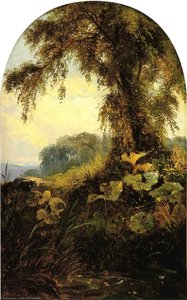
James McDougal Hart (1828-1901): A Pioneer of Hudson River Romanticism
James McDougal Hart (1828-1901) stands as a prominent figure in the Hudson River School, an influential movement that championed idealized landscapes and celebrated America’s natural beauty during the mid-nineteenth century. Born in Kilmarnock, Scotland, Hart's artistic journey began with formative studies in Düsseldorf, Germany—a pivotal location for realist art pedagogy—where he absorbed techniques honed by luminaries like Albert Bierstadt and Worthington Whittredge. This exposure profoundly shaped his stylistic approach, favoring grand vistas and meticulous detail to convey the sublime grandeur of the American wilderness.- Early Life & Training: Hart’s upbringing instilled a deep appreciation for observation and artistic discipline. His formal training in Düsseldorf provided invaluable experience in capturing atmospheric effects and rendering textures with remarkable accuracy—skills that would later define his oeuvre.
- Hudson River School Style: Like many of his contemporaries, Hart embraced the Hudson River School's aesthetic principles. He skillfully blended Romantic idealism with scientific observation, producing canvases brimming with luminous color palettes and dramatic compositions.
- Notable Works & Techniques: Hart’s artistic output is characterized by monumental landscapes—particularly cattle scenes—that exemplify the movement’s commitment to portraying America’s untamed grandeur. Pieces such as “The Old Homestead” (1862), measuring 42 x 68 inches and residing in the collection of the High Museum of Art in Atlanta, Georgia, showcase his mastery of scale and technique.
Landscape Vision & Influences
Hart’s artistic vision was undeniably shaped by Düsseldorf realism, which instilled a meticulous attention to detail and an understanding of atmospheric perspective—influences readily apparent in paintings like “Summer in the Catskills” (1865), now housed at the thyssen-bornemisza museum in Madrid, Spain. The expansive scale of these landscapes underscores the Hudson River School’s ambition to capture the immensity of the American wilderness and convey its spiritual significance. Furthermore, Hart's brother William, who eschewed academic European training, developed a more modest artistic style focused on smaller canvases.Family & Legacy
Hart was survived by two daughters—Letitia Bonnet Hart (1867-1953) and Mary Theresa Hart (1872–1942)—both accomplished figure painters who continued the family’s artistic tradition. His interment at Green-wood Cemetery in Brooklyn, New York, serves as a testament to his enduring presence within American art history. Kevin J. Avery notes that “the bovine subjects that once distinguished Hart's artistic complacency.” (p. 250 in American Drawings and Watercolors in the Metropolitan Museum of Art, volume I: A catalogue of works by artists born before 1835)Critical Reception & Historical Significance
James McDougal Hart’s landscapes are considered cornerstone achievements of the Hudson River School. They embody the movement's core ideals—a reverence for nature and a belief in its capacity to inspire awe—and contribute significantly to our understanding of nineteenth-century American art and culture. His enduring legacy resides not only in his masterful depictions of the American wilderness but also in his role as an influential teacher who nurtured the talents of subsequent generations of landscape artists.Q&A
James McDougal Hart은(는) 어느 시대의 작품을 남겼나요?
James McDougal Hart은(는) 19th Century 시대에 활동했습니다. 이 시기는 역사적 맥락 속에서 작가의 예술적 위치를 보여줍니다.
키워드별로 분류된 James McDougal Hart의 작품은 어디에서 볼 수 있나요?
James McDougal Hart의 작품은 아티스트의 키워드별 탐색 페이지에서 키워드별로 찾아보실 수 있습니다. 각 키워드를 통해 관련 작품들을 모아 감상하실 수 있습니다.
주제별로 분류된 James McDougal Hart의 작품들은 어디에서 확인할 수 있나요?
주제별 작품 모음 페이지에서는 James McDougal Hart의 작품들을 주제별로 확인하실 수 있습니다.