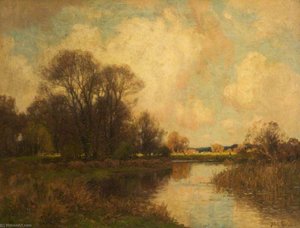
The Luminous Legacy of John Noble Barlow
In the soft, shifting light of the late nineteenth and early twentieth centuries, few artists captured the ephemeral soul of the landscape as poignantly as John Noble Barlow. A master of the Impressionist spirit, Barlow possessed a rare ability to translate the atmospheric weight of the English coast and the fleeting brilliance of autumnal transitions onto canvas. Born in Manchester in 1861, his journey was one of profound geographical and stylistic expansion. While his roots were firmly planted in the industrial heart of England, his artistic vision was forged in the prestigious studios of Paris, where he refined his technique under the watchful eyes of masters such as Jules Joseph Lefebvre, Paul Louis Delance, and Jean-Joseph Benjamin-Constant at the Académie Julian. This rigorous academic foundation provided him with a disciplined command of form, which he would later dissolve into the breathtaking, textured brushwork that defines his most celebrated works.
Barlow’s life was characterized by a restless, wandering intellect and a deep devotion to the natural world. His travels through Belgium, the Netherlands, and even the bustling streets of New York City enriched his palette with diverse light qualities and cultural nuances. This period of exploration allowed him to bridge the gap between traditional academic realism and the burgeoning Impressionist movement. By 1892, having married the American Marie Elizabeth Johnson, Barlow found a spiritual and artistic home in St Ives, Cornwall. It was here, amidst the rugged cliffs and serene tidal pools, that his artistry reached its zenith. The Cornish landscape became more than just a subject; it became a collaborator in his creative process, providing the raw, elemental energy required for his evocative seascap and pastoral vistas.
Mastery of Light and Atmosphere
The true magic of Barlow’s work lies in his profound understanding of luminosity. He did not merely paint landscapes; he painted the very air that inhabited them. His technique involved a sophisticated layering of color and texture, allowing light to appear as though it were vibrating beneath the surface of the oil paint. This is perhaps most evident in his celebrated masterpiece, “Spring, Lamorna,” a work that captures the tender, revitalizing glow of the Cornish springtime with such palpable atmosphere that the viewer can almost feel the damp, salt-kissed breeze.
His repertoire extended beautifully into the melancholic splendor of autumn and the quietude of river scenes. Whether depicting the rhythmic ebb and flow of the sea or the muted, contemplative tones of “On the Thames,” Barlow maintained a consistent focus on the emotional resonance of the environment. His ability to manipulate light allowed him to evoke a sense of nostalgia and timelessness, making his landscapes feel both intimately personal and universally enduring. The following elements define his stylistic hallmarks:
- Impressionistic Brushwork: A reliance on visible, textured strokes that prioritize the sensation of light over rigid anatomical or geological detail.
- Atmospheric Perspective: The masterful use of soft edges and tonal shifts to create a profound sense of depth and spatial immersion.
- Seasonal Narrative: An expert command over the specific color palettes required to convey the transition from the vibrant rebirth of spring to the golden decay of autumn.
Recognition and Historical Significance
Barlow’s ascent within the international art community was marked by significant accolades that validated his unique position between British tradition and Continental innovation. His presence in prestigious exhibitions, such as the National Academy of Design and the Art Institute of Chicago, solidified his reputation far beyond the shores of England. The global art world took notice of his prowess when he was awarded a gold medal (third class) at the 1899 Paris Salon and further recognition at the 1900 Paris Exposition. These honors were not merely personal triumphs but served to cement the importance of the Cornish Impressionist style on the broader European stage.
Though his life ended in 1917, leaving behind a legacy etched in the landscapes of Cornwall and Rhode Island, Barlow’s influence persists. He remains a pivotal figure for those studying the evolution of landscape painting at the turn of the century—a period where the boundaries between reality and perception were being beautifully redrawn. His work stands as a testament to a life spent chasing the light, capturing the fleeting moments of nature before they vanished into the shadows of history.
Q&A
John Noble Barlow의 작품을 색상별로 정렬해서 볼 수 있나요?
John Noble Barlow의 작품은 작가의 컬러 인덱스 페이지에서 색상별로 감상하실 수 있습니다.
John Noble Barlow의 활동 시기는 어떻게 구분되어 있나요?
John Noble Barlow의 예술적 여정은 연대기 페이지에서 시기별로 펼쳐집니다. 이곳에서는 작가의 활동 시기를 장(chapter)으로 나누어 작품들을 연대순 타임라인 형태로 한눈에 확인할 수 있습니다.
John Noble Barlow의 작품을 분위기별로 찾아볼 수 있나요?
아티스트의 무드 룸 페이지에서는 John Noble Barlow의 작품들을 분위기에 따라 큐레이션된 형태로 만나보실 수 있습니다.