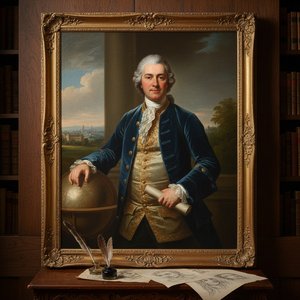
The Meticulous Realism of Josiah Rushton
In the heart of the Victorian era, a period defined by both rapid industrial expansion and a profound sense of social duty, the art of portraiture served as a vital mirror to the era's burgeoning civic identity. Josiah RusHDton (1836–1909) emerged from Worcestershire, England, as a master of this medium, capturing not just the physical likenesses of his subjects but the very essence of their authority and character. His work stands as a testament to the meticulous realism that characterized British portraiture during this transformative age, offering a window into the dignified lives of those who shaped the local landscape of Worcester and beyond.
Rushton’s artistic journey was deeply rooted in the classical traditions of anatomy and light. His formative years were marked by an unwavering commitment to accuracy, a trait that would become his professional hallmark. This dedication was significantly bolstered by his mentorship under John Opie, a celebrated Romantic painter whose influence breathed life into Rushton's technical prowess. From Opie, Rushton absorbed more than just the mechanics of masterful draughtsmanship; he learned the art of psychological insight, discovering how to use subtle shifts in expression and light to convey the inner life and moral weight of his sitters.
A Legacy of Civic Dignity
The primary engine of Rushton’s career was the demand for commissioned portraits among the influential figures of 19th-century English society. His oeuvre is particularly noted for its focus on the leaders of Worcester—mayors, aldermen, and high sheriffs who embodied the era's ideals of leadership and responsibility. Through his brush, these men were rendered with a palpable sense of permanence and gravity.
Among his most significant contributions to the historical record are his portraits of prominent civic figures, such as:
- William Adams (1706–1789), whose depiction captures the prestige of the Mayor of Worcester and High Sheriff.
- John Dent (1777–1855), a notable figure who served with distinction in local governance.
- Alderman Joseph Wood (d. 1887), rendered with a formal elegance that highlights his legal and social achievements.
In these works, Rushton’s technique shines through his extraordinary attention to detail. One can observe the heavy, textured folds of ceremonial drapery and the precise rendering of skin tones, all working in harmony to create an atmosphere of timelessness. His ability to balance the physical textures of clothing with the soft, emotive nuances of a human face allowed him to transcend mere documentation, turning each commission into a piece of historical narrative.
Historical Significance and Artistic Impact
While biographical details regarding his early life remain somewhat sparse, the impact of Rushton’s work is undeniably profound. He did not merely paint faces; he painted the social fabric of Victorian England. His portraits serve as essential historical documents, preserving the visual identity of a class of people whose influence was central to the stability and growth of the English Midlands.
The legacy of Josiah Rushton extends into the modern era through the preservation of his works in various collections, where they continue to offer scholars and art enthusiasts alike an intimate look at the 19th-century psyche. His contribution to the tradition of British portraiture lies in his ability to marry the technical rigor of the classical school with a deep, empathetic understanding of his subjects' roles within their community. In every stroke, Rushton sought to immortalize the dignity of the individual, ensuring that the faces of Worcester’s history would never fade into obscurity.
질의응답
Josiah Rushton의 작품 전체 목록을 볼 수 있는 곳이 있나요?
본 웹사이트에 등록된 Josiah Rushton의 모든 작품은 작가의 모든 작품 보기 페이지에서 확인하실 수 있습니다.
Josiah Rushton의 작품을 색상별로 모아둔 곳은 어디인가요?
색상별 인덱스 페이지에서는 Josiah Rushton의 작품들을 색상별로 모아 보실 수 있습니다.
Josiah Rushton 작품의 연도별 타임라인이 있나요?
Josiah Rushton의 작품 연표를 확인해 보세요: 작품 연대기 페이지에서 작품들을 제작 날짜순으로 보실 수 있습니다.