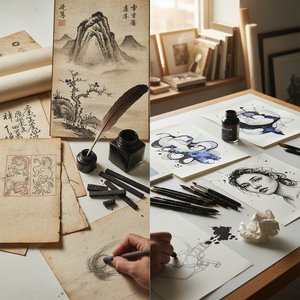
A Legacy of Ink and Serenity: The Life of Kanō Kōi
In the delicate dance of brush against paper, few artists captured the profound stillness of the Edo period as masterfully as Kanō Kōi. Born around 1598 in Wenzhou, China, Kōi’s very origins suggest a bridge between worlds, bringing an Eastern sensibility that would eventually become a cornerstone of Japanese art history. As a prominent practitioner of the prestigious Kanō school, his life and work were defined by a pursuit of tranquility, where every stroke of ink served to harmonize the physical landscape with the spiritual realm. Though his early years are shrouded in the mists of time, his lineage is unmistakable; as the son of the renowned painter Kanō Hansui, Kōi was immersed from birth in a tradition dedicated to the elevation of Buddhist aesthetics and the meticulous application of mineral pigments.
The training Kōi underwent was far more than mere technical instruction; it was an initiation into a philosophical way of seeing. Under his father’s guidance, he mastered the rigorous demands of the Kanō lineage, learning to balance the bold, structural strength of Chinese landscape conventions with the subtle, understated elegance prized in Japanese culture. This synthesis allowed him to create works that were not merely representations of nature, but meditative windows into a deeper reality. His development was deeply influenced by the masters of the Tang Dynasty, particularly Wang Wei, whose poetic approach to landscape inspired Kō i to utilize interlocking vistas and atmospheric depth to evoke a sense of infinite space and quiet contemplation.
Mastery of Style and the Floating World
Kōi’s artistic repertoire is characterized by an exquisite command over both ink and color. While his roots lay in the classical traditions of the Kanō school, his work often touched upon the burgeoning sensibilities of the Ukiyo-e movement—the "pictures of the floating world." This era, marked by the rise of the chōnin merchant class in Edo, demanded art that could capture both the grandeur of nature and the fleeting beauty of human life. In masterpieces such as "Chinese Woman in a Boat and Figures in Landscapes," Kōi demonstrates a breathtaking ability to blend these worlds. Through fluid brushwork and a vibrant yet harmonious palette, he depicts scenes where human figures move gracefully through serene environments, suggesting a seamless connection between the individual and the cosmos.
The technical brilliance of his work can be observed in several key areas:
- Compositional Harmony: The use of complex, layered landscapes that guide the viewer's eye through winding rivers and distant mountains.
- Pigment Application: A sophisticated use of mineral pigments that provides a luminous quality to his subjects, contrasting beautifully with deep, soulful ink washes.
- Symbolic Depth: The integration of natural elements—such as water, mist, and flora—to represent the ephemeral nature of existence and the permanence of the spirit.
Historical Significance and Enduring Influence
The passing of Kanō Kōi around 1636 marked the end of a significant chapter in the evolution of Japanese painting, yet his influence remained etched into the fabric of the Kanō school for generations. He stood at a pivotal historical juncture, helping to navigate the transition from the heavy influences of imported Chinese styles to a uniquely Japanese aesthetic that would define the Edo period. By successfully bridging the gap between the monumental and the intimate, Kōi provided a blueprint for future artists to explore the intersection of tradition and innovation.
Today, the works of Kanō Kōi are revered not just as historical artifacts, but as living embodiments of tranquility. His ability to capture the "breath" of a landscape—the subtle movement of wind through trees or the quiet ripple of a boat on a lake—continues to resonate with modern viewers. He remains a master of the ephemeral, reminding us that within the meticulous detail of a single brushstroke lies the capacity to touch the infinite.
Q&A
Kanō Kōi의 다른 이름이나 별칭에는 무엇이 있나요?
Kanō Kōi은(는) Kano Kōi라는 이름으로도 활동하고 있습니다.
Kanō Kōi의 작품 중 몇 점을 둘러보실 수 있나요?
전체 작품 보기 페이지에서 Kanō Kōi의 작품 작품 2점점을 만나보실 수 있습니다.
Kanō Kōi의 작품을 컬러 팔레트별로 둘러볼 수 있나요?
Kanō Kōi의 작품은 작가의 컬러 팔레트별로 보기 페이지에서 컬러 팔레트별로 만나보실 수 있습니다.