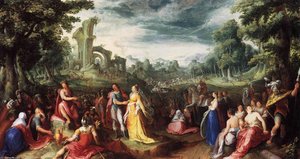
Early Life and Training
- Born: Mellebeke, Belgium (1548)
- Died: 1606
- Karel van Mander was born into a noble family in Meulebeke, County of Flanders.
- He received his early artistic training under Lucas de Heere in Ghent (1568-1569) and subsequently with Pieter Vlerick in Kortrijk.
- Early on, he also engaged in writing religious plays and designing scenery for them.
Travels and Artistic Development
- Rome (1574-1577): Van Mander spent three years in Rome, where he encountered classical art and developed his artistic style. The biographical sketch mentions him as the "discoverer of caves," possibly referring to the catacombs.
- Vienna: During a return journey from Italy, he collaborated with Bartholomeus Spranger and Hans Mont on creating a triumphal arch for Emperor Rudolf II's royal entry. This experience exposed him further to Mannerist influences.
Settlement in Haarlem and Artistic Leadership
- Haarlem (1583): Due to religious troubles and the plague, Van Mander settled in Haarlem, Dutch Republic.
- City Art Inventory: He was commissioned by the city fathers of Haarlem to inventory confiscated Catholic art after the Satisfactie van Haarlem. This work formed a basis for his later writings.
- Founder of an Academy: Together with Hubertus Goltzius and Cornelis van Haarlem, he founded an "academy to study after life," which fostered artistic discussion and possibly included drawing classes.
The *Schilder-boeck* and Art Historical Significance
- Major Work: Van Mander is primarily remembered for his *Schilder-boeck* (Book of Painters), a biographical dictionary of Early Netherlandish and Northern Renaissance artists.
- Influence on Mannerism: His dissemination of drawings by Bartholomeus Spranger, through engravings by Hubertus Goltzius, significantly contributed to the spread of Northern Mannerism in the Dutch Republic.
- Art Theorist: He played a crucial role in art theorization during the 16th century, emphasizing style and cultivated elegance over naturalism. His theories promoted exaggerated musculature, dramatic scenes, and rich detail.
Legacy and Artistic Style
- Northern Mannerism Pioneer: Karel van Mander is considered a key figure in the development of Northern Mannerism.
- Influence on Dutch Art: He significantly influenced artists in Haarlem and beyond, shaping the artistic landscape of the Dutch Republic.
- Artistic Characteristics: His own paintings often featured historical allegories characterized by a strong awareness of style, cultivated elegance, and a preference for dramatic compositions.
Q&A
Karel van Mander의 작품을 기법별로 모아볼 수 있는 곳은 어디인가요?
특정 매체로 제작된 Karel van Mander의 모든 작품을 확인하시려면, 작가의 모든 매체별 페이지를 이용해 주세요.
Karel van Mander 작가의 다른 활동명이나 알려진 이름이 있나요?
Karel van Mander은(는) Carel van Mander I(으)로도 알려져 있습니다.
Karel van Mander 작가의 국적은 어디인가요?
Karel van Mander은(는) Belgium 출신입니다.